Unlocking 2027: The Surprising SEO Revolution Set to Redefine Search Forever
Think SEO is dead? Think again. If anything, it’s like a chameleon on steroids—constantly shifting, adapting, and evolving to match the wild twists of how people search and how search engines think. Gone are the days when stuffing exact keywords was the name of the game. Now, it’s about decoding intent, dancing with AI-powered answers, and showing up where it truly counts amidst an explosion of platforms from AI assistants to social and video.
But here’s the kicker: while the tools and tactics morph, the essence of SEO—getting your business discovered when it matters—remains rock solid. So, how do you not just survive but thrive in this ever-changing landscape? It starts by understanding what’s shaking the ground beneath SEO today, and which tried-and-true foundations will keep you standing strong years down the road. Ready to dive into the five seismic shifts redefining SEO right now? Let’s unravel this puzzle together.
SEO has always adapted to changes in how people search and how search engines work. Its focus has expanded from targeting exact-match keywords to understanding search intent to now covering AI-powered search experiences.
So SEO isn’t dead. It just keeps evolving because businesses still need to be discoverable as search changes.
But to understand that evolution and the future of SEO, we should first look at what’s changing today and what’s likely to remain foundational even years from now.
What’s changing in SEO?
Search is evolving in how people find information and how websites gain visibility.
Here are five key developments shaping SEO today:
- AI Overviews are changing the search experience
- Zero-click searches are changing how SEO delivers value
- Search visibility now includes AI, video, and social platforms
- AI search is creating new opportunities for brand visibility
- SEO is shifting from individual keywords to broader topics
AI Overviews are changing the search experience
Google’s AI Overviews are changing the search experience by providing answers directly on the results page and making it easier to explore related questions.
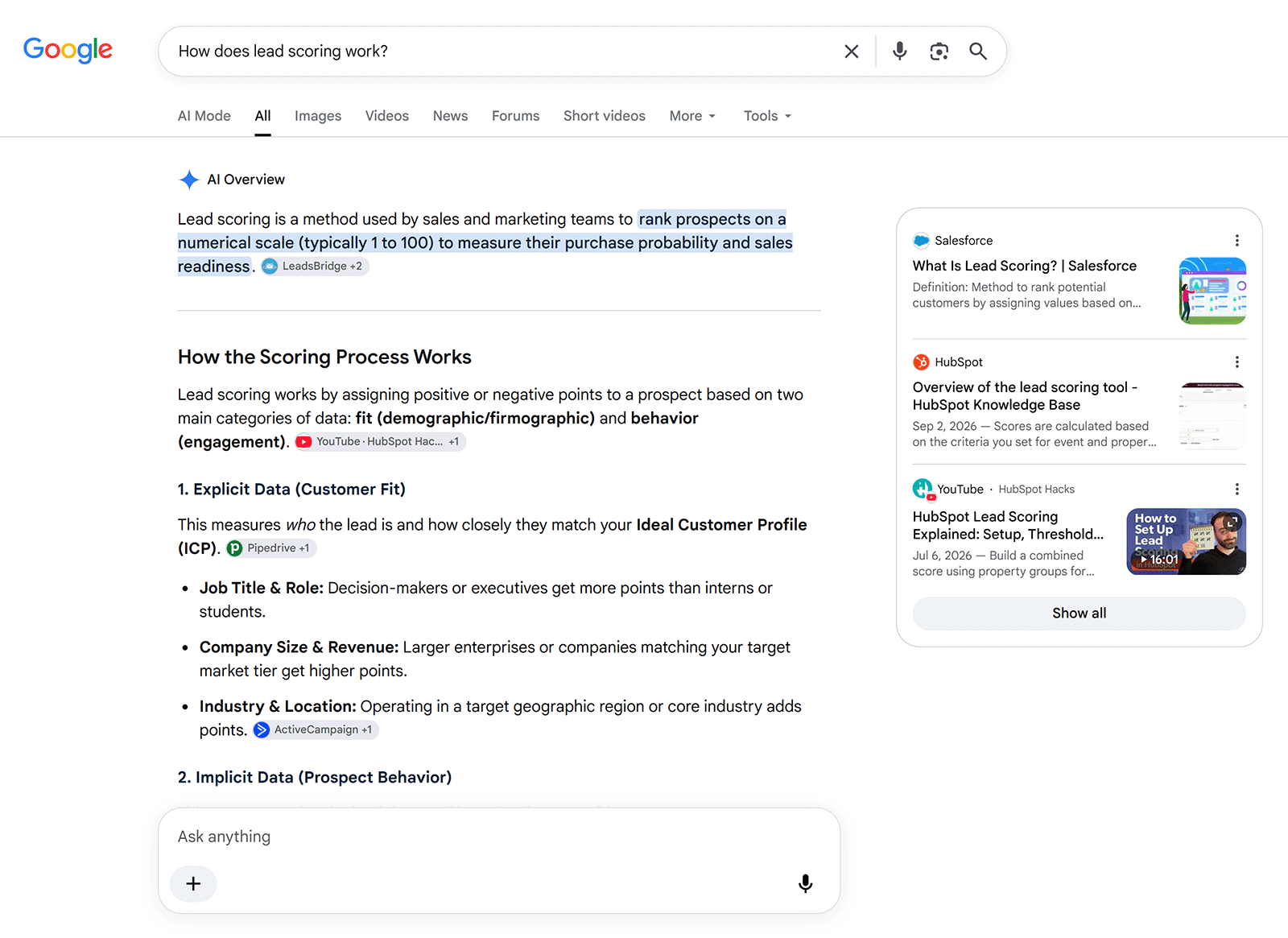
These summaries already combine information from multiple sources and include links to relevant webpages. For example, searching for “How does lead scoring work?” might show how businesses score leads based on their characteristics and behavior.

Initially, AI Overviews appeared mainly for informational searches, where people were looking to learn something or find answers to top-level questions. But Google has also rolled them out to commercial searches, where people compare products, services, and brands before making a purchase.
In a Semrush study of more than 600,000 U.S. keywords, the share of commercial-intent keywords triggering AI Overviews grew by an average of 71% between November 2025 and April 2026.
For example, someone searching for “best payroll software for small businesses” might now encounter an AI-generated comparison of different vendors before reaching the organic listings.
Google is also automatically expanding AI Overviews for some searches, displaying fuller answers without requiring users to click “Show more.” These expanded answers can include a field for asking follow-up questions, allowing users to continue the conversation in Google AI Mode.
AI Overviews create a separate visibility opportunity alongside organic rankings. A webpage can rank near the top of Google’s results without appearing among the sources highlighted in an AI Overview.
You therefore need to pay attention to both your organic rankings and whether your content appears in AI Overviews to accurately assess your performance.
Want to know if your site appears in AI Overviews? Use Semrush’s Position Tracking tool to see which of your target keywords trigger AI Overviews and whether your website appears among the cited sources.
Zero-click searches are changing how SEO delivers value
Zero-click searches are changing how marketers evaluate SEO performance because visibility in search results doesn’t always translate into website traffic.
Google has long provided answers directly in search results through features like knowledge panels, featured snippets, and built-in calculators, which can reduce the organic traffic websites receive.

More recently, a 2026 field experiment by researchers at Carnegie Mellon University and the Indian School of Business found that displaying AI Overviews increased zero-click searches by 34.5% and reduced outbound organic clicks by 39.8% (compared with hiding them).
These findings highlight a challenge for marketers: website traffic alone can’t capture the full impact of SEO. Someone might encounter your brand in search results without clicking through, then search for it directly when they’re ready to make a purchase. Or they might add your company to their shortlist when comparing vendors.
This is where zero-click marketing comes in. It focuses on delivering useful information directly where people discover it, rather than depending entirely on website visits.
You should therefore evaluate SEO performance beyond organic traffic. Metrics such as search impressions, branded search volume, and conversions can help assess whether your optimizations contribute to brand awareness and business results.
Search visibility now includes AI, video, and social platforms
People are increasingly using AI assistants, video platforms, and online communities alongside search engines to research products and make buying decisions.
In fact, buyers rarely rely on one platform from start to finish anymore. They move across search, AI, social platforms, reviews, videos, and websites as they gather information and narrow their options.
For example, someone comparing customer support software might discover products through Google, watch demos on YouTube, and read Reddit discussions about customer experiences. They could then use ChatGPT or Google’s AI Mode to compare shortlisted options before visiting vendor websites to check pricing and integrations.

Recent research supports this multi-channel pattern. In a Semrush survey of 1,030 U.S. consumers who had tried AI tools, 77% reported using AI tools alongside search engines when researching online, while only 4% said they mostly relied on AI. More specifically, 33% started with search engines before turning to AI, 26% started with AI before checking search engines, and 18% switched between the two throughout their research.

This shift toward multi-channel research expands the scope of SEO beyond traditional search rankings. You increasingly need to build visibility across the different platforms your audience uses to discover and evaluate products.
This broader approach is often called “search everywhere optimization,” which focuses on building visibility across relevant discovery channels rather than relying entirely on Google and Bing. The priority isn’t to be everywhere, but to identify the platforms that matter most to your audience and build a meaningful presence there.
AI search is creating new opportunities for brand visibility
AI search is creating new opportunities for brands to improve visibility by featuring their names, content, and offerings in AI-generated responses.
The potential here is serious, as ChatGPT now has 1.2 billion weekly users, while Google’s AI Mode has surpassed 1 billion monthly users.
Brand visibility in AI-generated answers comes in three forms:
- Citations: An AI answer links to your webpage as a source of information
- Mentions: An AI answer names your brand directly
- Recommendations: An AI answer not only names your brand or product but also suggests it as a suitable choice
These outcomes don’t always occur together (being cited doesn’t necessarily mean your brand gets mentioned).
In a Semrush study of 3,981 domain appearances across ChatGPT, Gemini, Google AI Overviews, and AI Mode, 61.7% were citations without a brand mention. Another 25.1% were mentions without citations, while just 13.2% included both.

This means an AI platform might cite your page while recommending another company’s product. Your content contributes to the answer, but your brand doesn’t appear among the recommendations.
Improving how your brand appears in AI-generated answers is the focus of generative engine optimization (GEO) or answer engine optimization (AEO). Both build on existing SEO practices and extend beyond your own website (which is crucial as AI platforms can also draw on third-party content and community discussions when describing brands and recommending products).
SEO is shifting from individual keywords to broader topics
Focusing on broader topics helps you build topical authority by addressing related questions, rather than targeting individual keywords in isolation.
For example, a company selling inventory management software might have a page targeting “inventory management software.” But people researching the category also want to know about stock forecasting, warehouse tracking, software integrations, and pricing. Creating useful content around these related needs helps the company demonstrate expertise in inventory management.
Covering a subject in depth has long been valuable for SEO on Google and Bing. AI search makes it even more relevant for two reasons.
First, keyword databases don’t capture every way people express their needs on other platforms. In a Semrush analysis of ChatGPT prompts, 65%-85% of prompts in most months didn’t match any keyword in our database of more than 27 billion keywords.

(Although the study included interactions beyond web searches, the finding suggests keyword research alone may miss relevant questions and use cases worth covering.)
Second, many AI search systems use query fan-out, a technique that breaks a user’s question into multiple related searches to gather information before generating an answer.
For example, if someone asks an AI search engine, “What’s the best inventory management software?” the system might run searches such as “inventory management software reviews,” “inventory software pricing,” “inventory management integrations,” and “inventory software features.”
Each search explores a different aspect of the broader topic. Covering these related subtopics gives your website more opportunities to provide relevant information for AI-generated answers.
Keywords still matter for understanding search demand. But organizing content around related searches, questions, and AI prompts can help you cover a topic more thoroughly while building topical authority.
What hasn’t changed about SEO?
SEO’s core purpose of helping people find useful information and make informed decisions remains unchanged, even as search technology evolves.
Here are three core principles that remain central to SEO:
- Understanding the human need
- Informing the machine
- Influencing the customer journey
Understanding the human need
Understanding what the user is trying to achieve remains fundamental to SEO, regardless of where or how they search.
The platforms they use and the ways they express their needs may change, but the underlying reasons for searching (to find answers, solve problems, and make decisions) haven’t.
For example, someone looking for payroll software might compare products on Google, ask ChatGPT for recommendations, or read user reviews on G2. Regardless of the channel, they’re still trying to find a solution that meets their specific use case.
For SEO, understanding the search intent behind the keywords is just as essential as it ever was. You need to know what people are trying to accomplish, what problems or constraints they face, and what information would help them move forward.
These human needs will continue to guide SEO, even as the technology people use to find and deliver information evolves.
Informing the machine
You still need to make information about your business easy for search systems to find and understand so they can surface it when relevant.
Your website is an important source of that information. Technical SEO helps search engines like Google and Bing crawl (discover) and index (store) your pages so they can appear in relevant search results.
Technical accessibility also supports AI search visibility. For example, Google requires a page to be indexed and eligible for a search snippet before it can appear as a supporting link in AI Overviews or AI Mode.

AI tools like ChatGPT, Claude, and Perplexity can also gather information through web searches or by accessing webpages directly. Their methods differ, but inaccessible pages limit what these systems can retrieve and cite.
Making information accessible is only part of the job. Search systems also need to understand what your business does and why you’re relevant.
On-page SEO helps provide that context through descriptive page titles, clear headings, internal links, and accurate product or service information.
Backlinks provide additional signals from outside your website. Links from relevant, credible websites help search engines discover your pages and assess their relevance and authority. Both Google and Bing use links in their search systems.
So, while search technology may change how information is retrieved and evaluated, making your business discoverable and understandable to those systems will remain an SEO fundamental.
Influencing the customer journey
An effective SEO strategy goes beyond increasing search visibility to also influence how potential customers evaluate your business.
That influence depends on the information people find. Clear explanations can help build interest, while honest comparisons, accurate product details, and credible evidence can give people reasons to trust your business and take the next step.
For example, someone researching payroll software might find your product comparison on Bing. The information could help them understand how your software stacks up to alternatives. They might then ask Perplexity about its integrations, pricing, or limitations before deciding whether to shortlist your product or request a demo.
These actions can eventually contribute to leads and sales, which is why business outcomes have always been an important part of SEO.
The ways people search may change, but influencing their decisions and encouraging meaningful actions remains a core SEO objective and will continue to be so in the future.
Where is SEO heading in 2027?
The future of search marketing will bring new opportunities for SEO professionals to influence how people discover brands and make decisions without necessarily visiting a website.
Here are three developments that could shape the future of SEO:
- Search experiences will become more interactive and contextual
- AI agents could change how people discover and buy products
- The skills SEO professionals need will evolve
Search experiences will become more interactive and contextual
Search experiences will increasingly enable users to refine questions, provide more context, and explore topics without starting a new search each time.
Early research already points in this direction. In a Semrush study, Google AI Mode queries averaged 7.22 words, which is nearly twice the length of regular Google searches (4.0 words). This suggests people are providing more detail when using AI-powered search.
In another analysis of ChatGPT clickstream data, the average number of prompts per session increased by 50% over the four months ending February 2026.

Search platforms are also making it easier to continue exploring a topic after receiving an initial answer.
As mentioned earlier, users can ask follow-up questions from a Google AI Overview and continue in AI Mode, where the context of their initial search is preserved.

AI tools like ChatGPT and Claude can also ask clarifying questions with clickable options, making it easier for users to provide more context and continue the conversation.

Search is becoming more multimodal, too, allowing people to use images and voice alongside text. For example, Google’s Search Live and Microsoft’s Copilot Vision let users ask questions about what their cameras see. ChatGPT and Perplexity also support image-based questions and voice interactions.

As these interactions progress, the information search systems retrieve can change. A follow-up question, a selected option, or an image can provide new details that make different sources relevant to the answer.
For SEO, this creates opportunities beyond the initial search. Your webpages, product information, images, or videos could become relevant later in the interaction, even if they weren’t featured in the first response.
So, as search becomes more interactive, visibility may increasingly depend on the full context of a conversation rather than just the initial query.
AI agents could change how people discover and buy products
AI agents could increasingly handle product research, comparisons, and purchasing tasks on people’s behalf, changing how businesses get discovered and chosen.
Unlike AI tools that primarily provide answers, AI agents can carry out multistep tasks by searching multiple sources, evaluating options, and taking actions with the user’s permission.
For example, someone could ask an agent to find payroll software for a 15-person team. The agent might compare pricing, integrations, and customer reviews, shortlist suitable products, and even help start a free trial.
This is known as agentic search. When agents help people complete shopping and purchasing tasks, it’s called agentic commerce.
The technology is already developing. ChatGPT’s shopping research feature can explore and compare products using information from retailers and other online sources. Google’s Universal Commerce Protocol (UCP) also enables participating shopping agents to retrieve product details, check prices and inventory, and add items to shopping carts.
Here’s how product evaluation could shift toward AI agents:

Consumer behavior is evolving, too. While a 2026 Forrester survey found that 75% of surveyed consumers were uncomfortable letting AI agents complete purchases and payments autonomously, a Semrush survey of 1,030 U.S. consumers found that 22% had completed a purchase directly within an AI tool.
For SEO, the implications extend beyond fewer website visits. An AI agent could research, shortlist, and eventually purchase a product without the customer ever even seeing the seller’s website.
To evaluate products, agents need reliable information about features, pricing, availability, and other factors that influence buying decisions. They can gather this information from webpages, product catalogs, and independent sources such as customer reviews.
As agents take on more buying tasks, SEO will increasingly focus on making businesses easy for these systems to discover and evaluate, not just helping people find them.
The skills SEO professionals need will evolve
As AI automates more routine SEO tasks and how people search changes, search marketers will need stronger strategy, research, technical SEO, and data analysis skills.
AI tools can already do several SEO tasks like grouping keywords, preparing content briefs, identifying potential technical issues, and summarizing performance data. But SEO professionals still need to verify the findings, identify meaningful opportunities, and decide which actions are worth pursuing.
Evolving search behavior is also expanding the role. As people increasingly use AI assistants alongside search engines, SEOs need to understand how these systems surface information and how to improve and measure visibility across them.
Employers are already looking for a broader mix of skills. For instance, AI literacy is a key part of many SEO roles now.

In fact, a Semrush analysis of 3,900 U.S. SEO job listings in November 2025 found that 31% of senior roles mentioned AI at the time, compared with 22.3% of other roles. More specific AI search terminology, including AEO and SGE (Search Generative Experience), appeared in 6.3% of senior listings.
In the same study, we also examined broader skill requirements. Project management (31%), communication skills (26.5%), and A/B testing and experimentation (23.9%) were among the most frequently mentioned skills in senior SEO listings. Communication and project management were also the top two skills in other SEO positions.

These findings offer a useful indication of how SEO roles may evolve. Technical knowledge and AI proficiency will remain valuable, but SEO professionals will also need to translate their expertise into decisions and results.
For example, identifying technical issues is only one part of improving a website’s SEO. Someone still needs to determine which problems deserve attention, work with developers to implement fixes, and evaluate whether those changes improve search performance.
This also helps answer whether AI will replace SEO professionals: the answer is no.
As search evolves, businesses will face new questions. Are their brands appearing in AI-generated answers? How do they compare with competitors across platforms? And which types of search visibility are actually bringing in customers?
SEO professionals who can answer these questions, develop effective strategies, and show results will continue to play an important role.
How to prepare for the future of SEO
Preparing for the future of SEO involves building on proven practices while adapting to changes in how search systems help people find information and make decisions.
Here are five priorities to focus on:
- Keep investing in SEO fundamentals
- Research the topics your customers care about
- Create content that offers original value
- Strengthen your brand’s authority and credibility
- Measure SEO performance beyond rankings and traffic
1. Keep investing in SEO fundamentals
Keep investing in SEO fundamentals to keep your website accessible, your content useful, and your brand credible as search evolves.
Focus on these core areas:
- Verify that search engines can crawl and index your important pages
- Ensure that your website is fast, mobile-friendly, and easy to navigate
- Use clear page titles, headings, and internal links to help search engines understand your content
- Regularly update existing content to keep it accurate, relevant, and useful
- Continue earning quality backlinks from relevant, trustworthy websites
These practices remain important even for AI search visibility. For example, Google confirms that existing SEO best practices apply to AI Overviews and AI Mode, without requiring special technical optimizations.
Start by checking your website’s technical health using Semrush’s Site Audit. Open the tool, configure it, and click “Start audit.”

Once the audit is complete, go to the “Issues” tab to review errors and warnings. Start with errors, which are the most severe, and click an issue to see the affected pages.

Fix the identified problems and rerun the audit to check your progress.
2. Research the topics your customers care about
Research the topics your customers care about to understand what they want to know and how they search for answers.
People often explore the same subject through multiple related searches and AI prompts. Looking at the broader topic helps you understand these connected questions rather than treating every query as a separate content opportunity.
Start by identifying a few topics that connect your customers’ needs with your products or services. Sales conversations, customer feedback, and online discussions can help you identify those topics. Then, investigate how people search for information about them.
Use Keyword Magic Tool to explore related searches. For example, if customers frequently ask about payroll integrations, enter “payroll software integrations.” Use the “Questions” filter to find related searches, then check search volume to gauge demand and search intent to understand the kind of content people want.

Next, use Prompt Research to explore the same subject in AI search. Review related topics and their estimated AI search demand, then open a relevant topic to see the exact prompts people ask AI platforms.

Use these findings to decide which questions your content should address within each topic. Prioritize questions with meaningful search demand or a clear connection to purchasing decisions.
Check whether your existing content answers those questions. Update pages with missing or incomplete answers, and create new content where coverage is lacking.
3. Create content that offers original value
Create content that offers original insights or information people can’t easily find elsewhere to make your website a more useful source for search engines and AI systems.
When multiple websites publish similar information, there’s little to distinguish their content. Adding something genuinely new can help your pages answer questions other sources don’t fully address and provide evidence that others may reference.
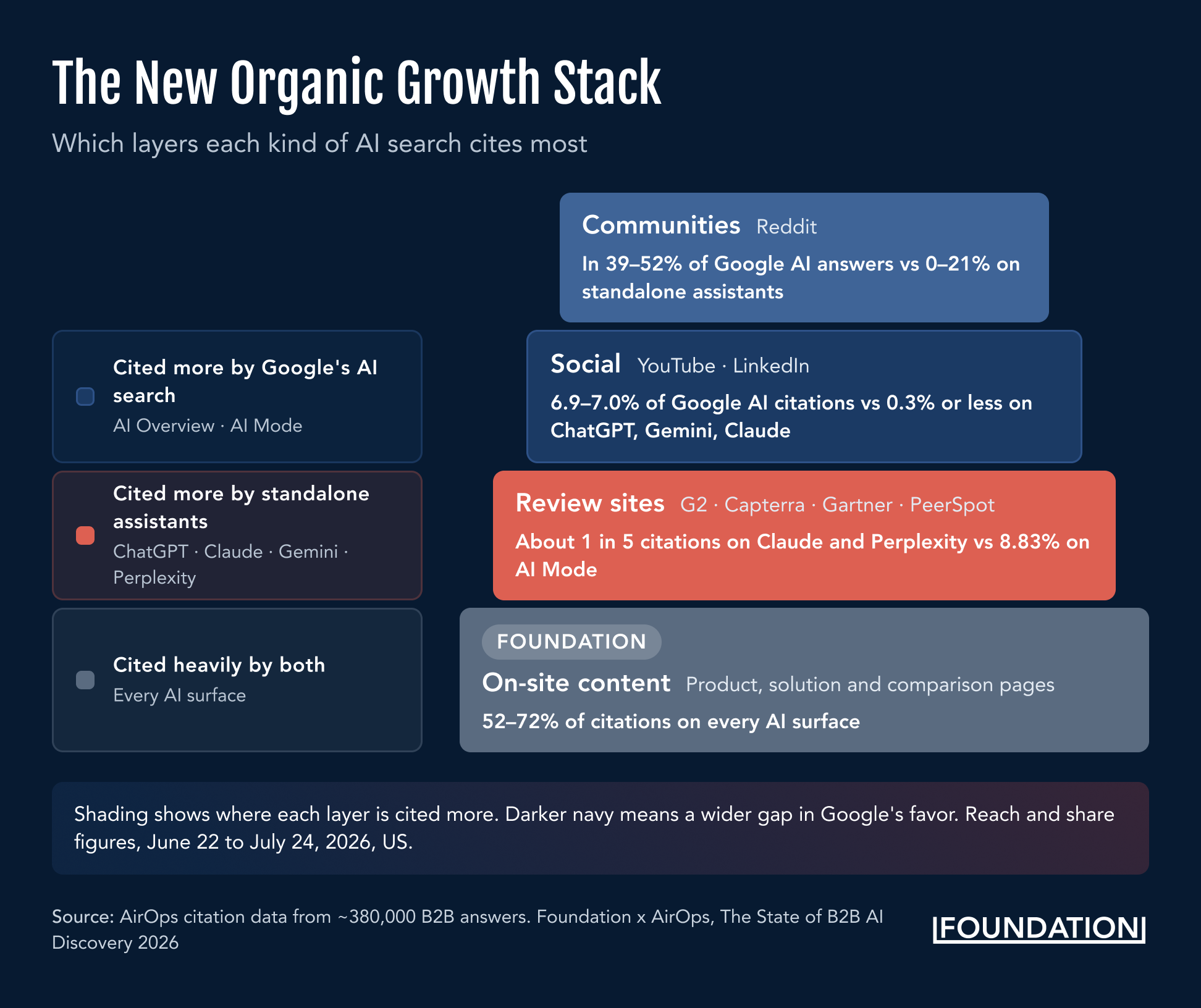
At Semrush, we regularly publish original research, like this:

But you don’t need large-scale studies to offer original value. You can also:
- Share firsthand experience: Explain what you’ve learned from testing products or applying strategies yourself
- Publish customer case studies: Show how you’ve solved specific problems, supported by actual results
- Include expert insights: Ask experienced practitioners to share knowledge that isn’t widely documented
- Provide original analysis: Examine existing research and explain what the findings mean for your audience
Whatever approach you choose, support your claims with evidence and explain how readers can apply your insights to their own work.
4. Strengthen your brand’s authority and credibility
Strengthening your brand’s authority and credibility can help search systems recognize your expertise on relevant topics.
While your own content helps demonstrate a level of expertise, both AI search and the future of SEO will increasingly rely on how your brand is represented across the web. Information from independent sources can reinforce your brand’s credibility and help establish what your business is known for.
Focus on these areas:
- Make your expertise clear: Explain what your business does, highlight relevant credentials and experience, and keep your company information consistent across your website and external profiles
- Earn credible mentions and backlinks: Use digital PR to secure coverage in reputable industry publications. Offer expert commentary to journalists and participate in relevant podcasts.
- Associate yourself with relevant topics: Participate in industry discussions and seek opportunities to be featured alongside other experts in the subjects your customers research
With regard to the second and third points above, prioritize quality over quantity and focus on getting mentioned by relevant, reputable sources (instead of just getting your brand named on any site that will list it).
5. Measure SEO performance beyond rankings and traffic
Measure SEO performance beyond rankings and traffic to understand how visible your brand is across search experiences.
Rankings show where your pages appear in search results, while traffic reports show how many visits your website receives. But neither tells you whether your brand is mentioned or your content is cited in AI-generated answers.
For instance, someone might see your business recommended in an AI-generated answer without clicking through to your website. That exposure won’t appear in your traffic reports, even though it could eventually lead to a conversion.
So, expand your measurement to include AI visibility alongside your existing SEO metrics.
Semrush’s AI Visibility Toolkit can help you answer three important questions:
- How visible is your brand? Use the Visibility Overview report to check your AI Visibility Score, how often your brand is mentioned, and whether your pages are cited. Monitor these metrics over time to identify changes in visibility across AI platforms.

- How is your brand perceived? Use the Brand Performance report to compare your share of voice with competitors and analyze brand sentiment. This helps you understand how AI platforms describe your business, not just how often they mention it.

- Is your brand visible for important customer questions? Use the Prompt Tracking tool to monitor a selected set of relevant prompts. See whether your brand appears in the answers, which sources are cited, and how your visibility changes over time.

Use these findings to investigate gaps in your visibility. For example, if your brand is missing from answers to important prompts, examine which sources AI platforms cite. If brand sentiment raises concerns, review how your business is being described and address inaccuracies.
As search expands beyond rankings and website traffic, use Semrush One to monitor your SEO performance and AI visibility together. Get started with a 7-day free trial today.
Frequently asked questions
Is SEO still relevant?
Yes, SEO is still relevant because people continue to rely on search, even as AI changes how answers are delivered. Businesses still need to make their website and brand easy for search systems to find and understand.
How has AI changed SEO?
AI has changed SEO by introducing AI-generated answers and new ways for people to discover brands. The broader AI impact also extends to how businesses measure visibility. Brands can appear in AI-generated answers even when users don’t visit their websites, making AI mentions and AI citations important signals to monitor alongside organic search performance.
How will AI Overviews change SEO?
Google’s AI Overviews can answer questions directly in search results, potentially reducing website clicks while creating opportunities for websites to appear as cited sources. SEO professionals should monitor when AI Overviews appear, whether their websites are cited, and how these features affect organic search performance.
Is SEO a good career in the future?
Yes, SEO remains a good career as businesses continue to invest in improving their visibility across search platforms. Professionals who keep up with AI and the future of SEO while strengthening their technical and strategic skills will be better positioned as the industry evolves.
Will SEO be replaced by AI?
No, SEO will not be replaced by AI, although AI will automate some of the work involved. The future of SEO includes approaches like AEO and GEO, which extend optimization to AI-generated answers. The terminology may change, but the underlying goal remains helping people find relevant information and businesses through search.











Post Comment