Unlock the Future of Marketing: How AI and Communities Are Revolutionizing Organic Growth Forever
So, here’s the kicker: your site is still ranking, but the clicks? They’re ghosting you. Why? Because Google’s AI isn’t sending folks down the old click-through rabbit hole anymore. Instead, it’s handing out answers right on the results page—fast, slick, no need to leave. Between January and April 2026, a whopping 68% of U.S. Google searches didn’t generate a single click. And it’s not just Google; more and more B2B buyers are skipping traditional search altogether, kicking off their quests inside AI chatbots. What does this mean for those of us hustling in SEO? It means the game’s changed—your organic growth stack now stretches far beyond your own website, tapping into a cocktail of Reddit debates, YouTube clips, review sites, LinkedIn chatter, and those ever-important comparison pages. If you’re just tweakin’ your site and hoping for glory, you’re fishing in a dwindling pond. Ready to figure out which platforms you need to master first, and how to build your presence where it counts? Let’s dive in. LEARN MORE
Your rankings are holding. Your clicks aren’t.
Google’s AI features answer the question on the results page, and the searcher never leaves. From January to April 2026, 68% of U.S. Google searches ended without a click. And less of Google’s traffic reaches the open web than it used to.
Because for a growing share of B2B buyers, the search doesn’t start on Google at all. It starts in an AI chatbot.
Google’s results page, its AI features, and the standalone LLMs all pull from a mix of sources. Reddit threads. YouTube videos. Review profiles. LinkedIn posts. Comparison pages.
That’s your organic growth stack. It’s also the mix your buyers use to build a shortlist.
If you only optimize your site, you’re competing for a shrinking slice of the pool. To stay competitive, SEO has to expand beyond on-site.
Today, I’ll show you which sources each surface leans on and what to build first.
Search Is Splintering Across Surfaces
For our State of B2B AI Discovery 2026 report with AirOps, we tracked roughly 380,000 AI answers covering 81 enterprise software topics across six AI surfaces. Unless linked otherwise, the figures below come from this study.
Let’s start with what didn’t change. Product pages still get cited more than anything else.
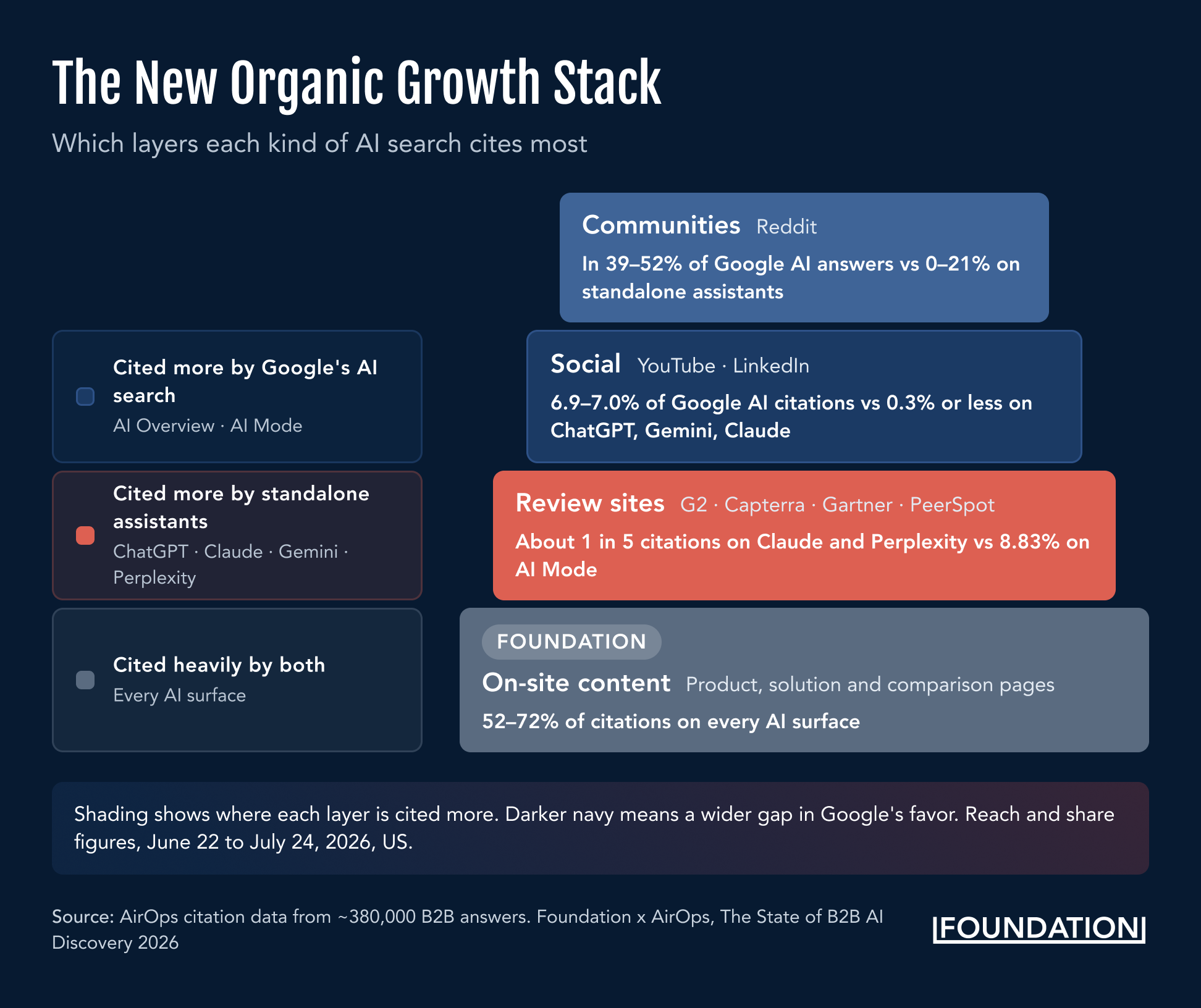
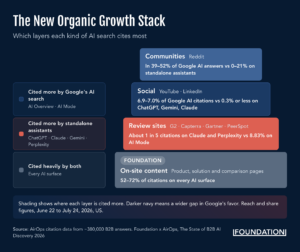
Across every AI surface we tracked, vendor sites, integrators, and tool directories took the largest share of citations. That ranged from 52% on Perplexity to 72% on Gemini. Review sites added another 9% to 21%.
Remember: Vendor share isn’t yours by default. It includes your competitors’ sites and the software directories that list you side-by-side.
This is the stack’s foundation, and it’s crowded. Your product pages compete with your rivals’ pages. The comparison pages written about you compete with the ones you write yourself.
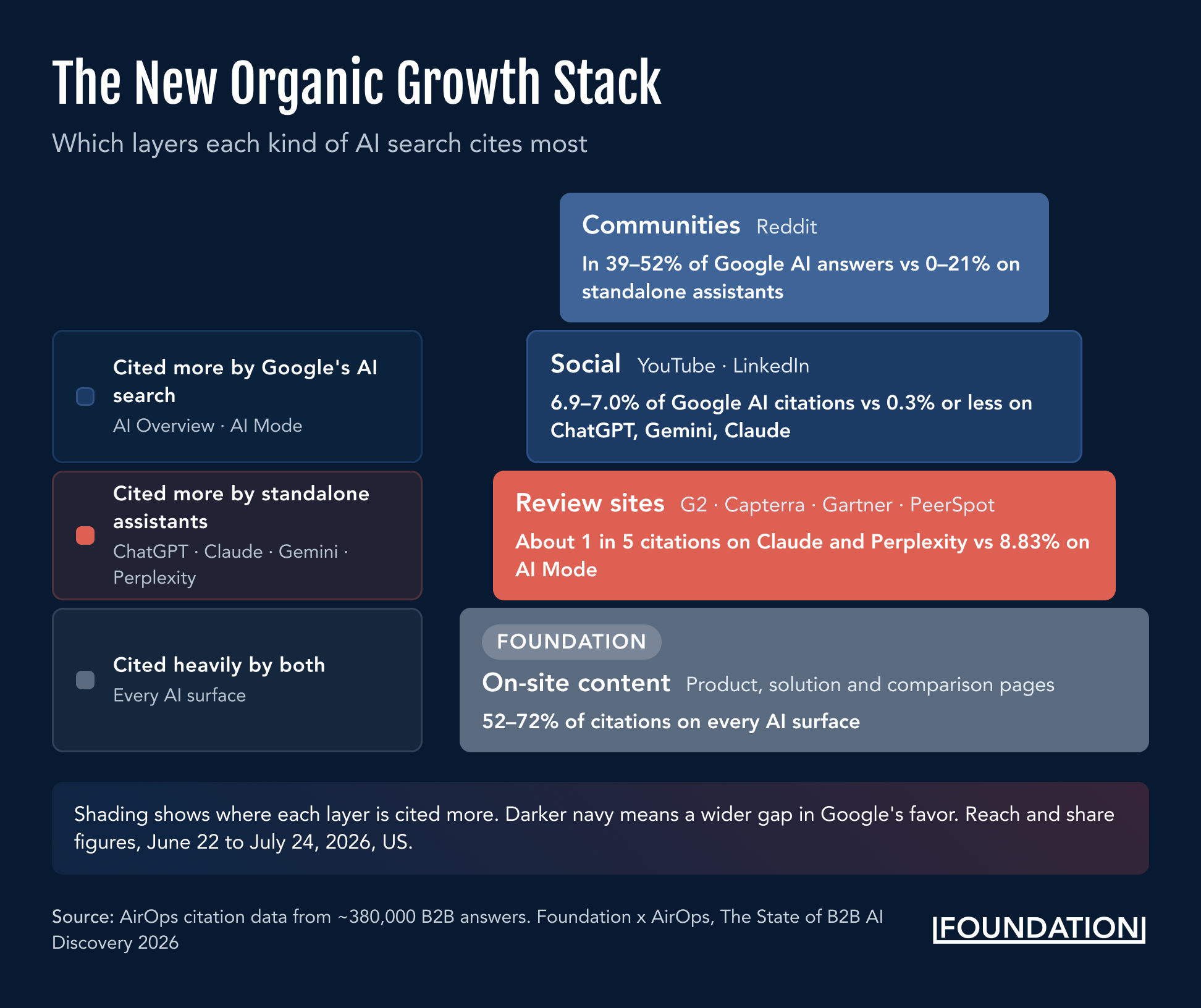
The layers above the foundation are where search starts to splinter.
Google’s AI Overviews and AI Mode ground their answers in live Google Search results. They inherit what already ranks. ChatGPT, Claude, Gemini, and Perplexity run their own retrieval.
The citations split right along that line.
Google’s two AI surfaces put 7% of their citations into social platforms like YouTube and LinkedIn. ChatGPT, Gemini, and Claude sit at 0.3% or below.
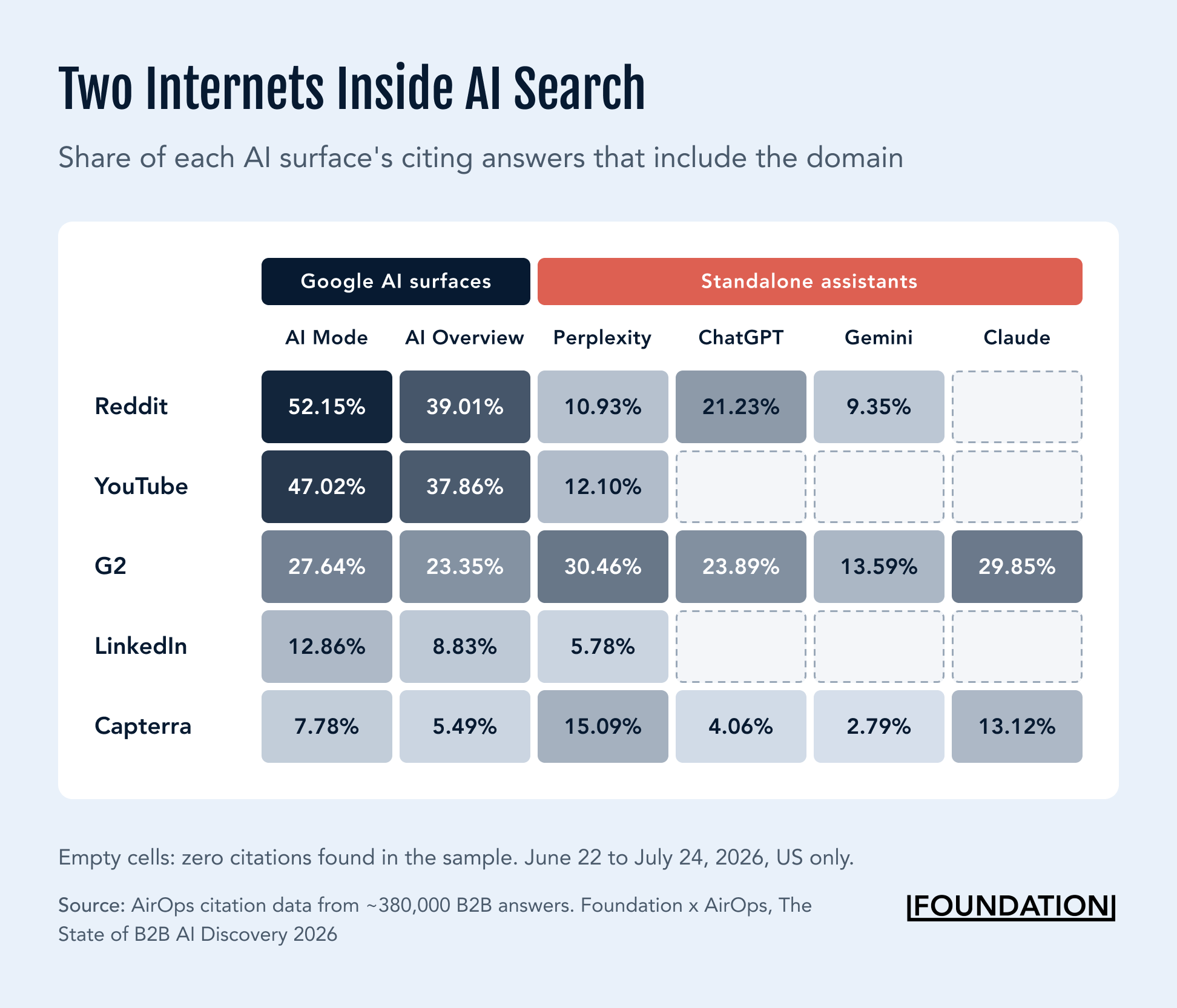
Domain by domain, the gap gets sharper:
- Reddit appears in 52% of AI Mode’s citing answers and 39% of AI Overviews. ChatGPT cites it in 21%, and Claude didn’t cite it at all.
- YouTube appears in 47% of AI Mode answers and 38% of AI Overviews. ChatGPT and Claude: essentially zero.
- LinkedIn reaches 13% of AI Mode answers, 9% of AI Overviews, and 6% of Perplexity’s.
- G2 lands between 23% and 30% on five of the six surfaces. It’s the one domain every surface agrees on.
So “AI visibility” is at least two games.
A brand can be everywhere in Google’s AI answers but invisible in ChatGPT and the other standalone models. Or the reverse. Using a blended visibility score hides each one’s contribution.
See also: Wikipedia, Podcasts & Reddit Now Drive AI Citations, Ask Your PR Team How They Did It
Build Your Organic Growth Stack Layer By Layer
Organic visibility now comes down to surface coverage: showing up on the domains each AI surface trusts most.
Your new organic growth stack has to address both internets. Here’s how to do it.
See also: What Search Engines Trust Now: Authority, Freshness & First-Party Signals
1. Start With The Pages You Own
AI tools are catching on fast with B2B buyers. According to G2, 51% of B2B software buyers now start their research in an AI chatbot more often than Google, up from 29% a year earlier.
But Google still dominates search overall. It handles roughly three-quarters of all desktop searches. AI Overviews alone reach 2.5 billion monthly users and another billion use AI Mode.
I still think ranking matters. It just doesn’t guarantee a citation anymore. AI Overviews have been pulling fewer citations from top-ranking pages.
The standalone engines lean on product pages too.
Gemini sends 72% of its citations to vendor and product domains, while G2 shows up in just 14% of its answers. Gemini is choosing between vendor pages, and yours are up against everyone else’s in your category.
Then there’s comparison content.
Eighty-four of the 100 most-cited URLs in our data were either comparison pages (59) or listicles (25). Together, they drew over 66,000 citations. Whoever writes those pages shapes how AI frames your category.
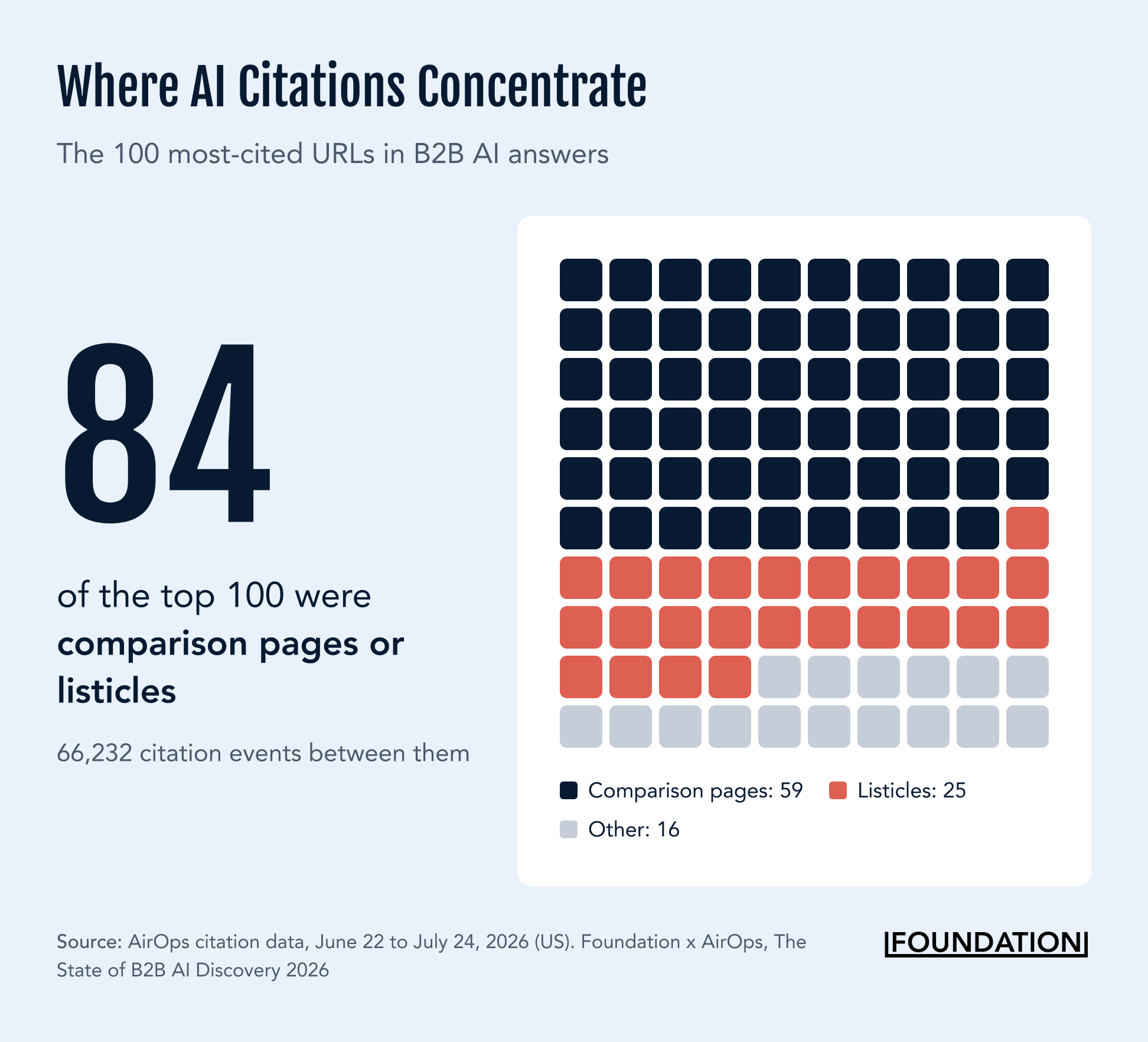
A lot of teams pour budget into the blog and let product and comparison pages go stale. I’d flip that. Fix the pages AI already cites before you write another post.
As James Scherer, Foundation’s VP of Strategy, puts it: “Editorial gets the budget; product pages get the citations.”
Action: Identify the 10 most-cited comparison pages and listicles in your category. Check how you’re framed in each one. Then publish your own comparison page against your top three competitors.
2. Earn A Place In The Communities Your Buyers Frequent
Reddit was the most-cited external domain in our dataset, earning 159,000 citations across 12,500 unique URLs.
Reddit’s logged-out users, who mostly arrive from search engines, grew 27% year over year in Q2 2026. They now outnumber logged-in users, 77.7 million to 52.6 million. Threads rank on Google. Google sends readers into the threads. Then Google’s AI features cite them.
The layers feed each other.
But those layers can also shift fast. After reports that ChatGPT was citing Reddit less, we extended our tracking and found its Reddit citation rate fell from 21% in July to 10% in August, while Google’s surfaces kept citing Reddit.
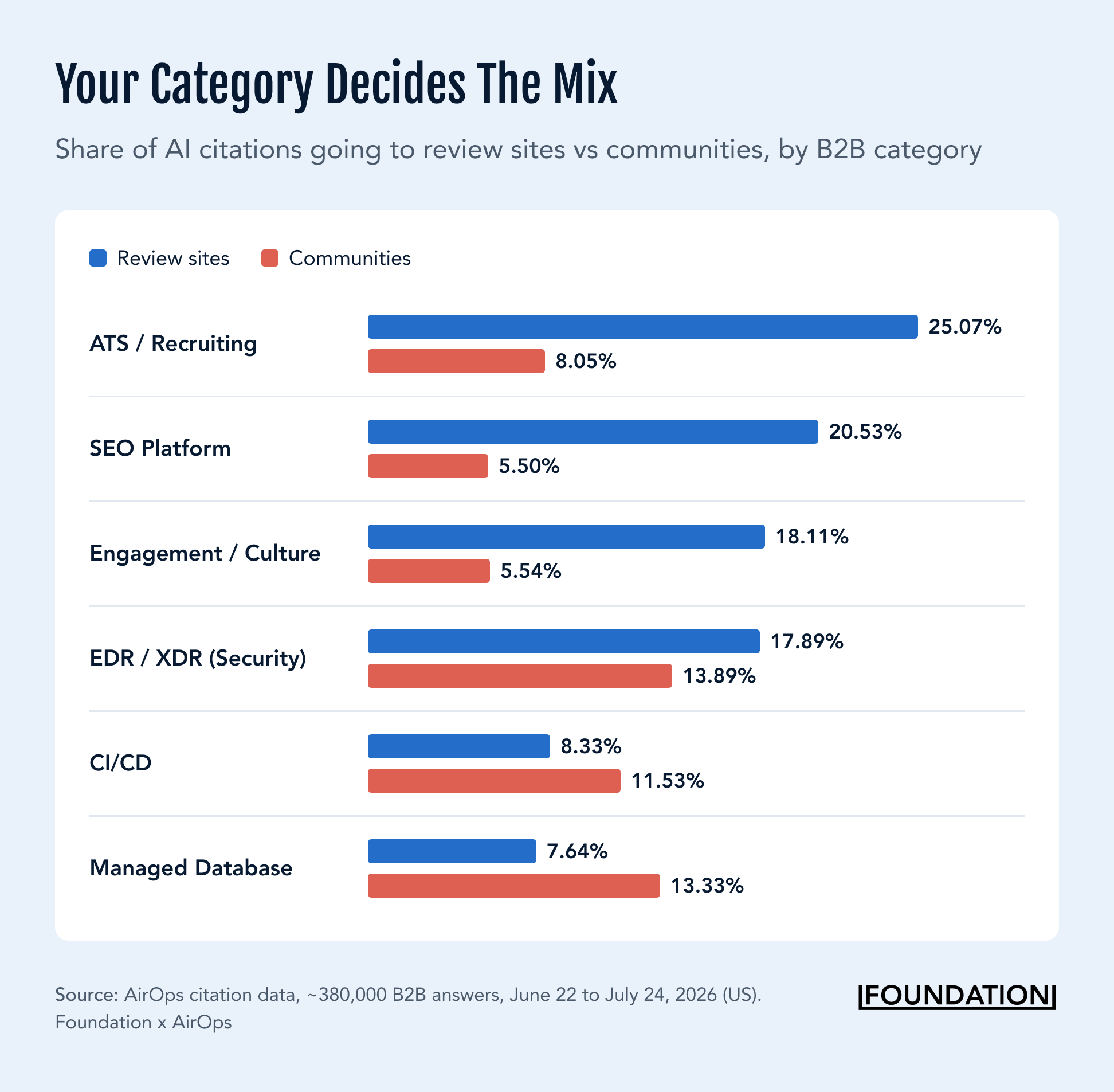
How much community platforms like Reddit matter also depends on your category. Community citations ranged from 5% of the total for SEO platforms to 14% for EDR/XDR security tools.
If you’re new to the platform, start with this SEJ AMA with a Reddit marketing veteran.
My biggest advice: Don’t treat Reddit like a launch channel. I’d trade one viral thread for steady, useful answers across 50.
Action: Spread your effort across many threads and subreddits. Don’t bet on one. Track community citations weekly, because monthly reporting would have missed a drop like ChatGPT’s.
3. Show Up Where Categories Are Defined
LinkedIn is a Google-surface play. It reaches 13% of AI Mode answers, 9% of AI Overviews, and 6% of Perplexity’s. ChatGPT, Gemini, and Claude didn’t cite it at all.
Across B2B software categories, social is the second-largest citation source after brand and product content, at 6%.
LinkedIn is where executives and practitioners set the category narrative. Google’s AI features pick up that narrative. It’s why employee amplification belongs in the stack.
Don’t fall into the likes and follows trap. If the goal is getting cited, watch whether Google’s AI answers pick up the way your people describe the category.
Action: Pick the category questions you want to own. Post on them every week from executives and practitioners. Measure the impact in AI Overviews and AI Mode, since that’s where LinkedIn gets cited.
4. Make Video Content For Google’s AI Search Features
YouTube shows up in 47% of AI Mode’s citing answers and 38% of AI Overviews.
It’s tempting to read that as Google favoring its own property, but our data complicates that. Gemini is also a Google product, and yet YouTube showed up in 0.3% of its citations: roughly 17x less than on AI Overviews.
The difference is how each surface finds its sources. AI Overviews and AI Mode are Search features. Google uses query fan-out, running multiple related searches to build each answer, so videos that already rank in Search get pulled in.
A lot of B2B videos are made for people who already know your brand and product. But the videos that earn a place in this layer answer the questions buyers ask before they’ve picked a vendor.
Action: Ship comparison, alternatives, and best-of videos. Title them the way your buyers phrase the question.
5. Treat Review Profiles As Retrieval Infrastructure
The standalone engines lean hard on review sites. Claude and Perplexity draw about one in five citations from review domains.
Claude’s third-party citations are almost entirely review platforms. G2 appears in 30% of the Claude answers that cite sources. Capterra appears in 13%, and Gartner and PeerSpot in about 9% each.
Category matters here too. Review citations ranged from 8% in managed databases to 25% in ATS and recruiting software.
Buyers back this up. In G2’s 2026 research, review sites (38%) narrowly passed AI chatbots (37%) as the top source shaping B2B software shortlists.
G2 isn’t a one-time push. For Claude and Perplexity, your profile is a live source, so run it like one.
Action: Give your G2 profile a named owner and a monthly review target.
What To Build First
Nobody builds every layer at once. Run two checks before you start.
- Ask buyers which AI tools they use. Do it on sales calls and during onboarding. If they use Google, prioritize the community, video, and social layers. If they use ChatGPT or Claude, prioritize your own pages and review profiles.
- Pull your category’s source mix before you set a budget. Review citations swing 3.3x across categories. Community citations swing 2.5x.
Copy the wrong organic growth stack, and you end up investing in the wrong channels. The AirOps data shows just how much the source mix changes from industry to industry, even within the SaaS space.
The managed database niche is an illustrative example. A brand in this space that borrows an HR tech playbook pours budget into review sites, which earn just 8% of that category’s citations. Meanwhile, it starves communities, which earn 13%.
Once you know which layers matter in your category, match them to the team you have. At every size, the question is the same: which internet are you still missing?
- If it’s just you: Your own pages, plus the one layer your category leans on most. The base layer gets cited on every AI surface, so it pays off whichever tool your buyer uses. A second layer you can’t keep up with just goes stale.
- Three to five people: Add a second layer from the other internet. If you started with Reddit, which feeds Google’s AI answers, add review profiles, which feed the standalone engines. A second layer on the same side only makes you stronger where you’re already visible. Give review profiles a named owner, because they go stale fast.
- Eight or more: One owner per layer, plus one person who reports citations by surface. At this size, the bigger risk is drift. A blended score hides it when one platform changes what it cites, the way ChatGPT did with Reddit.
Finally, measure by surface.
Run a fixed set of 100+ prompts on a schedule. Track citation rate and share for each AI surface. Set an alert for any 20% week-over-week swing.
Watch sentiment per platform, too. On the same prompts, AirOps’ 100-point sentiment scores ranged from 81 on Perplexity to 69 on Claude.
Then tie it back to the numbers leadership already watches, like branded searches, referral traffic, and pipeline sourced from your content.
Give it 12 months.
The first quarter is slow. You’re fixing old comparison pages and setting baselines nobody asked for.
By month 12, it compounds. Your comparison pages are the ones AI quotes in your category. Your review profiles stay fresh without a scramble. Your threads and videos show up when Google answers your buyers’ questions. And when a platform changes what it cites, you catch it that week.
Last month, you built the engine. Now you know where to point it.
Search gets you found. The stack gets you chosen.
More Resources:
Featured Image: Roman Samborskyi/Shutterstock







Post Comment