Trump Exposes Senate Deadlock on CLARITY Act: What’s Really Behind the Crypto Standoff?
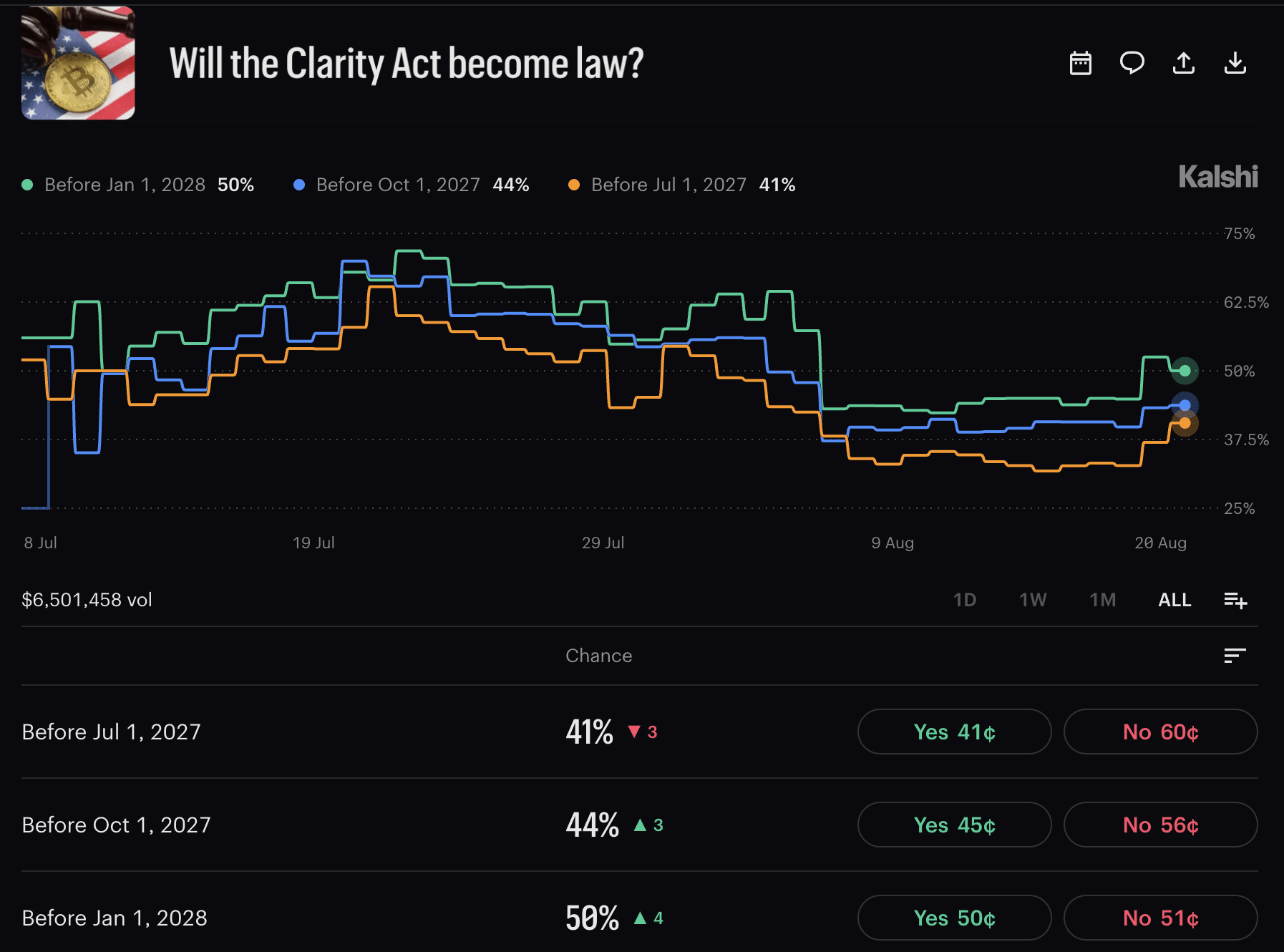
Ever wonder why a seemingly straightforward bill like the CLARITY Act could get stuck in the Senate mire for what feels like forever? Well, buckle up, ’cause it’s not just any bill—it’s the linchpin that could finally untangle the messy web of crypto regulation in the U.S. President Trump recently threw his weight behind pushing Congress to pass a “fair version” of this act, during a charged White House gathering that had the SEC’s Paul Atkins and CFTC’s Mike Selig in the same room. Funny thing is, while Congress drags its feet, these agencies are busy crafting their own patchwork rules—a bit like fixing a leaky roof with duct tape — which keeps the crypto industry cruising but leaves legal durability up in the air. Meanwhile, crypto markets shot up overnight, perhaps echoing the optimism from Trump’s rallying cry and the industry’s push for clarity. But this raises the question: Can regulation born from agency improvisation ever replace the certainty of solid law? Or are we just buying time in a grand poker game of jurisdiction and power? Let’s dive into this saga and see why the Senate’s slowdown matters for your next Bitcoin or Ethereum move. LEARN MORE.
In Trump crypto news, the President called on Congress to pass a “fair version” of the CLARITY Act at a White House event attended by Securities and Exchange Commission (SEC) Chair Paul Atkins and Commodity Futures Trading Commission (CFTC) Chair Mike Selig, according to Reuters.
The bill, which would split digital-asset oversight between the two agencies and define when a token is a security versus a commodity, remains stalled in the Senate.
This is not simply a bill stuck in procedural limbo. It is a jurisdictional vacuum that the SEC and CFTC are now filling on their own authority, producing rules the industry wants but that carry none of the durability a statute would provide.
This outburst from Trump came as the crypto market surged +10% overnight, with Bitcoin hitting $71,800 and Ethereum surging +19% to $2,300 following a bullish meeting between the US President and crypto industry leaders.
Trump Crypto News: Why the Senate Bottleneck Matters
JUST IN: Trump URGES Congress to pass the Clarity Act.
“Will keep us ahead of China, ahead of everyone else.” pic.twitter.com/yd80gsEqlX
— Bitcoin Archive (@BitcoinArchive) August 19, 2026
The crypto industry has spent hundreds of millions of dollars over several years lobbying for legislation intended to put the sector on firmer legal footing, per Reuters reporting on midterm campaign spending. That effort has stalled, and with little legislative calendar left before the next Congress convenes, the prospects of a deal narrow further, a dynamic detailed in an earlier CoinSpeaker breakdown of the CLARITY Act’s Senate stall.
Miller Whitehouse-Levine, CEO of the Solana Policy Institute, characterized the moment plainly: the agencies “seemingly are ready to act, given that Congress has been unwilling or unable to do so,” he said, according to Reuters.
DISCOVER: Best Meme Coins to Buy in 2026
The Mechanism Filling the Gap
The mechanism functions as follows: absent statute, the SEC and CFTC are using existing rulemaking and interpretive authority to approximate what CLARITY would codify. The SEC is working on a rule to exempt certain token offerings from securities registration, which is expected to advance in the coming weeks, while the CFTC is discussing crypto regulation at an industry gathering this week, per its published schedule.
That approach has already produced concrete outputs. Selig’s CFTC approved perpetual bitcoin futures earlier this year, and executives expect the commission to extend similar treatment to additional assets, a pattern Atkins has echoed on the SEC side with plans to overhaul capital-markets rules for crypto, a push also covered in reporting on Atkins’s push during the Senate recess.
A CFTC spokesperson told Reuters that the CLARITY Act is crucial to American competitiveness and that Congress should use the opportunity to set durable rules. “If that doesn’t happen, the CFTC stands ready to protect America’s leadership in financial markets and ensure we remain the crypto capital of the world,” the spokesperson said.
CLARITY Act News: Reversal Risk and Industry Pushback
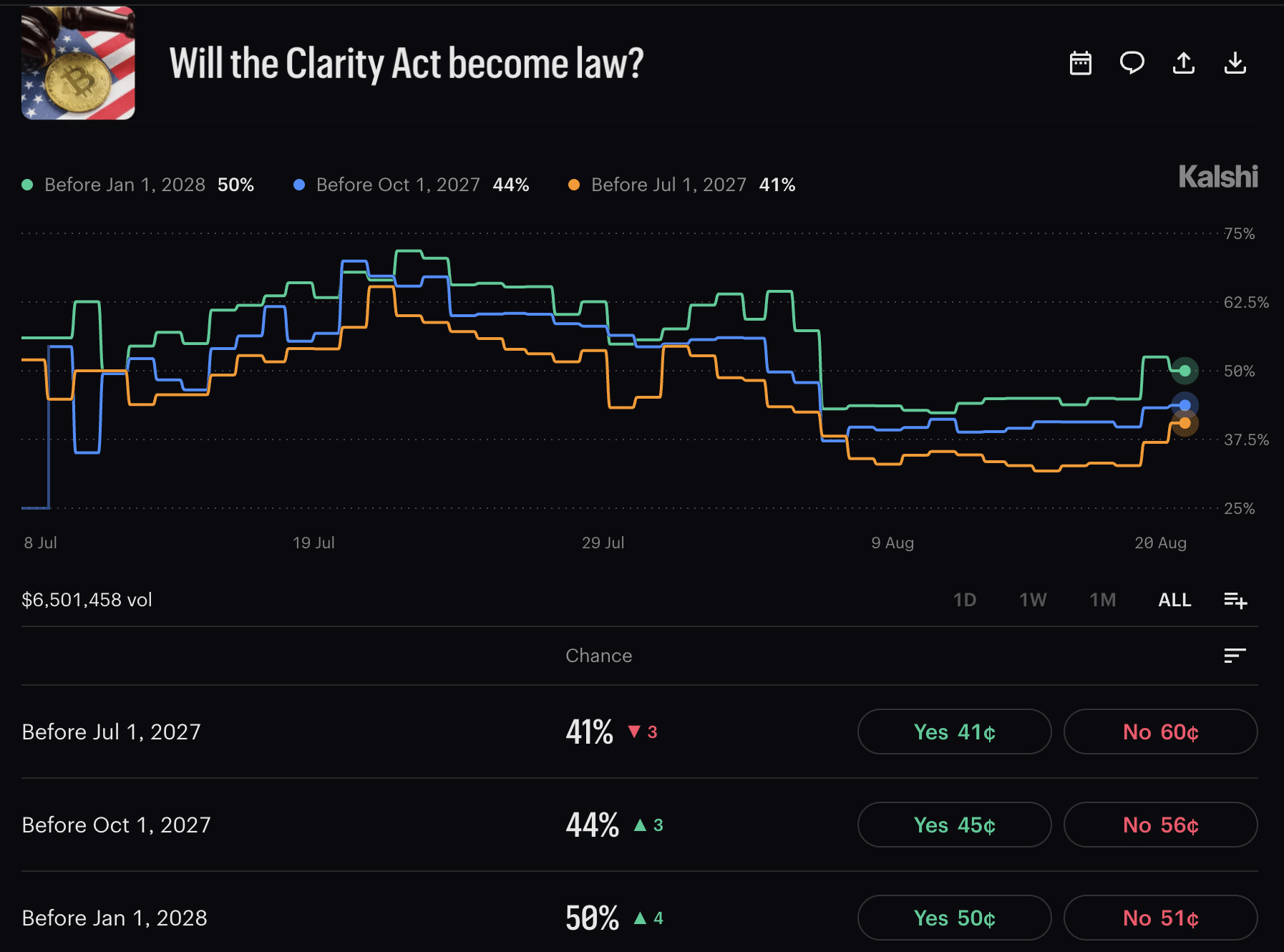
Josh Riezman, chief legal and strategy officer at trading firm GSR, said he expects the SEC and CFTC to push through ambitious rules that help the industry in the short term.
But he warned that a future administration could look “very much like a potentially Gensler 2.0 type scenario,” referencing former SEC Chair Gary Gensler’s enforcement-heavy approach under the Biden administration.
We suspect this reversal risk, not the current rulemaking pace, is what most worries crypto executives, since polling suggests Democrats could retake the House in November’s midterms and use that leverage to scrutinize the very rules Atkins and Selig are now writing.
Summer Mersinger, CEO of the Blockchain Association and a Republican CFTC commissioner from 2022 to 2025, welcomed the agencies’ momentum but drew a clear line. “That’s going to be really helpful, and we applaud their work,” she said. “But we need something permanent.”
Traditional finance is not standing still either. CME Group sued the CFTC in June over its approval of perpetual futures, and the Securities Industry and Financial Markets Association has pressed the SEC on restrictions on blockchain-based stock trading.
EXPLORE: Best Crypto Coins to Buy for August
Disclaimer: Coinspeaker is committed to providing unbiased and transparent reporting. This article aims to deliver accurate and timely information but should not be taken as financial or investment advice. Since market conditions can change rapidly, we encourage you to verify information on your own and consult with a professional before making any decisions based on this content.

Daniel Frances is a technical writer and Web3 educator specializing in macroeconomics and DeFi mechanics. A crypto native since 2017, Daniel leverages his background in on-chain analytics to author evidence-based reports and deep-dive guides. He holds certifications from The Blockchain Council, and is dedicated to providing “information gain” that cuts through market hype to find real-world blockchain utility.