Strait of Hormuz Closure: Could This Hidden Crisis Trigger a Worldwide Economic Collapse?
Ever wonder how a tiny stretch of water—barely 33 kilometers wide—can hold the global economy hostage? That’s exactly what’s happening with the Strait of Hormuz, the world’s busiest energy funnel squeezed between Iran and Oman. With Middle East tensions heating up and this critical chokepoint effectively closed to commercial shipping, the whole market circus is buzzing—and not in a good way. Could this spark the next big recession, or will it fizzle out like just another headline? Given that nearly 20 million barrels of oil and a fifth of the world’s liquefied natural gas flow through this spot daily, a shutdown here isn’t just inconvenient—it’s a potential seismic shockwave for economies, traders, and your wallet. Hang tight, because this isn’t a mere geography lesson; it’s a front-row seat to how fragile the energy supply chain truly is—and why everyone with skin in the game should be paying close attention. LEARN MORE.
With Middle East tensions still dominating headlines, markets are buzzing about what the closure of the Strait of Hormuz could mean for the global economy. Are recession bells about to ring soon?
The Strait of Hormuz, which is that narrow stretch of water between Iran and Oman, has been called the world’s most important energy crossroads. And right now, it’s effectively closed to commercial shipping. Here’s why its shutdown could be a huge deal for markets, economies, and your trading portfolio.
The Basics: What Is the Strait of Hormuz?
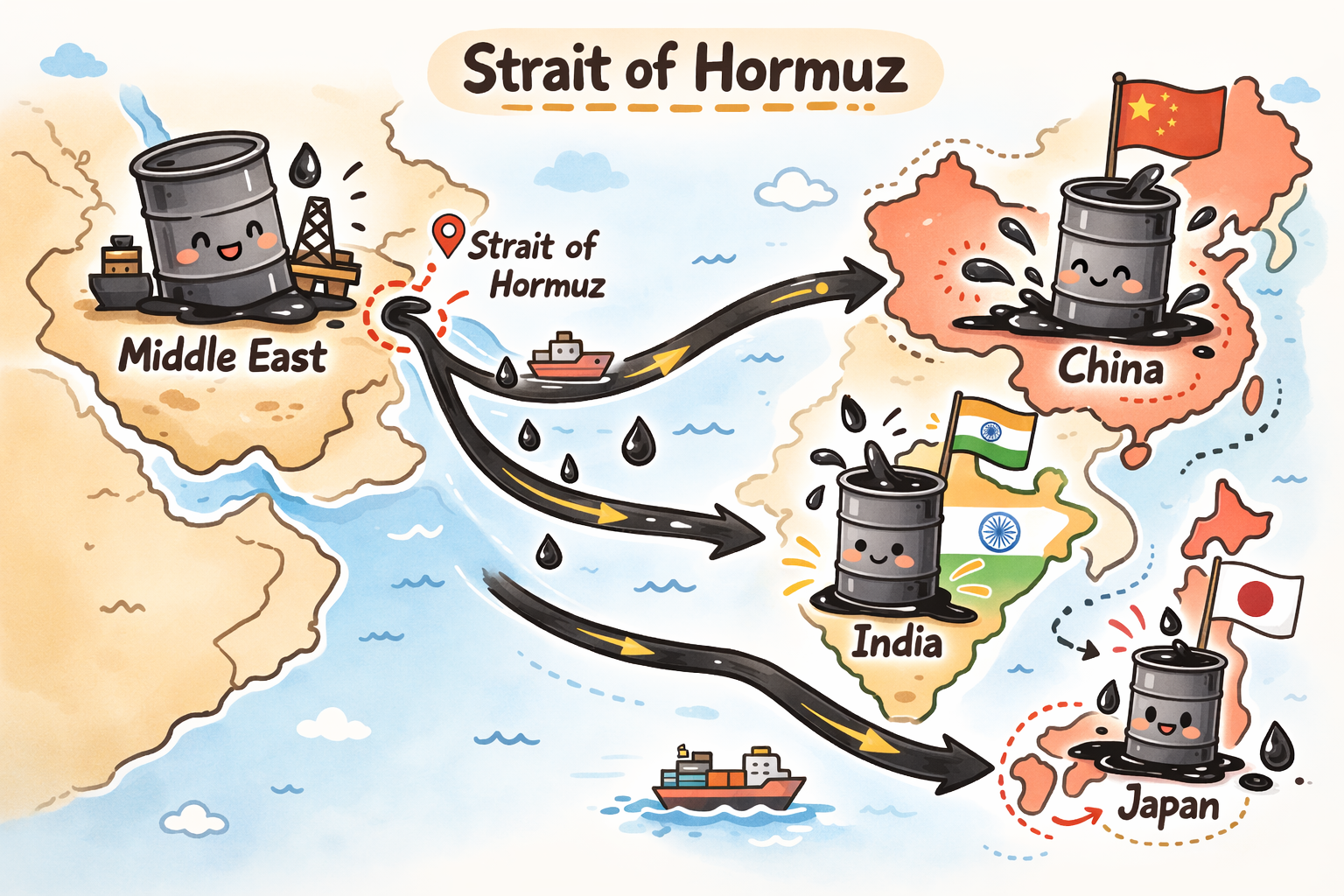
The Strait of Hormuz is a slim waterway, barely 33 km wide at its narrowest point, connecting the Persian Gulf to the Gulf of Oman and the Arabian Sea. Think of it as a one-way corridor that the entire oil-producing Gulf region depends on to get its energy exports to the rest of the world.
Roughly 20 million barrels of oil flow through the strait every single day. That represents about 20% of all global petroleum consumption and around 27% of all seaborne oil trade, according to the U.S. Energy Information Administration (EIA). Add in the fact that about 20% of the world’s liquefied natural gas (LNG) primarily from Qatar also transits the strait, and you start to understand what’s at stake.
The countries that depend most on this waterway are giants:
- China receives roughly 37–40% of its crude imports through the strait
- India sources about 60% of its oil from the Middle East, largely via Hormuz
- Japan and South Korea each receive around 10-12% of all Hormuz crude flows
- Saudi Arabia, Iraq, the UAE, Kuwait, and Qatar all funnel most of their oil exports through this single channel

There are almost no meaningful bypass alternatives, which means there is no real Plan B. When the strait gets disrupted, the oil doesn’t just take a detour. It simply doesn’t arrive anywhere else around the world.
Although Saudi Arabia has a pipeline that can move roughly 5 million barrels per day to the Red Sea, and the UAE has a 1.5-million-barrel-per-day bypass route, these cover only about 3–3.5 million barrels per day or a fraction of the 20 million that normally flow through Hormuz daily.
Why It Matters: Recession Domino Effect
When the Strait of Hormuz gets blocked, the chain reaction is fast and brutal. Here’s how it can play out across global markets:
Energy prices explode first. With over 20% of global oil supply suddenly removed from the market, crude prices spike sharply. Analysts at Bernstein have warned prices could reach $150 per barrel in a severe, prolonged closure scenario. One expert described it as potentially “three times the severity of the Arab oil embargo” of the 1970s.
After that, everything else gets more expensive. Oil isn’t just gasoline. It’s the input cost for manufacturing, transportation, agriculture, and plastics. When oil prices double or triple, inflation surges across every sector of the economy. Number crunchers estimate that a sustained $100/barrel oil price would likely add roughly 0.7 percentage points to global inflation.
Central banks get stuck. With rising oil prices causing inflation to spike, central banks like the U.S. Federal Reserve would normally be pressured to raise interest rates. But if the economy is simultaneously slowing because of an energy shock, tightening monetary policy risks making things much worse. This toxic mix of high inflation plus slow growth is called stagflation, and it’s exactly what happened in the 1970s oil crisis.
Asia likely gets hit hardest. About 84% of Hormuz crude flows go to Asian markets. Pakistan gets 99% of its LNG from Qatar and the UAE through the strait. India’s economy would face a major shock because so much of its imports are priced in Brent crude. Japan faces the same squeeze, as its heavy energy import reliance means a weaker yen and higher domestic inflation simultaneously.
Former White House energy adviser Bob McNally put it bluntly: “A prolonged closure of the Strait of Hormuz is a guaranteed global recession.”
Promoted: Stop Risking Your Own Capital on Unpredictable Geopolitics.
You’ve read the geopolitical headlines and watched crude oil prices spike, but playing big macro shifts requires serious capital. With FundingPips, you trade a simulated account and can earn up to 100% of your rewards. Whether you’re looking for a 2 Step PRO evaluation starting at just $26 or seeking funding options up to $300K, you have the flexibility to trade your way.
Learn more about FundingPips and use code HELLO to get 20% OFF your first purchase!
Disclosure: We may earn a commission from our partners if you sign up through our links, at no extra cost to you.
Key Lessons for Traders
1. Oil is the master variable.
When the strait is disrupted, oil prices move first and fastest. Every other market (stocks, bonds, currencies, commodities) would likely take cues from oil. If you’re watching markets during a Hormuz crisis, the oil price is your north star. Everything downstream flows from there.
2. “Risk-off” could be a longer-term theme.
In crisis environments like this, traders tend to rush to safe-haven assets. The U.S. Dollar typically strengthens because it’s the world’s reserve currency. The Swiss Franc (CHF) also rallies due to Switzerland’s strong financial position. Currencies of energy-importing nations such as the Japanese Yen, Indian Rupee, or Korean Won face serious selling pressure because their countries’ import bills explode.
3. Duration is everything.
A two-day disruption is a market scare. A two-week disruption is a supply shock. A two-month disruption is a global recession catalyst. The difference between a spike-and-recover pattern and a structural market shift is entirely about how long the closure lasts. Watch the diplomatic calendar as closely as the oil price.
4. Insurance kills trade before missiles do.
You don’t need ships to get blown up for the strait to “close.” When war-risk insurance premiums surge or underwriters cancel coverage entirely, shipping companies simply park their tankers. That’s already happening since tanker transits plummeted by 86% in early March 2026, leaving over 700 vessels anchored and waiting. Insurance markets, not military movements, are often the real enforcement mechanism.
5. Not all currencies are equally exposed.
Energy-exporting currencies like the Canadian Dollar (CAD) or Norwegian Krone (NOK) can actually benefit from oil price spikes. Meanwhile, energy-importing nations’ currencies suffer. This divergence creates trading opportunities for traders who understand which direction each currency should move during an energy shock.
The Bottom Line
The importance of the Strait of Hormuz is not just a geography lesson. It’s seeing how the disruption of the single most important piece of infrastructure in the global energy system has ripple effects that touch everything from the price of gasoline to the rate decisions of every major central bank on the planet.
The key risk to watch now is duration. A short disruption means painful but temporary price spikes. A prolonged closure measured in weeks or months would force demand destruction, ignite inflation, and potentially tip a fragile global economy into recession.
For traders, the playbook during a Hormuz crisis historically includes: watching oil as the lead indicator, expecting USD and CHF strength, anticipating weakness in energy-importing nations’ currencies, and being very cautious about stocks in energy-intensive sectors.
Most importantly, geopolitical crises usually create enormous volatility in both directions. News of ceasefire talks can reverse oil prices just as violently as news of escalation. Manage risk carefully, size positions conservatively, and never forget that in crises, the unexpected is the most likely outcome.
This article is for educational purposes only. It does not constitute financial advice. Trading involves substantial risk, and past performance is not indicative of future results. Always do your own research and consider consulting with a qualified financial advisor.
Promoted: Master Your Execution During Macro Shocks
When major geopolitical headlines raise the odds of a recession, does your execution stay clinical or get emotional? TradeZella’s trade replay tool lets you revisit your past trades tick-by-tick. See exactly where your entry slipped or why you hesitated, so you can dominate the next volatility spike with a data-driven playbook.
Start Your Journal with Tradezella and use code “PIPS20” to save 20%!
Disclosure: To help support our free daily content, we may earn a commission from our partners if you sign up through our links, at no extra cost to you.