RBA Holds Steady at 3.60%—What’s Behind the Surprising AUD Surge?
Ever wonder why the Reserve Bank of Australia chose to keep interest rates steady at 3.60% this December, even while waving a cautious flag about inflation’s unexpected rebound and those ever-tight labor market knots? It’s like watching an expert tightrope walker pausing mid-step—careful, deliberate, yet fully aware that any sudden move could tip the balance. The RBA’s latest statement isn’t just a routine memo; it signals a subtle but significant shift in the economic narrative—acknowledging that inflation risks are no longer just whispers but a real and present force, even as the economy keeps limping forward with stronger consumer and investment appetite. And let’s not forget how the Aussie dollar danced—pausing, dipping, then surging—a market show that kept traders on their toes! Curious to see how this tango of caution, recovery, and market reaction plays out next? LEARN MORE.
As expected, the Reserve Bank of Australia (RBA) maintained interest rates at 3.60% in their December decision while highlighting the rebound in inflation and tight labor market conditions.
Key Takeaways
- The RBA maintained its cash rate at 3.60%, keeping monetary policy in restrictive territory as it monitors inflation dynamics
- Recent data indicate inflation risks have tilted to the upside, with underlying inflation showing signs of a more broadly based pick-up
- Economic activity continues to recover, driven by strengthening private demand in both consumption and investment
- Labour market conditions remain “a little tight” despite gradual unemployment increases, with capacity utilization above long-run averages
- The Board emphasized it will remain cautious and data-dependent, taking time to assess the persistence of inflationary pressures
Link to Reserve Bank of Australia Monetary Policy Statement (December 2025)
The RBA’s December statement marked a notable shift in tone from previous meetings, explicitly stating that “the risks to inflation have tilted to the upside,” marking a departure from the previous communications which had emphasized progress on disinflation.
Despite inflation concerns, the RBA noted that economic activity continues to recover, with growth in private demand strengthening across both consumption and investment. However, the Board emphasized that financial conditions have eased since the beginning of the year, credit remains readily available, and the full effects of earlier interest rate reductions have yet to materialize.
During the press conference, RBA Governor Michelle Bullock clarified that they did not explicitly consider the case for an interest rate hike in this particular discussion and that their February meeting would have more data on whether or not inflation is failing to slow down.
Market Reactions
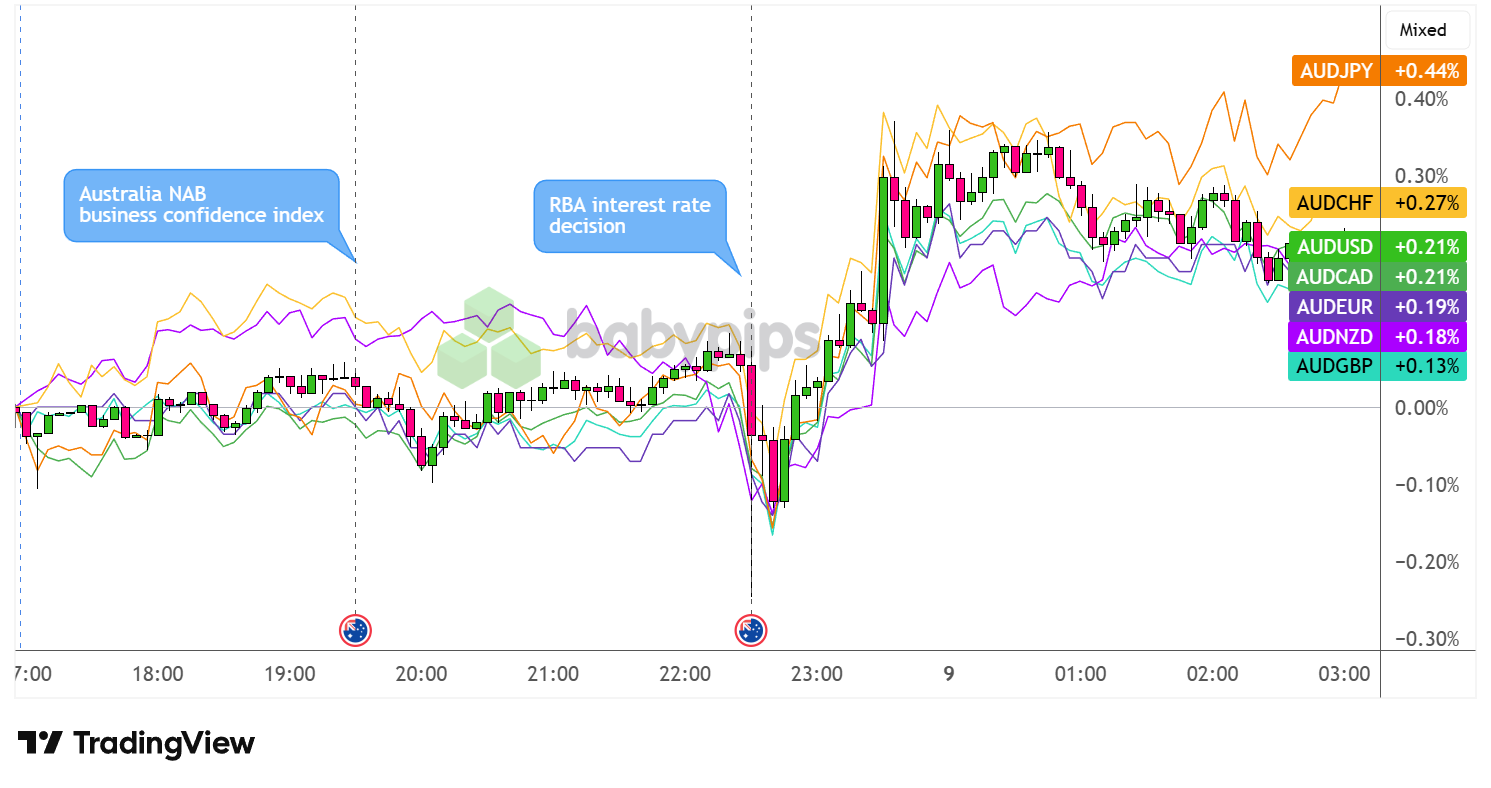
Australian Dollar vs. Major Currencies: 5-min

Overlay of AUD vs. Major Currencies Chart by TradingView
The Aussie, which had been consolidating during the first few hours of the Asian session leading up to the RBA decision, drifted briefly lower during the actual announcement, possibly in a “buy the rumor, sell the news” reaction to the event.
Still, AUD quickly bottomed out a few minutes after the statement and ripped higher across the board, especially after RBA Governor Bullock’s press conference which kept hopes alive for policy tightening soon.
AUD raked in its strongest gains versus JPY (+0.44%) followed by CHF (+0.27%) towards the end of the Asian session while also logging in wins against USD (+0.21%) and CAD (+0.21%).