Maximizing ROI: The Value of AI Agents in Business Operations
G2’s review analysis of more than 2,700 verified user experiences reveals that AI agents for business operations became widely adopted across industries in 2025. Users report high satisfaction levels and rapid deployment, with 88% expressing positive views on AI functionalities. Key benefits include reductions in manual tasks and significant time savings in sales, marketing, and customer support roles. Despite these gains, buyers encounter challenges related to complex configurations and unclear pricing, which impact their purchasing choices.
Effectiveness of AI in Business Operations Software
The majority of reviews describe AI as transformative or an essential aid. Only 3% of feedback is negative, mainly addressing extra costs or insufficient advanced controls, while 9% remain neutral—acknowledging usefulness but pointing out functional limitations. AI agents are valued for managing high task volumes, such as conversation analysis, routing to human agents, and using human input to drive automation. Users often highlight that AI allows their teams to increase output without adding personnel, enabling a shift from repetitive administrative tasks to strategic activities.
Additionally, AI agents are praised for their consistency. Unlike humans who may tire, AI maintains uniform attention and adheres to processes continuously, ensuring predictable business outcomes.
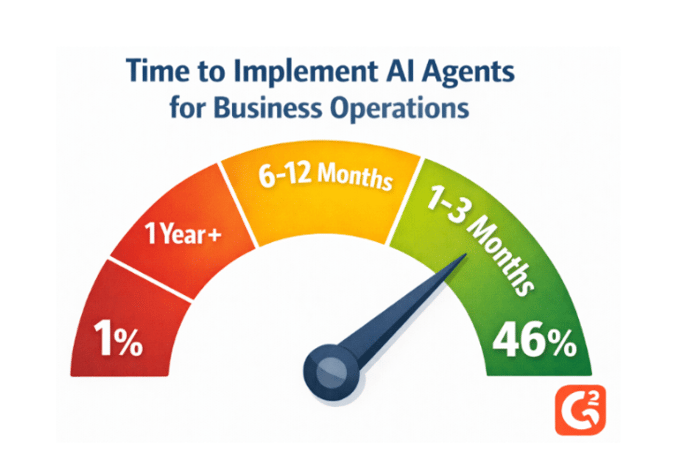
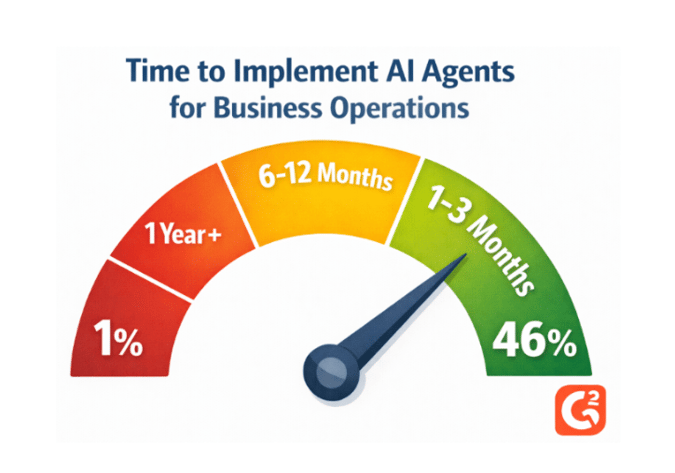
According to G2, 46% of users implemented AI agents in under a month, and only 1% required more than a year. The average time to return on investment was 5.03 months, indicating noticeable benefits within six months of adoption.
Key Success Areas of AI Agents in Business Operations
Users particularly appreciate automation, conversational intelligence, and real-time insights.
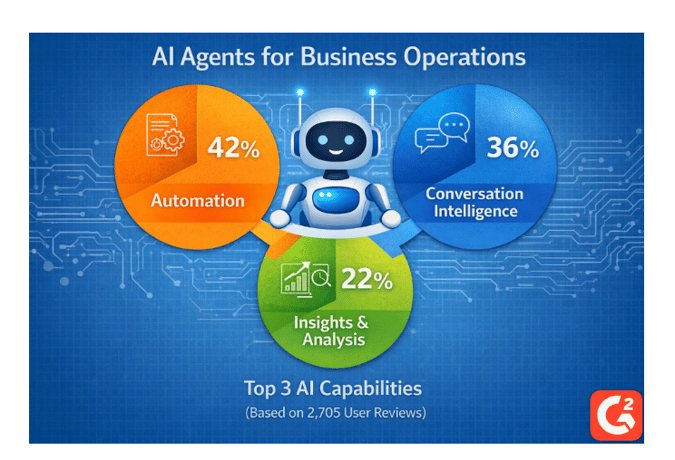
- Automation of repetitive tasks: 42% of reviewers highlight automation of routine calls, scheduling, and administrative duties like data entry, which frees time for more strategic work.
- Conversational intelligence and natural interaction: 36% note AI’s human-like qualities, especially in voice agents and chatbots that facilitate form completion and customer support. Natural language capabilities have advanced to the extent that customers often cannot distinguish between AI and humans, reducing skepticism.
- Real-time insights and analysis: 22% value features such as automatic call scoring, real-time transcription, and data analysis that provide business intelligence access without requiring specialized technical skills.
Primary Limitations in AI Agents for Business Operations
Despite overall positive experiences, two main pain points consistently arise:
- Complexity and initial setup: 8% of users report difficulties with advanced configurations, including managing intricate AI voice flows and prompt engineering. While basic setups are usually manageable
G2’s analysis of over 2,700 verified reviews showed that AI agents for business operations achieved industry-wide adoption in 2025, with users reporting satisfaction and fast implementation. The data reflects that 88% of reviewers express positive sentiment toward AI capabilities, primarily due to decreases in manual work and time savings across sales, marketing, and customer support responsibilities. However, despite these advantages, buyers continue to face challenges around configuration complexities and a lack of pricing transparency that influence purchasing decisions.
How effective is AI in AI agents for business operations software?
Most reviews highlight AI as a “game changer” or “indispensable assistant.” Only 3% of reviews show negative sentiment, primarily focused on additional costs or a lack of advanced controls. However, 9% of users are neutral, finding the tools helpful but noting specific functional limitations.
The effectiveness of these AI agents is seen in their ability to handle large volumes of tasks, such as analyzing conversations, routing conversations to a human, and usinghuman’s output as input to drive automation. Users frequently note that AI capabilities enable their teams to accomplish a lot more work without significant increases in headcount. The automation features allow teams to better allocate their time from repetitive admin tasks to higher-valued strategic work.
Users also write that AI agents deliver value through their consistency. Unlike human workers, who get tired, AI agents provide the same level of attention and follow processes 24/7, which maintains predictable outcomes for businesses.
According to G2’s analysis of 2,705+ reviews, 46% of users were able to implement AI agents for business operations in less than one month, while only one percent took more than a year. The average months to ROI was 5.03, showing that these platforms deliver noticeable value within the first half-year of use.
Where AI is winning in AI agents for business operations software
Automation, conversational intelligence, and real-time insights are the most valued features among users.
- Automation of repetitive tasks: 42% of reviewers favor the ability to automate routine calls, scheduling, and administrative work such as data entry. This feature addresses what users describe as the most time-consuming aspects of business operations and often prevents them from focusing on more strategic-based work.
- Conversational intelligence and natural interaction: 36% of users share that AI feels “human-like,” particularly in voice agents and chatbots. These agents guide users through forms or handle customer support questions. Reviewers note that natural language interactions have reached a point where customers can’t tell the difference between AI and humans, which decreases skepticism about whether AI can handle customer-facing interactions.
- Real-time insights and analysis: 22% of reviewers favored features like automatic call scoring, real-time transcription, and analysis that answer complex data questions. Review sentiment for this trait highlights that these analytical capabilities make it easy to access business intelligence, allowing employees without technical data skills to export insights that previously required specialized expertise.
Biggest AI limitations in AI agents for business operations software
Despite high overall satisfaction, users consistently identify two pain points that affect their experience.
- Complexity and initial setup: 8% of reviews complain about the difficult nature of advanced configurations, such as managing complex AI voice flows or advanced prompt engineering. While many find the basic setup easy, the gap between simple implementation and advanced customization creates frustration for teams attempting to take advantage of the full capabilities of their AI agents.
- Cost and pricing transparency: 12% of user complaints, with common issues including extra costs for AI add-ons, steep price increases at higher volumes, and a lack of simple, user-friendly pricing plans. This pricing concern affects growing teams, as costs jump unpredictably as usage increases, making budget planning difficult.
These pain points are both valid and typical of a rapidly evolving category. As AI agents become more advanced, the gap between basic usability and sophisticated customization naturally introduces complexity, while pricing models are still catching up to usage-based scaling.
However, the overall trajectory is positive — vendors are already simplifying deployment through no-code interfaces and improving pricing transparency, indicating these challenges are likely to diminish as the market matures.
Adoption trends: Is AI use accelerating?
AI is transitioning from experiential to a necessity. According to user feedback, companies are no longer just looking for AI to automate simple tasks; they are leveraging AI Agents to serve as intelligent analysts that bring together complex data and actionable business decisions.
G2 Data shows that mentions of AI in reviews for AI Agents For Business Operations have increased by 45% over the last year, displaying that organizations are counting on AI more than ever, where AI handles the heavy lifting of data analysis and workflow management.
What this means for AI agents for business operations software buyers
G2 Data suggests that use cases for AI are shifting from merely storing data to actively interpreting and analyzing it. Its value lies beyond automation; buyers today are looking for “artificial colleagues” who can work with them to manage data, workflows, and analysis. If users can properly set up these AI agents with the necessary integrations (CRM, marketing, ERP, etc.), workers can move past the initial learning curve to gain useful skillsets faster without an in-house engineering team.