How Adoption Challenges Influence AI (and Their Impact on HR Software)
AI technology is evolving rapidly. Previously, standalone models served specific tasks, but now users prefer integrated, agent-based AI systems that collaborate seamlessly, according to PwC.
This trend is especially evident in AI Recruiting and AI Agents for HR. Although users seek interconnected solutions, adoption remains challenging. This article analyzes G2 data to identify hurdles and opportunities for AI within the HR sector.
Effectiveness of AI in HR Software
AI is integrated across almost all HR functions, with four primary AI-focused HR categories:
- AI Agents for HR: Autonomous bots that automate HR processes, answer employee inquiries, and connect various HR systems.
- AI Recruiting: AI applications covering the full recruitment cycle, including sourcing, screening, scheduling interviews, candidate evaluation, and communication.
- AI Interview Agent: Specialized copilots assisting with interview scheduling, scoring, and sometimes conducting interviews via AI avatars.
- Talent Intelligence: AI tools aimed at enhancing talent management and broader HR analytics.
A sentiment analysis of reviews from January 1 to March 16, 2026, across these categories highlights that AI technologies related to candidate screening and recruiting lead the conversation. Features such as AI agents, copilots, assistants, and conversational AI are increasingly mentioned. Core recruiting technologies like real-time evaluation and candidate sourcing remain fundamental.
Major Limitations in AI Recruiting and HR
The biggest obstacle to deploying advanced AI in HR is implementation. This challenge is multifaceted, but fundamentally, it is less a technological issue and more a learning challenge. Users frequently cite the learning curve as the main barrier to AI adoption in HR.
Analysis of reviews during early 2026 reveals five prominent issues: steep learning curves, training and onboarding difficulties, workflow integration problems, implementation challenges, and general adoption resistance.
Approximately 19% of reviews across AI-related HR categories mention concerns about AI adoption or implementation.
Emerging Leaders: AI Interview Agents and AI Agents for HR
AI adoption varies across HR use cases. Adoption rates on G2 indicate that AI Interview Agents lead with an average adoption of 82.7%, followed by AI Recruiting and Talent Intelligence at 74.6% each. AI Agents for HR have a lower adoption rate of 57.4%.
However, AI Agents for HR boast the highest Net Promoter Score (NPS) of 19, implying that although fewer organizations adopt these agents, those who do report higher satisfaction.
Understanding the Adoption Gap
AI Agents for HR integrate multiple AI-driven self-service functionalities, transforming traditional workflows. This shift requires significant changes
AI is maturing. Where once we relied on one-off models for specific purposes, users are embracing more comprehensive, connected agentic AI systems that work together in tandem, according to the PwC.
Nowhere is that more true than in AI Recruiting and AI Agents for HR. While users are looking for interconnected solutions, adoption issues are putting up barriers. In this article, we’ll examine G2 Data to see where challenges and opportunities are creeping up for AI across the HR sphere.
How effective is AI in HR software?
While AI is present in nearly every HR category, there are four main AI-centric categories in HR. Let’s check them out:
- AI Agents for HR: Agentic bots that automate HR tasks, answer employee questions, and streamline across HR systems.
- AI Recruiting: Uses AI in the entire recruiting flow from top to bottom. Includes AI in sourcing, screening, setting up interviews, evaluating candidates, and communication along the pipeline.
- AI Interview Agent: Like AI Recruiting, but of a copilot specifically for the interview, including scheduling, scoring, and sometimes even running it with an AI avatar.
- Talent Intelligence: Covers a range of other AI, but specifically focuses on those that enhance talent management.
In a sentiment analysis done by G2, these are the top-mentioned AI-related technologies in HR in reviews from AI Agents for HR, AI Recruiting, AI Interview Agent, and Talent Intelligence from January 1st, 2026, to March 16th, 2026.
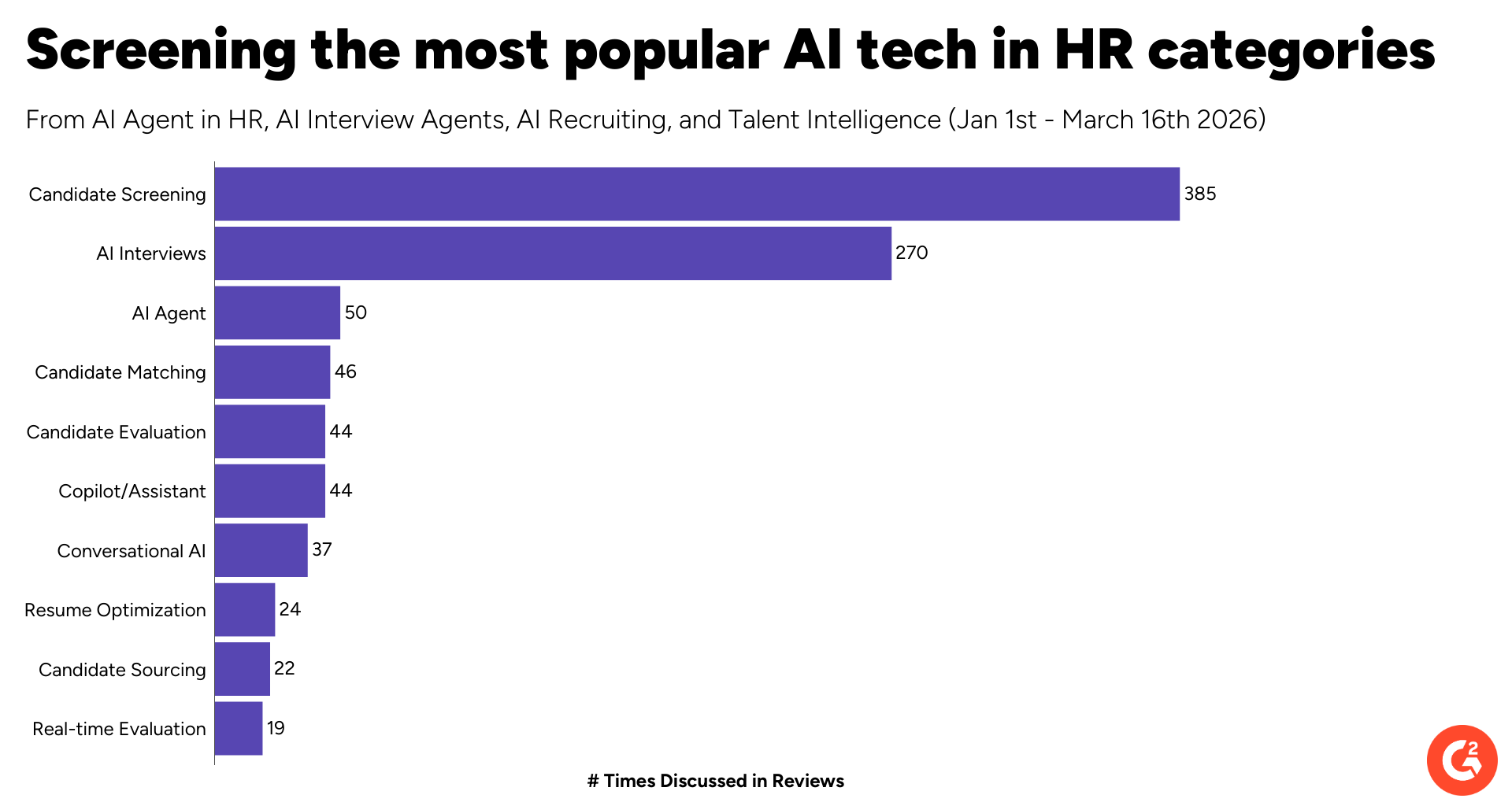
Recruiting and interview-related technology led the way with candidate screening, using AI to flag potential top candidates, as the number one most-mentioned technology. However, we also see that agents and chatbots are coming up with the features AI agent, copilot/assistant, and conversational AI. The last tech being discussed is core recruiting functions such as real-time evaluation, candidate sourcing, and real-time valuation, which have been in the industry since ATS.
Biggest AI limitations in AI recruiting and HR categories
When it comes to implementing truly agentic AI in HR, there is one big stumbling block: implementation. In fact, this isn’t one simple problem, but a bunch of them twined together like a rat’s nest.
What’s most significant is that the issue that caused the most stress wasn’t tricky workflow integration. It’s not a technology problem; it’s a learning problem. People cited the learning curve as the single greatest problem related to AI and adoption in the HR space.
.png?width=675&height=360&name=top-mentioned-ai-tech-in-hr%20(1).png)
We examined the output of reviews from January 1st to March 16th, 2026, from the four G2 categories and found five major issues: difficult learning curves, problems with training and onboarding, workflow integration, implementation issues, and general adoption issues.
(From AI Agent in HR, AI Interview Agents, AI Recruiting, and Talent Intelligence)
AI Interview Agents and AI Agents for HR are winning
AI is gaining traction in recruiting, but not all use cases are evolving at the same pace. Two distinct trends are emerging: First, we see it with AI interview agents and AI recruiting when it comes to the adoption percentage.
The adoption percentage on G2 tracks what percentage of an organization is using a product. The top two adoption percentage rates came from AI Interview Agents and AI Recruiting, likely because those two are already streamlined with the recruiting funnel. AI Interview Agents have the highest adoption rate at 82.7% on average, with Talent Intelligence and AI Recruiting coming in right behind at 74.6% each. AI Agents for HR come in last with a 57.4% adoption rate.
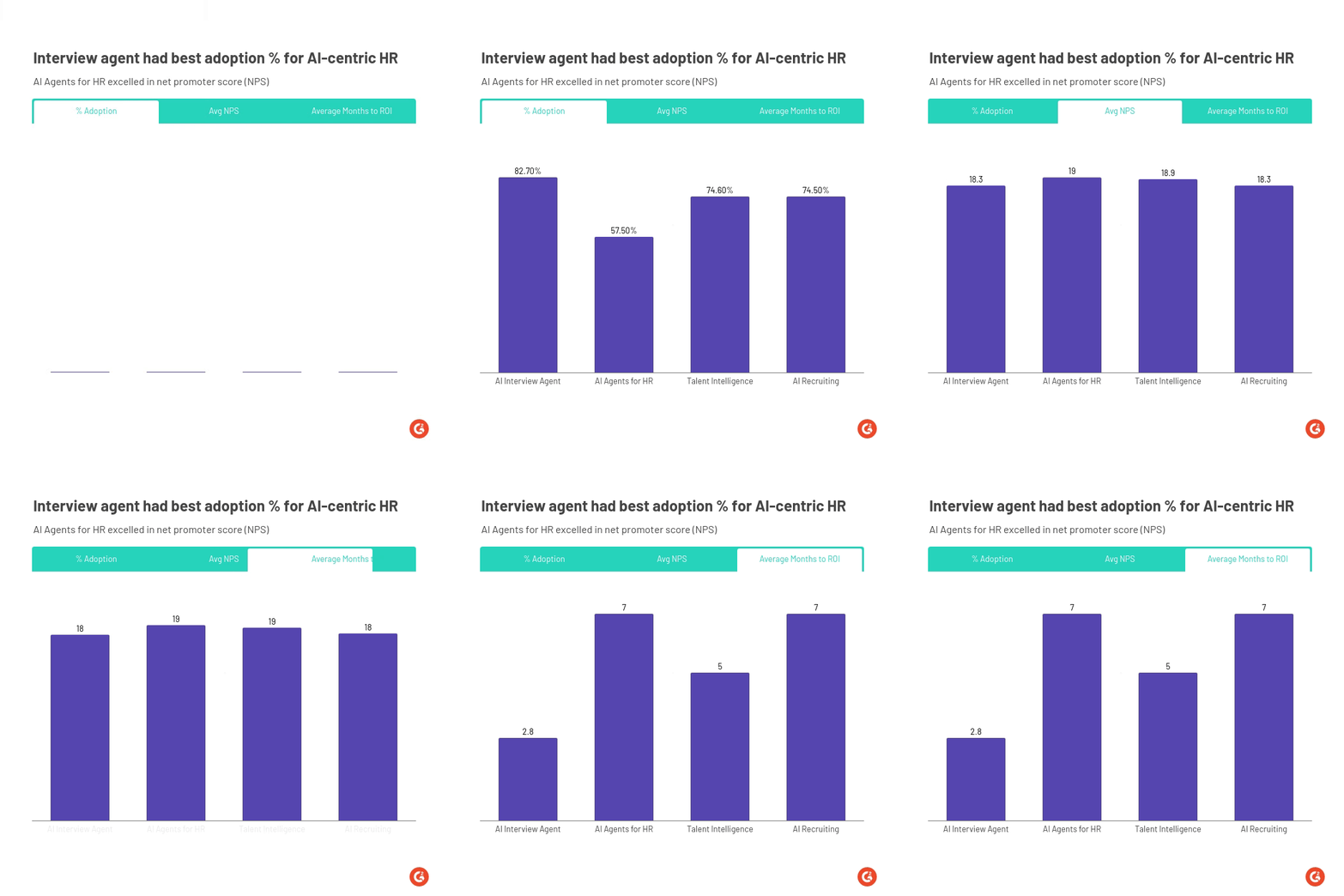
Data is from each category’s creation in 2026 to March 16th, 2026. Talent Intelligence data is from January 1st, 2025, to March 16th, 2026.
Next, we see that AI Agents for HR are winning when it comes to Net Promoter Score (NPS). AI Agents for HR has the highest NPS with a score of 19. This suggests a different dynamic:
- Fewer organizations are adopting AI HR agents
- But those who do are significantly more satisfied
Why the disconnect?
AI Agents for HR are a combination of all the promises we’ve been made for AI in HR. It brings together all the self-service systems and automates them. However, the learning curve for this is causing adoption woes. Why? The answer comes down to use.
For many users, going to an AI agent instead of emailing people questions is a complete redesign of the workflow. Users may also be used to submitting individual tickets and tracking replies. Agents disrupt this workflow, often making it more effective, but it’s going to take time and care to teach users how to adapt.
AI Interview Agents and AI Recruiting, on the other hand, are used by recruiters, HR managers, and others who have already been pushing their funnels to be faster for years. Most systems already had a workflow with sourcing, an ATS, an HRIS, and various other HR modules. It’s easier to replace this entirely or in part with AI because it’s designed to be streamlined.
Moving to agents may be difficult, but with a better understanding of where the stumbling blocks come in, it’ll be easier to design implementation plans to reap the benefits and assist workers.
What this means for HR buyers
Perhaps the most important takeaway is that the steep learning curve is a huge stumbling block for AI adoption in HR departments. Learning AI tools takes time. Investing in them should also come with a clear implementation plan and suggestions for use. A buyer is more likely to adopt a tool if it comes with a promise of, “you can get rid of this horribly boring thing you hate and make your quota better.”
Lastly, it all comes back to trust. Users need to teach their AI, refine prompts, try new experiments, and give it valuable context and native knowledge for an AI to function well. If workers are worried about being replaced, they’re less likely to put in that time and effort. If workers see AI as a copilot, a research assistant handling busywork, that changes everything.
Trust, transparency, and communication will ultimately make the difference between successful adoption and failed initiatives. That’s something that no model can replicate.
Dive deeper into the trends shaping AI in HR — explore G2’s 2026 AI in HR report: a market reality check.