Machine Learning in 2026: Transitioning from Experimentation to Core Strategy
Machine Learning in 2026: Key Insights
Machine learning has evolved into a central business strategy where the focus is on owning the outcome rather than the model itself. Organizations that have successfully scaled machine learning clearly define what constitutes a good result before deployment and assign a dedicated business owner to oversee the model’s output. The primary obstacle to broader adoption is data readiness, not model capability.
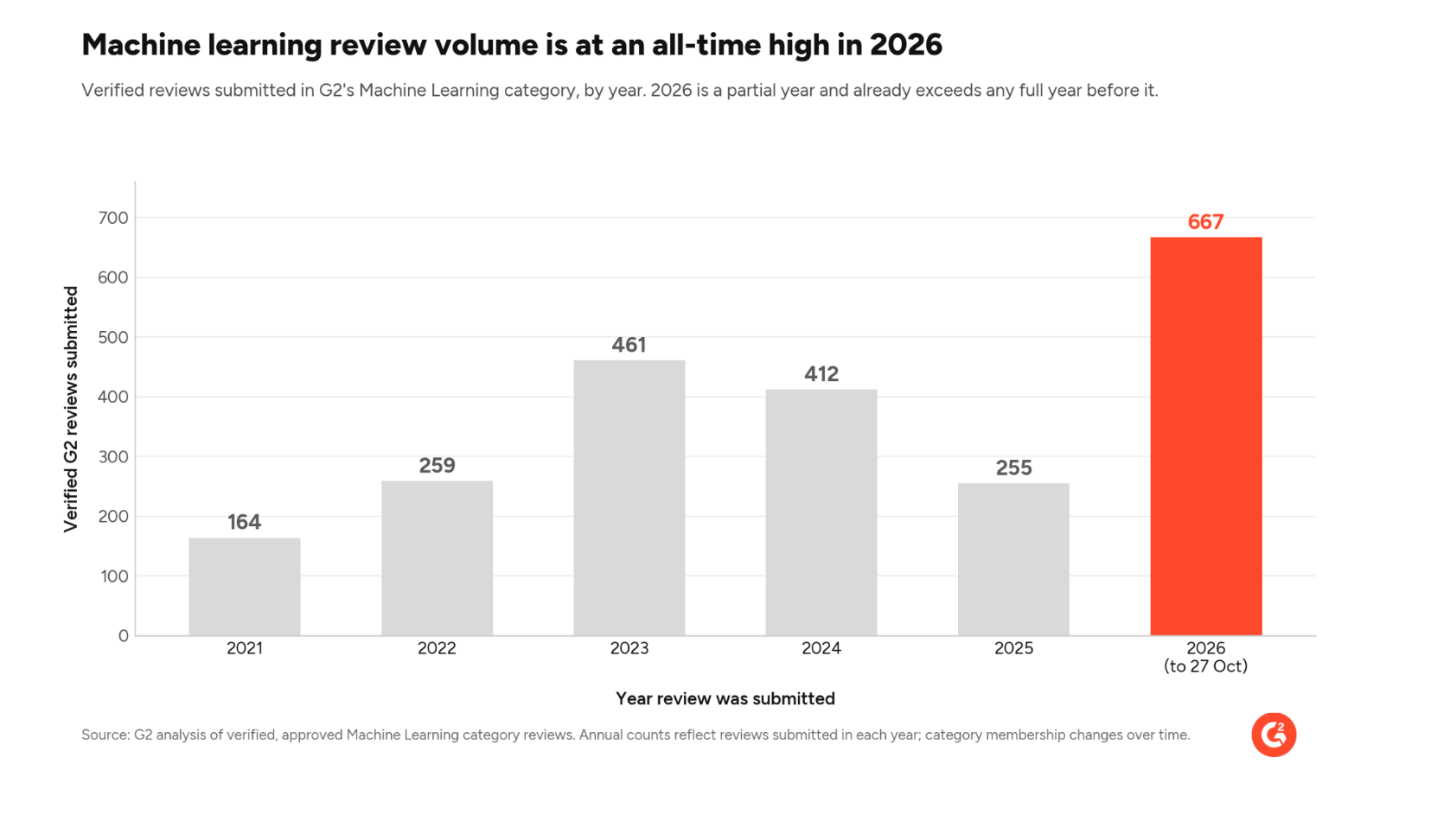
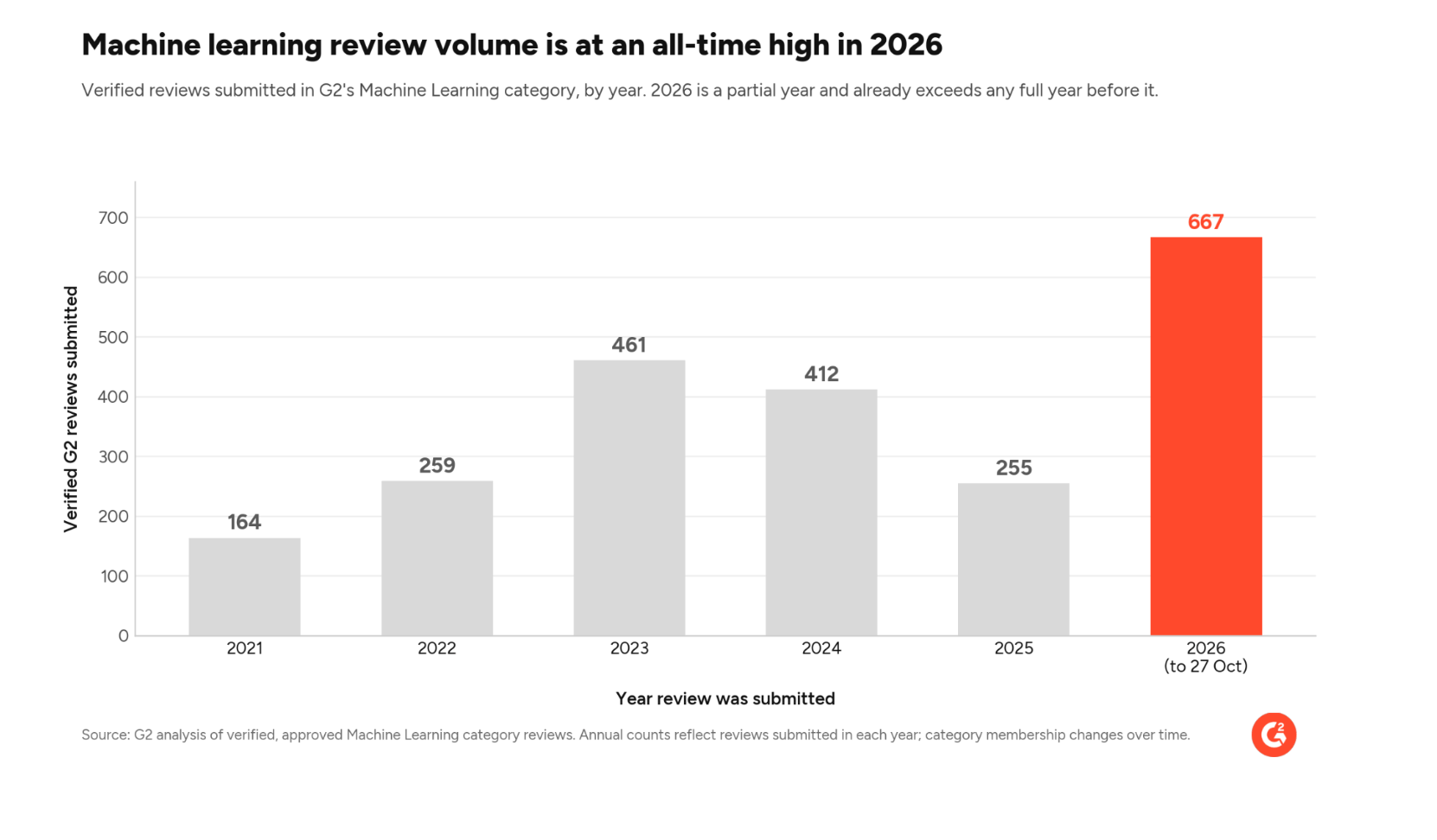
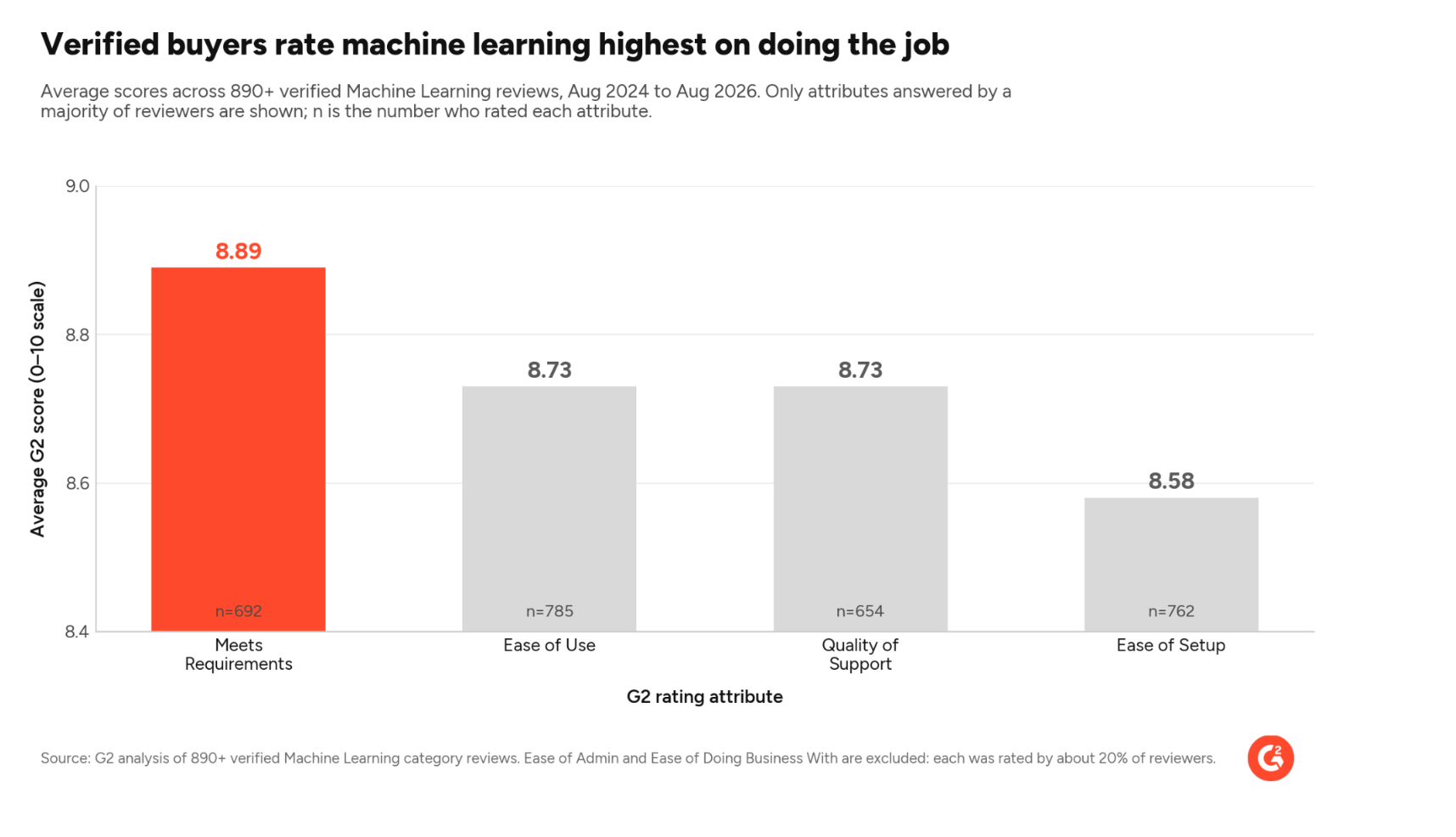
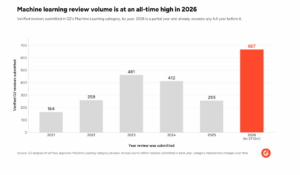
G2’s analysis of over 890 verified machine learning reviews reveals that buyers rate these tools highly for meeting requirements, scoring an average of 8.89 out of 10. Despite this, all four leading vendors surveyed identify data readiness as the main challenge hindering scalability. Machine learning review submissions have surged in 2026, with more than 660 verified reviews by late October—surpassing the total for the entire previous year.
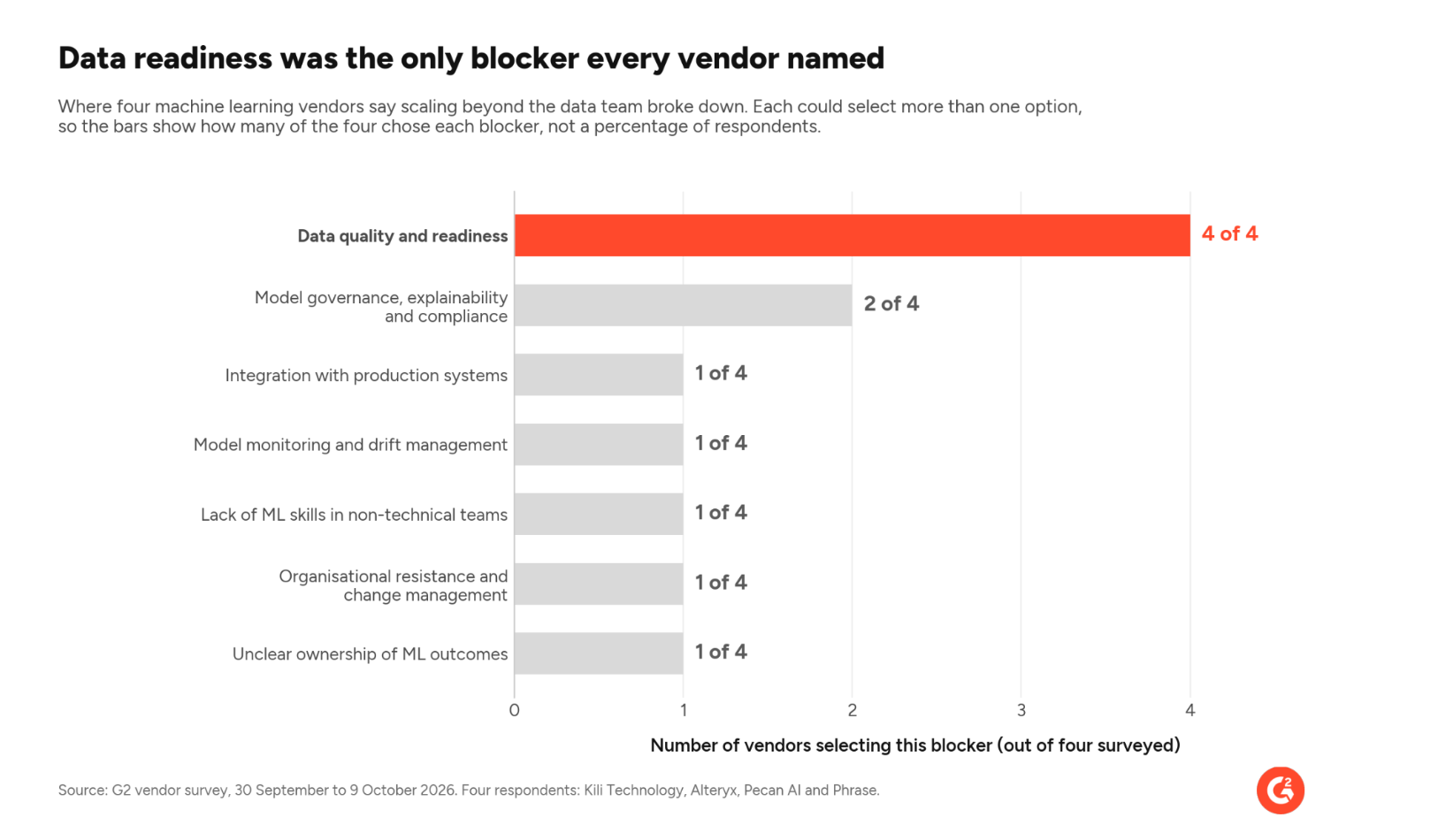
All four vendors concur that data quality and readiness are the biggest difficulties when scaling ML beyond data teams. Additionally, three of the four vendors note that measuring or attributing ROI directly to machine learning remains challenging, with an average rating of 3.75 out of 5 for demonstrating clear business impact.
Transition from Experimentation to Execution
Machine learning tools have moved from experimental stages to solid execution. Verified buyers rate G2’s Machine Learning platforms an average of 4.46 out of 5, with a particular strength in meeting requirements. Setup ease scores slightly lower at 8.58 out of 10. The growth in reviews confirms rising adoption, with over 660 reviews submitted in just the first ten months of 2026.
This trend is consistent across enterprise-level users, who rate the platforms even higher in meeting requirements (9.05 out of 10). Related categories, such as Predictive Analytics and MLOps platforms, have similarly high average ratings, indicating robust performance and satisfaction across machine learning solutions.
Challenges in Scaling Machine Learning
The unanimous challenge across top vendors is data quality and readiness when extending machine learning beyond data teams. Three vendors reported that ROI is difficult to measure or attribute specifically to ML initiatives, and data quality often falls short of vendor promises.
Expert Insights on Scaling ML
Mathieu Azar, CEO of Kili Technology, advises, “Build your evaluation layer before adding more models, and assign a business owner accountable for it. Execution is primarily a data problem, not a modeling problem.”
Ben Canning, Chief Product Officer at Alteryx, adds, “The model was never the bottleneck. ML stalls in execution because the necessary business
TL;DR: What you need to know about machine learning in 2026
Machine learning becomes a core business strategy at the point where the business owns the outcome rather than the model. Organisations that have scaled it agreed what a good result looks like before deployment and put a named business owner in front of model output. What stops the rest is data readiness, not model capability.
According to G2’s analysis of 890+ verified machine learning reviews, buyers rate these tools highest on meeting requirements, at 8.89 out of 10. Yet all four vendors surveyed, all at the top of the maturity curve, name data readiness as where scaling still breaks.
Machine learning review volume reached an all-time high in 2026: 660+ verified reviews submitted by 27 October, against 250+ across the whole of 2025.
All four vendors selected data quality and readiness as where their organisations struggled most with scaling ML beyond the data team.
Three of four vendors said ROI was hard to attribute to ML specifically, and the four averaged 3.75 out of 5 on demonstrating attributable business impact.
Machine learning has moved from experimentation to execution on the tooling side. In 2026, data readiness stops organizations from scaling machine learning, not model capability. According to G2’s analysis of 890+ verified Machine Learning reviews, buyers score these platforms highest on meeting requirements, at 8.89 out of 10, and submitted more reviews in the first ten months of 2026 than in any full year before it. The four vendors G2 surveyed reached the same conclusion from the other side: asked where scaling still breaks down, all four named the data, and none of them named the model.
All four vendors are past the question of whether machine learning works. They place their own organizations at the scaling or optimizing end of the maturity curve, and three of the four run agentic ML in production today.
Methodology: How I evaluated machine learning platforms in 2026
G2 Review Data:
- Reviews analysed: 890+ | Period: 1 August 2024 to 19 August 2026 | Category: Machine Learning
Vendor Research
This report combines G2’s proprietary review data with structured input from 4 leading Machine Learning vendors. Vendor insights are clearly attributed throughout and represent platform-level observations.
Has machine learning actually moved from experimentation to execution?
It has definitely moved to execution from experimentation on the tooling side. Verified buyers give G2’s Machine Learning category an average rating of 4.46 across 890+ reviews, and score it highest on Meets Requirements at 8.89 out of 10. Ease of Setup is the weakest of the widely answered attributes at 8.58, a gap of 0.31. Volume also says that 660+ reviews were submitted in the first ten months of 2026, more than any complete year on record.
The pattern holds at enterprise scale. The 211 enterprise reviewers in the set score Meets Requirements at 9.05 out of 10, the highest of any segment. It holds across the wider family too: Average ratings sit in a narrow band, from 4.40 for Predictive Analytics to 4.59 for Machine Learning Operations (MLOps) Platforms, so this is not one category flattering itself.
What are the biggest challenges to scaling machine learning in 2026?
Asked where scaling ML beyond the data team broke down, all four selected data quality and readiness. Three of the four also reported that ROI was difficult to measure or attribute to ML specifically, and three said data quality turned out worse than vendors had promised.
“My advice for 2026: build your evaluation layer before adding more models, and make a
business owner accountable for it. Execution is a data problem long before it is a
modeling problem.”Mathieu Azar
CEO, Kili Technology
“The model was never the bottleneck. ML stalls at execution because the logic an agent
needs — how this company actually reconciles, allocates and approves — lives in
spreadsheets and in people’s heads, not anywhere a system can call..”Ben Canning
Chief Product Officer, Alteryx
What has actually worked in getting machine learning beyond the data science team?
Every vendor named the same shift: organisational change matters more than tooling. They described the same move of putting a named business owner in front of model output instead of routing every question back to data science.
“The biggest change has been organizational: giving a business owner responsibility for
output quality, backed by a simple feedback loop, did more for adoption than any model
upgrade.”Mathieu Azar
CEO, Kili Technology
Pecan AI frames it as a translation problem. “Nothing shuts down a CMO or Director of Supply Chain like showing them AUPRC, WMAPE, R^2 and the likes,” says Asaf Katz, Head of AI Deployment. Phrase paired a self-service platform with “a company-wide AI fluency program that covers what the tools can do and, just as importantly, where and how to apply human judgment.”
What does measurable machine learning impact actually look like?
The impact is specific, operational, and owned by the business. Pecan AI described a European luxury watch retailer whose model ranks its customer base weekly: “This increased repurchase rates by 3x and adds 200-400K $ revenue monthly.” Alteryx reported that “the same agent called a governing Alteryx workflow used 93% fewer tokens, ran 85% faster and made 12x fewer errors than when reasoning over the raw data on its own.”
Kili Technology cited a healthtech company whose “teams launched around 100 use cases, cut data delivery time by 30% and put three models into production.” Phrase reported a manufacturer where “the workflow delivered estimated savings near 80% against a 20% target, with output in under two minutes against a vendor turnaround of two working days.”
In every case, the business agreed in advance on what a good outcome was and then measured against it.
“The organizations that reach real execution accept that trade-off early and agree on when a prediction is trusted enough to act on. They also measure ML by the decisions it improves.”
Zohar Bronfman
CEO and Founder, Pecan AI
“My advice to leaders is to define what good looks like for your customers, then build evaluation around those expectations. Off-the-shelf metrics alone will not give you the full picture you need.”
Craig Stewart
Director of AI Research, Phrase
Key Shifts in Enterprise Adoption
Three shifts run through the review data. The vendors are now moving from piloting to optimising and scaling, with none still experimenting. Execution is moving to agents, with three of the vendors already running agentic ML in production and the same three ranking it the trend most likely to define the market by 2028. And consolidation is beginning, with two of four actively working toward a single platform for all machine learning use cases, while the rest still prefer specialised tools for different teams.
Frequently asked questions (FAQS) about machine learning in 2026
Q1. Is machine learning still experimental in 2026?
Not on the tooling side. G2 data shows verified buyers rate Machine Learning platforms 4.46 out of 5 and score them highest on meeting requirements. What remains experimental is
organizational: agreeing what a good outcome is and who owns it.
Q2. What is the biggest blocker to scaling ML beyond the data science team?
Data readiness. All four vendors G2 surveyed selected data quality and readiness, the only unanimous answer. None of them named model capability.
Q3. Can business teams build and run ML without data scientists?
Partly. The four averaged 4.0 out of 5 on enabling non-technical users, but in every description
data science kept oversight of evaluation criteria, guardrails, and monitoring.
Q4. How do you choose the right machine learning platform for your team?
Start with the use case, not the platform. G2 data shows buyers score Machine Learning platforms highest on meeting requirements, so raw capability is rarely what separates options. The vendors surveyed advise checking first whether the problem needs machine learning at all, since descriptive analytics answers many of them more cheaply, then confirming the platform lets the people who own the outcome define and test what a good result looks like. Here is in detail, the 8 best machine learning tools as per G2.
Q5.What ROI timeline should teams expect from enterprise machine learning?
This research does not support a single timeline, and the harder problem is attribution rather than speed. Three of the four vendors said ROI was difficult to attribute to machine learning specifically, and they averaged 3.75 out of 5 on how clearly they can demonstrate attributable business impact. The returns they could evidence, from a 30% cut in data delivery time to a tripling of repurchase rates, came from agreeing success criteria before deployment rather than measuring afterwards.
Execution is an agreement problem, not a modeling problem
G2’s analysis of 900+ reviews shows buyers rate these platforms highest on meeting requirements, and the four vendors surveyed agree the model no longer separates a pilot from production. What separates them is whether the business has agreed in advance what a good outcome looks like and who owns it.
Teams starting that conversation can see how verified buyers rate the platforms they are considering, and how other organisations have approached the same shift.
Explore the top-rated Machine Learning software on G2










Post Comment