Unlock the Future of Ecommerce: 8 Game-Changing SEO Secrets Powered by AI
Ever wondered where today’s savvy shoppers are hunting for their next purchase? Spoiler alert: it’s not just Google anymore. They’re chatting up ChatGPT, probing Google AI Mode, and picking Perplexity’s brain for recommendations—all before they even glance at a product page. This seismic shift has cranked ecommerce SEO from a “nice-to-have” to a “must-master.” If your product and category pages aren’t dancing at the front of the AI and search engine stage, trust me, your competitors are stealing the spotlight. So how do you stay front and center in this noisy digital bazaar? I’m about to break down eight crucial steps that’ll supercharge your ecommerce SEO—from architecting your site’s blueprint and digging into keyword and prompt research to tuning up AI visibility and slicing through performance data like a pro. Buckle up, and don’t forget to grab our free ecommerce SEO checklist to keep your progress on the rails. LEARN MORE.
Shoppers now find products in more places than Google. They ask ChatGPT, Google AI Mode, and Perplexity for recommendations, compare options across sites, and read reviews before they buy.
That raises the bar for ecommerce SEO. Your product and category pages need to be easy for search engines and AI platforms to find, understand, and trust. Otherwise, shoppers will see your competitors instead.
Below, I’ll walk you through eight steps to improve your ecommerce SEO, from site architecture and keyword research to AI search visibility and performance tracking.
Download our free ecommerce SEO checklist to track your progress as you work through this guide.
What is ecommerce SEO?
Ecommerce SEO is the process of improving your online store so its product pages, category pages, and supporting content show up in search engines and AI platforms. It helps you reach shoppers who are actively looking for what you sell, without paying for ads.
It covers the same core work as SEO for any site, including site structure, keyword research, on-page optimization, technical health, and authority building. The difference is that the work centers on the pages that drive sales.
1. Organize your site architecture
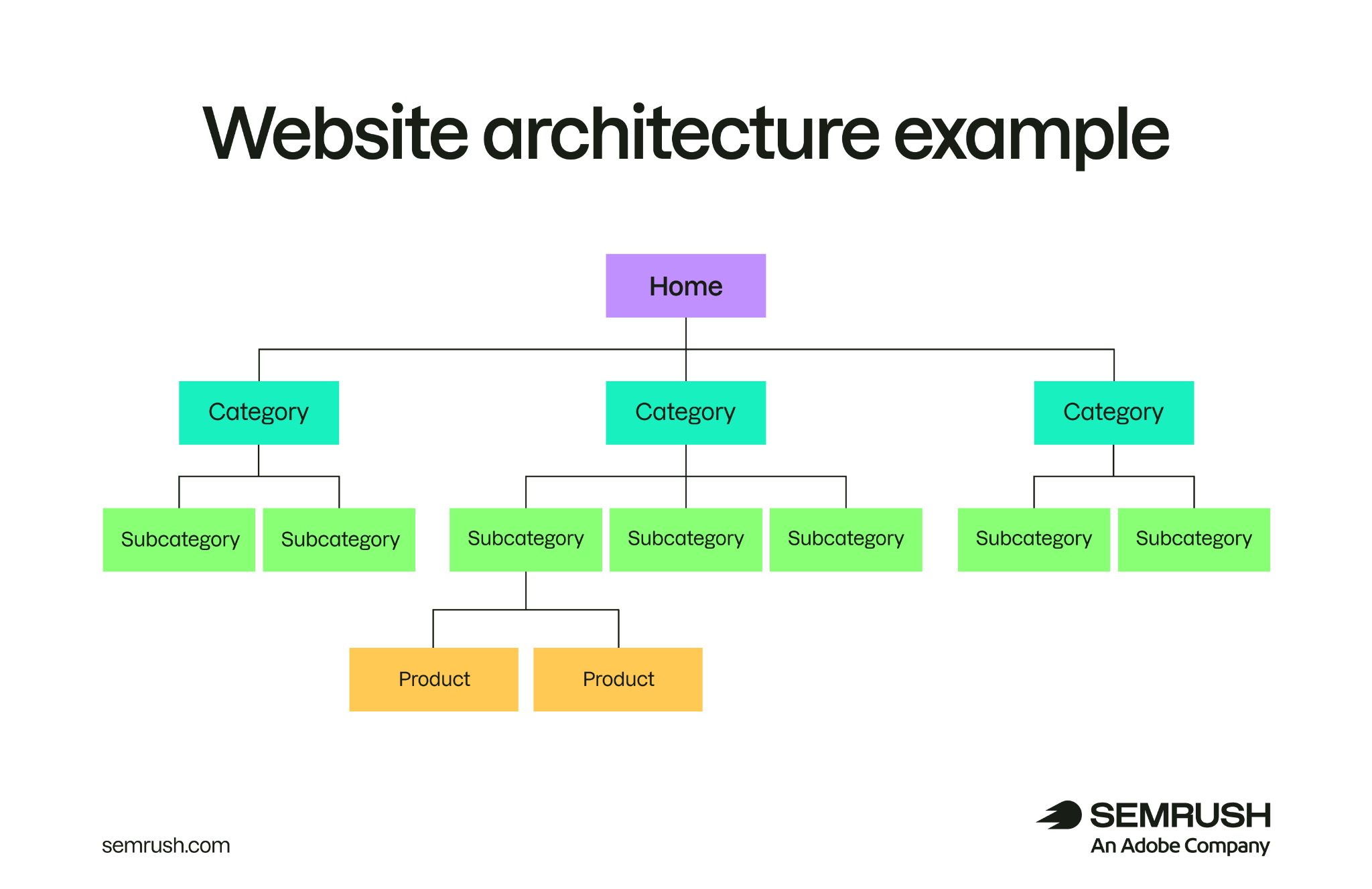
A clear site architecture helps shoppers and search engines reach your most important pages quickly and understand how your store is structured. For most ecommerce sites, that means keeping the hierarchy simple.

If your store has many categories and requires a deeper hierarchy, that’s fine. But keep the structure organized, keep important pages within a few clicks of the homepage, and avoid orphan pages (pages with no internal links pointing to them). A flatter structure makes key pages easier to discover and crawl.
Your navigation should reinforce this structure. Use clear category labels, menu paths, and internal links so shoppers can move from broad product groups to subcategories and product pages quickly and without guesswork.
Name your categories the way your customers actually search.
The category names you choose also influence how search engines and AI platforms understand your store. For instance, “Automatic Cat Feeders” signals the topic clearly, whereas “Smart Feeding Solutions” doesn’t.
Pet tech brand Petlibro, which we’ll use as a running example in this guide, has a clean structure. From the homepage, shoppers can easily see product categories like Litter Box, Feeders, and Fountains, and then quickly move into specific products.

You can check whether your structure works as cleanly in practice with Semrush’s Site Audit tool. It can help you find orphan pages, internal linking issues, and pages that may be sitting too deep in the site.
Open the tool, enter your domain, and complete the configuration. Then, click “Start audit.”
Once the report is ready, go to the “Issues” tab to review the errors and warnings affecting your store’s structure. Search “orphan,” “internal links,” and “crawl depth” to find specific issues. Click “How to fix” to learn more about the issue and the steps to resolve it.

Further reading: What Is Website Architecture? (& How to Improve it for SEO)
2. Perform keyword and prompt research
Keyword and prompt research shows what shoppers search for, how they compare options, and how they ask for recommendations before buying. Start your research with the terms tied to what you sell.
Keywords with commercial and transactional intent matter most for your product and category pages. A commercial intent keyword could be “best automatic cat feeder for multiple cats.” A transactional intent keyword could be “buy automatic cat feeder online.” Both signal a shopper is much closer to a purchase than someone searching “how do automatic cat feeders work.”
Informational keywords are important too. They can help shoppers find your store while they’re still researching what to buy. I’ll cover how to use them in step 4.
You can pull keyword ideas from Google and Amazon autocomplete. Type your product (e.g., cat feeder) into either search bar and look at the suggestions. These reflect searches shoppers are already making.
The “People also search for” section at the bottom of the Google results page is useful, too.
For more keyword ideas and to validate search volumes and difficulty scores, use Semrush’s Keyword Magic Tool. Enter a seed term and your domain to see a list of keyword ideas.
Use the “Intent” filter to narrow down to “Commercial” and “Transactional” keywords. And check personal keyword difficulty (“PKD %”), which shows how realistic it is for your specific domain to rank for each keyword. If your store is newer, use the “Personal KD %” filter to focus on keywords under 30% to start.

Shoppers increasingly use AI platforms to research products, and the way they phrase things there is different.
Someone might type “automatic cat feeder” into Google, then open ChatGPT and ask: “What’s the best automatic cat feeder for two cats?” Same product need, but the prompt reveals far more about what the shopper actually wants.
Semrush’s Prompt Research tool helps you find the exact prompts shoppers are using on AI platforms. Enter a topic or product category (e.g., cat feeder), and it returns real prompts and helpful data around them, including the AI response, brand mentions, and cited sources.

Focus on prompts that sound like someone comparing options or making a decision. Those are the buying conversations your store needs to show up in. Use the intent breakdown to zero in on topics with commercial or transactional intent.
By the end, you’ll have a list of keywords and prompts that reflect both how shoppers search in Google and how they ask for recommendations on AI platforms. Use it to decide which pages to optimize, where you need new pages, and what content to create, so your store has a better chance of showing up throughout the buying journey.
Further reading:
3. Optimize your product and category pages
Strong product and category pages help shoppers understand what you sell and decide what to do next. They also give search engines and AI platforms clearer product information to interpret, surface, and cite.
Use the keyword and prompt research from the previous step to guide what goes on these pages.
- URL: Keep it short, descriptive, and keyword-inclusive, with hyphens separating words
- Title tag: Include your primary keyword and keep it under 60 characters
- Meta description: Summarize the page and give shoppers a reason to click, in about 135 characters or fewer. Naturally include relevant keywords where they fit.
- Headings: Match your H1 to your primary keyword. Use H2s and H3s for variations, comparisons, and question-style phrasing from your prompt research.
For category pages, focus on clarity, browseability, and context. Keep filters, sorting, and paths to products easy to use.
Also, add descriptive content at the bottom of the page. It gives search engines more text to index on pages that are otherwise mostly product listings, and a natural place to work in secondary keywords and answer the questions shoppers ask when narrowing down options.
I didn’t find this on Petlibro’s category pages, but its competitor PetSafe does it well.

For product pages, write detailed, keyword-optimized product descriptions, include specifications, add an FAQ section, and consider a customer review section.
PetSafe’s product pages are a great example. They include detailed product descriptions, FAQs, specifications, product comparison sections, and often videos.
Their review section stands out, too. Customers have left detailed, specific reviews that add unique language search engines can index and give AI platforms additional signals about who the product is for and whether shoppers trust it.

Product information also needs to stay consistent beyond the page itself. Your product title, description, images, specs, price, and availability should match across your site, your Google Merchant Center feed, and any marketplace listings like Amazon.
Google uses Merchant Center product data to match products to relevant queries, and eligible free listings can appear across Google surfaces like Search, Images, Lens, YouTube, Gemini, and the Shopping tab. If your product page says one thing and your Shopping feed says another, Google and AI systems have more ambiguity to work through.
Semrush’s On Page SEO Checker can help you find page-level improvements. It compares your page against top-ranking competitors and surfaces actionable ideas around content, keyword usage, semantics, backlinks, readability, and technical issues.
Open the tool, enter your domain, set up your pages and keywords, and complete the configuration.
Then, go to the “Optimization Ideas” tab and click “# ideas” next to each page.

Go through the suggestions by category and prioritize the ideas that improve page clarity, keyword alignment, and content depth first.

Our free ecommerce SEO checklist breaks the work into clear steps you can apply across your store.
4. Create content that supports the full buying journey
Create content that helps shoppers compare options, answer questions, and move closer to buying.
A person may begin with a problem, move into category research, compare a few options, and only then decide which product to buy. Supporting content helps your store stay visible across more of that journey.
The keyword and prompt research from step 2 showed you how shoppers search before they buy.
- Some of those searches belong on product pages (e.g., “Granary Smart Feeder”)
- Some belong on category pages (e.g., “automatic cat feeders”)
- But many of the questions, comparisons, and use cases shoppers care about need their own content (e.g., “best automatic cat feeder for two cats” or “automatic vs. gravity cat feeder”)
That last group is where supporting content lives. AI platforms may also use these guides and comparisons to recommend products. You want to create three types:
- Buying guides: Help shoppers understand a category and what to look for before choosing a product
- Comparison content: Help shoppers weigh product types, features, or brands when narrowing down options
- Best-of listicles: Help decision-stage shoppers compare shortlists built around specific needs or use cases
To find topics worth creating, go back to your keyword and prompt research and look for phrases or questions with informational intent. In Keyword Magic Tool, use the “Questions” filter and set the “Intent” filter to “Informational” to focus on them.

Then, widen your view to find where real buying questions come up:
- Talk to your sales or support teams
- Read product reviews
- Check Reddit threads and customer forums
Semrush’s Topic Research tool can also help. Enter a topic like “cat feeder,” and it surfaces related subtopics and recurring search questions, giving you a list of content ideas grounded in actual search demand.
Once you have a list of topics, sort them by where they fit in the buying journey. That gives your store more chances to show up before the final product search.
Further reading: The Ultimate Guide to Creating a Content Marketing Strategy
5. Manage your technical SEO
Strong technical SEO helps search engines crawl, index, and interpret your pages properly. Even strong product and category pages can struggle if technical issues make them slow, hard to crawl, or difficult to understand.
Here are the basics to focus on first:
- HTTPS: Use a secure connection across your store
- Mobile-first: Make sure your product and category pages work cleanly on smaller screens
- Page speed and Core Web Vitals: Keep pages fast and stable, especially image-heavy product pages
- XML sitemap: Submit it to Google Search Console so important pages are easier to discover
- Noindex: Exclude cart pages, login pages, and other low-value URLs from search
- Product schema: Mark up product details (like price, availability, and reviews) so search engines and AI platforms can understand and display them accurately
- Canonicals: Use canonical tags where needed to prevent duplicate or competing versions of the same page
A good place to start is PageSpeed Insights. Run it on your key product and category pages to check load speed and Core Web Vitals. This gives you a quick page-level view of what is slowing a page down, whether it passes Core Web Vitals, and which issues need attention first.
For instance, this Petlibro product page passes the Core Web Vitals test.

The limitation is that PageSpeed Insights only analyzes one page at a time. For a complete picture across your entire store, use Semrush’s Site Audit.
In the “Overview” report, you can quickly assess your site’s overall health and review thematic reports for areas like crawlability, internal linking, markup, site performance, and Core Web Vitals. You’ll also see the AI Search Health widget, which helps you understand how technically ready your site is for AI-driven visibility.

Go to the “Issues” tab to review the errors and warnings across your store. Address errors first, then warnings. Each issue includes an explanation of what it affects and how to fix it.
If you’d like a structured way to work through the technical fundamentals and the rest of this guide, download our free ecommerce SEO checklist.
AI agents are also moving beyond product recommendations and into purchase flows. Protocols like Google’s Universal Commerce Protocol (UCP) and OpenAI’s Agentic Commerce Protocol (ACP) help agents browse catalogs, check product details, and complete transactions more directly. Google’s UCP-powered checkout runs through Merchant Center, which is another reason clean product data, structured markup, and crawlable product pages matter.
6. Build authority beyond your own website
Authority beyond your own website helps search engines and AI systems understand which brands are credible, discussed, and worth mentioning.
Backlinks remain one of the most important search ranking factors. But unlinked mentions also matter more now, especially in AI search.
For instance, getting mentioned on Reddit, LinkedIn, and YouTube can strengthen your visibility. These platforms are among the most-cited sources in ChatGPT Search, Google AI Mode, and Perplexity, according to a Semrush study of 325,000 prompts.
But your SEO team can’t build this kind of visibility alone. It needs to be a cross-team effort, with product, community management, social, and PR teams all playing a role.
Start with the content and channels you can influence more directly:
- Social media: Work with your social team to publish useful product education, comparisons, and answers to recurring customer questions
- YouTube: Publish demos, explainers, and side-by-side comparisons that help shoppers evaluate options
- Community: Work with community managers to identify recurring discussions and contribute useful answers where buyers already ask for recommendations
- Guest content: Contribute useful articles or expert commentary to relevant publications and partner sites in your category
Petlibro, for instance, regularly publishes product-related YouTube videos, which gives search engines and AI systems more product-focused material to surface when people are researching options.
Keep the way you describe your brand, products, and differentiators consistent across channels. If your positioning changes from your website to YouTube to LinkedIn to guest content, it becomes harder for both people and machines to understand what your brand stands for.
Then focus on the visibility you can’t fully control but can still influence:
- Community threads: Pay attention to recommendation and comparison discussions on Reddit, forums, and niche communities
- Roundups and comparisons: Work with PR or product marketing teams to earn inclusion in “best” lists, category roundups, and comparison posts
- Third-party reviews and feedback: Encourage detailed reviews on trusted platforms where shoppers already look for validation
Petlibro shows up in roundups on major publications like Wired. That kind of third-party validation can strengthen both search authority and AI visibility.

The goal isn’t to be everywhere. It’s to show up consistently in the places that influence how people and AI systems discover, compare, and trust products in your category.
You can use Semrush’s Brand Monitoring app to see where your brand is being mentioned across the web, including news, blogs, discussions, and social media. For each mention, you can see whether it includes a backlink to your site, the sentiment, and the estimated reach, so you know which ones are worth following up on.

Further reading:
7. Extend your SEO work for AI search visibility
SEO is still the foundation, but AI search adds another layer because AI platforms work differently from search engines. Search engines rank full pages. AI platforms often retrieve information from multiple sources, extract the most relevant passages, and synthesize them into a single answer.

That means your product pages, category pages, and supporting content need to do more than rank. They need to be clear enough to retrieve, specific enough to quote, and grounded enough to cite.
Here are a few practical ways to improve that:
- Lead with the answer: Open key sections with a direct response to the question implied by the heading (at Semrush, we call this bottom line up front, or BLUF)
- Use descriptive headings: Write H2s and H3s that reflect how shoppers actually ask questions and compare options
- Keep passages self-contained: A short section that makes one clear point is easier to interpret than a long section doing several jobs at once
- Use structured formats: Comparison tables, bullet lists, and short FAQs can make product information easier to follow and extract
- Ground your claims: Support important statements with clear product details, reviews, specifications, and other verifiable context
Formatting is only part of the picture, though. Another tactic is LLM seeding, which means publishing content in the formats and places AI systems are more likely to find, understand, and cite. For ecommerce, that includes product review sites, “best product” roundups, YouTube unboxings and comparisons, marketplace reviews, and shopping community discussions.
A few other AI search visibility tactics:
- Semantic HTML: Use clean heading structure, lists, tables, and other HTML elements that make content easier to interpret
- Original data and studies: Publish category research, product comparisons, pricing data, or customer trend insights that give AI systems something distinctive to reference and cite
A good place to start is Semrush’s AI Visibility Toolkit.
The Brand Performance reports give you a detailed view of how your brand appears across individual AI platforms, how your Share of Voice and sentiment compare against competitors, and which narrative drivers are shaping how AI systems describe your brand and products.

At the end of the report, you’ll find “AI Strategic Opportunities,” which are specific, prioritized recommendations for improving your AI search visibility based on your actual data.

Further reading:
8. Track performance across search and AI
Performance tracking across search and AI shows which pages, queries, and prompts are helping shoppers move toward purchase. For your ecommerce store, I’d start with the metrics closest to revenue:
- Visibility for commercial and transactional queries
- Visibility for buying-intent prompts in AI search
- Organic traffic to product and category pages
- Add-to-cart actions
- Purchases and revenue
Use Google Search Console (GSC) to see which search queries are putting your pages in front of shoppers, and which product, category, or content pages are earning the clicks.
Then use Google Analytics 4 (GA4) to see what those visitors do once they land on your site, whether they keep browsing, add a product to cart, complete a purchase, or leave. You’ll need GA4 ecommerce tracking set up properly to measure these actions. Check out our Google Analytics 4 events guide to learn how.
If you want tighter tracking for a fixed set of important keywords, use Semrush’s Position Tracking tool. It lets you see how your rankings change over time in Google and Bing, and check whether performance looks different by country, city, device, language, or keyword group.
You can also use Position Tracking to monitor visibility for the prompts you care about on AI search platforms like ChatGPT, Google AI Mode, and Gemini.

Further reading: How to Perform SEO Analytics: A 3-Step Guide to Success
Make ecommerce SEO work across search and AI
The way shoppers discover products has expanded. Search engines are still central, but AI platforms are now part of how buying decisions get made.
The good news is that a strong SEO foundation works across both. Get it right and it works harder for you than it ever did before.
Download our free ecommerce SEO checklist to check your foundation, find weak points, and take action.
FAQs
Why is SEO important for ecommerce websites?
SEO is important for ecommerce websites because it helps shoppers find your products through search engines and AI platforms, supports product discovery earlier in the buying journey, and can drive more qualified traffic and sales over time.
How do you improve the SEO of an ecommerce website?
Improving ecommerce SEO starts with identifying where your store has the biggest gaps. Common areas include thin or duplicate product descriptions, slow page speeds, weak site architecture, and limited off-site authority. Fixing these systematically, while tracking rankings and organic revenue, is how you see results over time.










Post Comment