Low-Code ML Platforms in 2026: Are They Fulfilling the No-Code Promise?
Key Findings
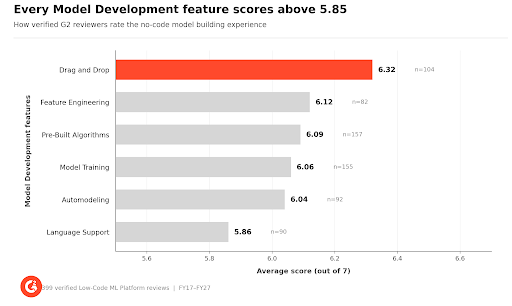
- The build experience has advanced significantly. Analysis of 399 verified Low-Code Machine Learning Platform reviews on G2 reveals that no-code model building is now the top-rated capability in this category. All Model Development features scored above 5.85 out of 7, with Drag and Drop leading at 6.32.
- Buyers value access over specific features. Terms like “no-code,” “low-code,” and “drag-and-drop” each received over 90% positive sentiment.
- Pricing continues to be a major challenge.
- The primary reviewer profile has shifted from data scientists to non-technical users, addressing a skills gap.
No-code model building enables users to create, train, and prepare machine learning models through graphical interfaces without any coding. Within G2’s Low-Code Machine Learning Platforms category, no-code modeling is offered alongside capabilities such as Drag and Drop, Model Training, Pre-Built Algorithms, Feature Engineering, and Automodeling. Originally, machine learning tools were designed by and for coders; no-code solutions break this cycle by opening access to non-programmers.
This capability is increasingly important because the profile of users building models has evolved. From 399 verified reviews spanning 2016 to 2026—more than half submitted in the last two years—127 reviewers are utilizing these platforms to build ML models, 81 to eliminate manual tasks, and 66 to automate processes.
G2’s data identifies two main buyer groups: data scientists looking to simplify and accelerate existing workflows, and non-technical users aiming to close skill gaps and contribute to model development without specialized coding knowledge. Today, the typical user is no longer the data scientist but business analysts, operational managers, and domain experts who possess the data and questions but lack coding expertise.
Research Methodology
This analysis is based on 399 verified G2 reviews of products in the Low-Code Machine Learning Platforms category, submitted from 2016 to 2026. Feature scores are rated on G2’s 1 to 7 scale. Keyword sentiment is determined by mentions within “What do you like best?” and “What do you dislike?” sections of the reviews. Percentages cited are calculated from the total keyword mentions.
No-Code Model Building Excellence within Low-Code ML Platforms
No-code model building outperforms other capabilities in the category, with every Model Development feature scoring above 5.85 out of 7 across 399 verified reviews. Low-code ML platforms cover end-to-end workflows, from
Key Findings
- The build experience has matured. G2’s analysis of 399 verified Low-Code Machine Learning Platform reviews shows no-code model building is now the highest-rated capability in the category. All Model Development feature scores above 5.85 out of 7. Drag and Drop leads at 6.32.
- Buyers praise access over features. “No-code,” “low-code,” and “drag-and-drop” each drew 90%+ positive sentiment.
- Pricing remains a key challenge.
- The dominant reviewer voice has shifted from the data scientist to the non-technical user, filling a skill gap.
No-code model building is a graphical way to create, train, and prepare a machine learning model without writing any code. Inside G2’s Low-Code Machine Learning Platforms category, no-code modelling exists alongside features such as Drag and Drop, Model Training, Pre-Built Algorithms, Feature Engineering, and Automodeling. Machine learning was built by people who write code, for people who write code. No-code model building exists to break that loop.
The capability matters now because the person doing the building has changed. In this analysis, we have reviewed 399 verified reviews from 2016 to 2026, and interestingly, more than half of these reviews have landed in the last two years alone. Of those reviewers, 127 are using these platforms to build ML models, 81 to remove manual work, and 66 to automate processes.
G2 review data suggests that two distinct buyer groups are represented in these numbers. One consists of data scientists seeking to accelerate and simplify existing machine learning workflows. The other consists of non-technical users looking to bridge a skills gap and participate in model development without specialized expertise.
The median reviewer is no longer the data scientist. It is the business analyst, the operations manager, and the domain expert who have the data and the question, but not the code.
Research Methodology
This analysis draws on 399 verified G2 reviews of products in the Low-Code Machine Learning Platforms category, submitted between 2016 and 2026. Feature scores reflect ratings on G2’s 1 to 7 scale. Keyword sentiment is measured by where the term physically appears in the review form, specifically inside the “What do you like best?” and “What do you dislike?” responses. All percentages cited are calculated against the total number of mentions for that keyword.
Inside the numbers: Where does no-code model building lead inside Low-Code ML Platforms?
No-code model building leads every other capability G2 measures in this category, with every Model Development feature scoring above 5.85 out of 7 across 399 verified reviews. Low-code ML covers the whole workflow from data prep to deployment.
The build stage is the foundation of this category and the capability it is named after. It is also the area G2 evaluates most directly, using six feature questions within the Model Development section. The chart below shows how 399 verified reviewers assessed this stage.
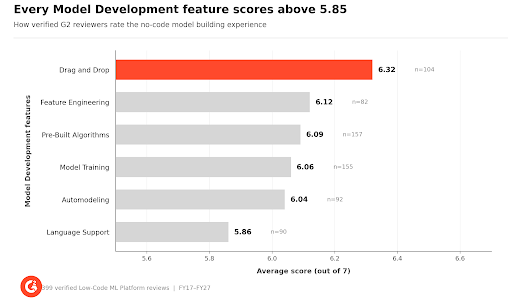
Across 399 verified Low-Code Machine Learning Platform reviews, every Model Development feature earned a score above 5.85 out of 7. On G2’s 7-point scale, ratings above 5.5 are generally considered a strong indicator of customer satisfaction. With every feature comfortably exceeding that threshold, the results suggest that model-building capabilities have matured from an emerging differentiator into a well-established expectation.
What do buyers love most about no-code model building?
Verified buyers don’t celebrate no-code model building because of what it produces. They value it because of who it enables. The language that appears in reviews isn’t the language of marketing copy – words like “accurate, fast, or powerful”. Instead, reviewers focus on accessibility, empowerment, and the ability for more people to participate in the work.
“No-code” shows up in 109 reviews, and 91% of those mentions appear in praise of the platform. “Low-code” shows up in 97 reviews, 93% appearing in praise. “Drag-and-drop” shows up in 39 reviews, also 93% in praise. Three themes closely associated with the model-building experience – usability, templates, and code-free development – appear across 40 reviews, with no corresponding negative mentions.
The reviews themselves make the point clearly. One Dataiku user writes that the platform “lets users of all levels gain experience and confidence.” A Qlik Predict reviewer says the no-code interface “lets users quickly create and test models.” Neither reviewer is describing a feature. They’re describing a shift in who can do the work once the technical burden is removed.
These platforms are not making model-building easier. They are turning the model build into something the user can run on their own, without owning the technical work underneath.
Where does no-code model building still have room to grow?
No-code model building still has room to grow on three fronts: the learning curve, the parts that still ask for code, and the price. Buyers love the build, but they are not silent about the rest. Three recurring themes emerge from the reviews, each reinforcing the others.
The first is the learning curve. The phrase surfaces in 45 reviews, and 40 of them land it inside the “What do you dislike?” response. Yet the context of those comments is revealing. Reviewers use the phrase to describe the initial ramp-up period rather than the experience of building models itself. The pattern is remarkably consistent: the learning curve reflects the effort required to get started, not ongoing friction once users are inside the platform.
The second is code. 138 reviewers mention coding, Python, or programming in a category built on the absence of it. The pattern is the same as the learning curve: the mentions concentrate on “What do you dislike?” and “What problems are you solving?” The no-code surface covers most of the build, not all of it.
The third is price. If there is a weak spot in the category, it is pricing. The theme appears in 71 reviews as a complaint and only once as praise, making it the most one-sided signal in the dataset. Buyers are generally convinced by the product experience. The cost of that experience is where doubts begin to emerge.
Two of these are the same problem in different shapes. The interface took away the syntax, but not the time it takes to learn the tool. The canvas took care of most of the build, but the more complicated work still needs to be done by someone who can code. Both are places where no-code cannot fully take the work off the user. Price is its own pattern. Buyers are not pushing back on what these platforms do. They are pushing back on what the platforms charge to do it.
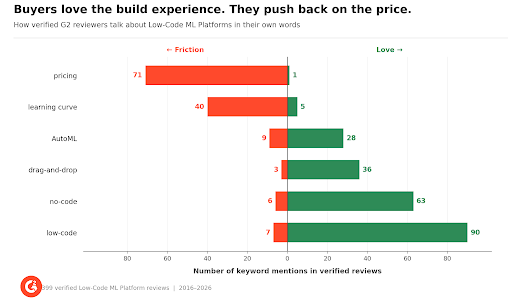
For buyers evaluating Low-Code Machine Learning Platforms in 2026, the core question is no longer whether they can build models. The evidence suggests they can. The more important considerations are how easily teams can get there, where the platforms’ limitations begin to surface, and whether the value delivered justifies the cost.
What does this mean for low-code ML buyers in 2026?
Two things are true. First, the build experience inside low-code ML has crossed into maturity, but the workflow around it has not. Second, the challenges buyers face have shifted beyond the build itself.
The conversation in the reviews has shifted. Buyers used to ask whether no-code worked at all. Now, the conversation has moved to what surrounds the build: how much the platforms cost, how long they take to learn, and where the no-code experience begins to give way to more technical work.
What used to make a low-code ML platform stand out was whether the build actually worked without code, which we see happening. The question for the next two years is a different one. Buyers are no longer comparing platforms on what they can build. The next phase of competition is already taking shape around onboarding, workflow boundaries, and pricing. Those are the questions buyers are asking now, and those are the areas where vendors will increasingly need to differentiate.
Read 32 low-code development statistics every buyer should know on G2.