Discover the Unexpected Sprinklr Rivals Set to Dominate 2026—Are You Ready?
Ever felt like you’re trying to manage a bustling social media empire but your tools feel more like a tangled web than a helping hand? That’s the exact crossroads many enterprises face with Sprinklr—powerful, yes, but also notoriously complex, pricey, and slow to roll out. Does your team really need a social media platform that feels like assembling IKEA furniture without instructions, or is there a smarter, faster, more budget-friendly way to conquer the digital landscape? As the social media management world evolves, alternatives are stepping into the spotlight, promising not just features but real usability, speed, and tailored solutions for various team needs—from deep listening and customer care to straightforward publishing. Whether you’re hunting for an all-in-one giant or a sleek specialist, understanding these options could be the game-changer your social strategy has been begging for. Ready to cut through the noise and find the perfect fit for your team’s flavor? LEARN MORE.
Table of Contents
Key takeaways
- Sprinklr is a powerful enterprise platform, but its cost, complexity, and long implementation timelines push many teams to evaluate alternatives.
- Hootsuite Social OS is the strongest Sprinklr alternative for enterprise teams that want intelligence and execution in one governed system.
- The best Sprinklr competitor for your team depends on your use case: full-suite enterprise management, social listening, mid-market publishing, or CRM integration.
- Pricing ranges from free plans (Buffer) to six-figure enterprise contracts (Sprinklr, HubSpot), so matching your budget to the features you actually use matters more than feature count.
What is Sprinklr?
Sprinklr is a unified customer experience management platform that combines social media management with marketing, advertising, customer care, and research in a single system. It is built for large organizations that want to run many brands, regions, and teams from one place.
The platform’s core modules cover publishing and scheduling, social listening, paid social and advertising, agent-based customer care, and analytics. Sprinklr also layers AI across those modules for things like sentiment detection, routing, and reporting.
That breadth is the main reason enterprise buyers shortlist it. It is also the main reason they look elsewhere. Sprinklr does not publish standard pricing, sells through an enterprise sales process, and typically requires a modular contract plus implementation support. Teams that only need social publishing, listening, and care often end up paying for a far larger social media management platform than they use.
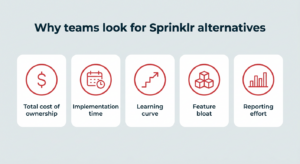
Why do teams look for Sprinklr alternatives in 2026?
Most teams searching for Sprinklr alternatives are not unhappy with what the platform can do. They are unhappy with what it costs to get there, and according to Forrester, 81% of B2C marketing executives planned to evaluate their social suite heading into 2025. Here are the reasons that come up most often in vendor evaluations and review sites like G2 and Gartner Peer Insights.
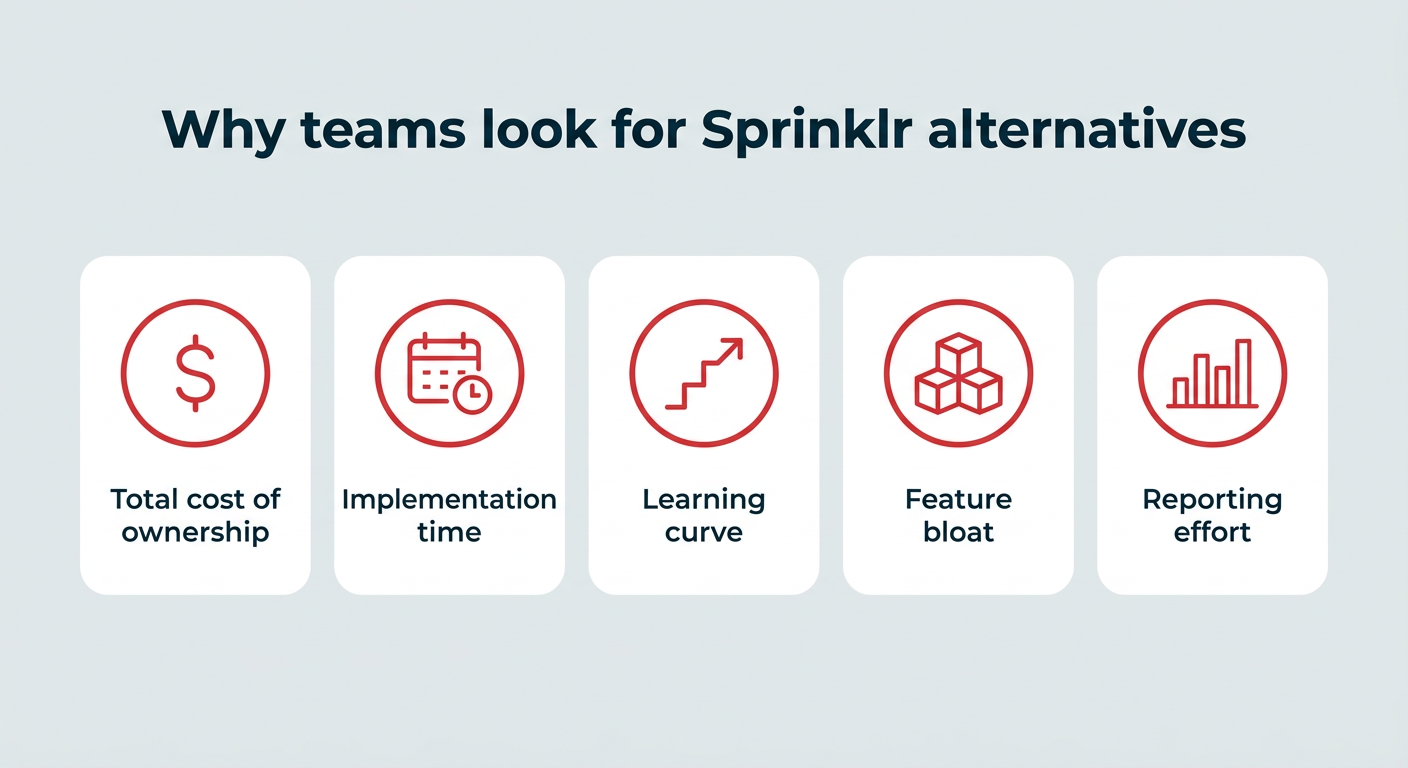
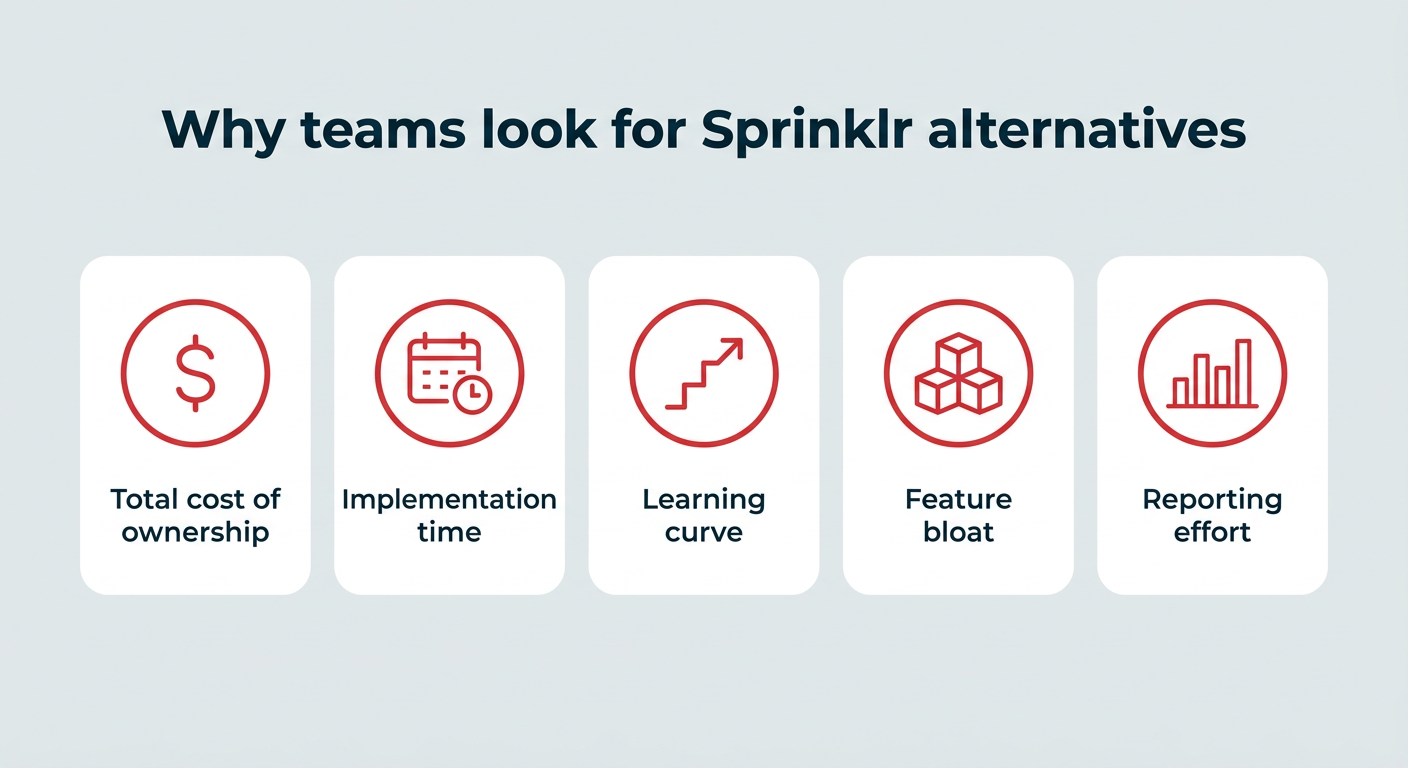
- Total cost of ownership: Sprinklr pricing is modular and custom-quoted, so costs climb quickly once you add care, listening, and advertising seats on top of social publishing.
- Implementation time: Enterprise rollouts commonly run several months and need dedicated internal resources, which delays time to value.
- Learning curve: Reviewers regularly flag the interface as difficult for occasional users, which limits adoption outside the core social team.
- Feature bloat: Teams that need publishing, listening, and inbox management often pay for CXM capabilities they never switch on.
- Reporting effort: Building the dashboards leadership wants can take configuration work or vendor support, which makes proving ROI slower than it should be.
If any of those sound familiar, the good news is that several platforms now offer enterprise-scale social operations with faster implementation and far less overhead.
Quick comparison of the top Sprinklr competitors
Tool | Best for | Starting price | Key differentiator |
|---|---|---|---|
Hootsuite | Enterprise and mid-market social operations | $99/user/month | Listening, publishing, care, and governance in one social operating system |
Meltwater | PR and media monitoring teams | Custom quote | Combined earned media and social monitoring |
Brandwatch | Listening-first research teams | Custom quote | Deep consumer research and segmentation |
Sprout Social | Mid-market publishing and engagement | Custom/per-user | Polished UI with per-user pricing |
Khoros | Digital care and online communities | Custom quote | Community platform plus agent-based care |
Emplifi | Social commerce and care | Custom quote | Commerce and influencer features alongside social |
Zoho Social | Teams already using Zoho apps | Premium $65/month (monthly billing), $40/month billed annually | Tight integration with Zoho CRM and suite |
Buffer | Small businesses and solo marketers | Free, paid from $6/channel/month | Lowest-cost entry point |
Later | Creators and visual-first SMBs | Paid plans from $25/month | Visual planning and link in bio |
HubSpot | Teams running social inside a CRM | Marketing Hub Professional from $890/month (monthly billing) | Social tied directly to CRM data |
The 10 best Sprinklr alternatives for 2026
Each tool below is evaluated on capabilities, pricing, ease of use, and the type of team it fits best. We have included pros and cons for every option so you can shortlist quickly.
1. Hootsuite

First up is Hootsuite, a comprehensive social media management tool that makes it easy to schedule posts, monitor conversations, and measure performance across all major social media networks.
Hootsuite Social OS brings those pieces together as a social operating system, so insight and action live in the same place instead of in separate tools. It also offers a range of features designed to help teams collaborate and stay organized, such as team dashboards, task assignments, custom approvals, and automated workflow processes.
Core capabilities inside Hootsuite Social OS include:
- Lumen: Integrated insights and listening, including real-time social listening across social and news sources.
- Perch: Planning, scheduling, and publishing across every connected network.
- Nest: A unified inbox for comments, mentions, and DMs so care and community work stay coordinated.
- Wisdom: AI-powered insights and assistance that surface what is working and what to do next.
- Parliament: Employee advocacy, so teams can extend reach through their own people.
- Vigil: Governed workflows, approvals, and permissions for regulated and multi-brand, multi-region teams.
For enterprise buyers, the practical difference against Sprinklr is time to value. Hootsuite connects to the tools you already run, including Salesforce, Adobe, and Microsoft, and teams can be live in days rather than quarters.
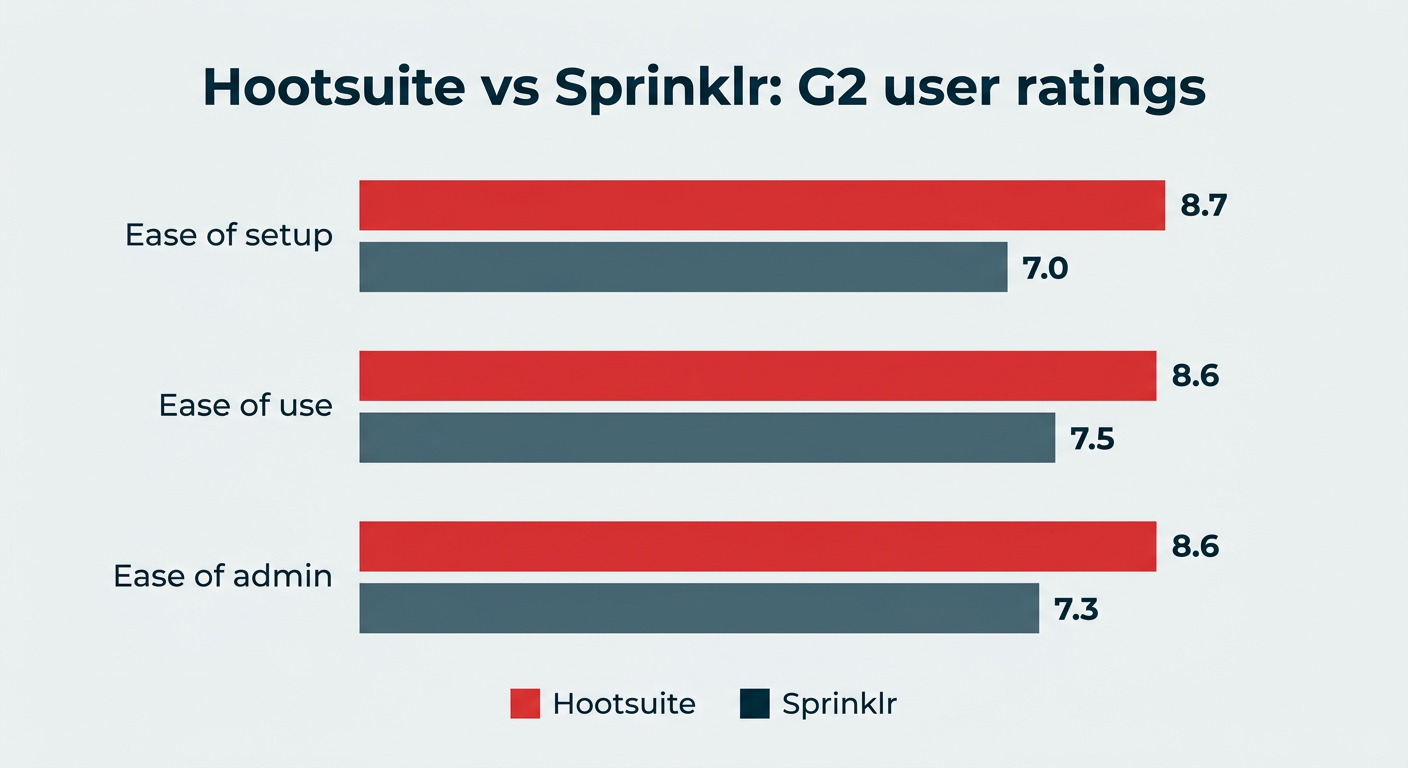
G2 reviewers say compared to Sprinklr, Hootsuite is:
- Easier to set up (8.7 vs 7.0 on G2’s ease of setup score)
- More usable (8.6 vs 7.5 on G2’s ease of use score)
- Offers better admin features (8.6 vs 7.3 on G2’s ease of admin score)
Pros
- Publishing, listening, inbox, analytics, and advocacy in one platform
- Faster onboarding and lower admin overhead than enterprise CXM suites
- Transparent published pricing for Standard, Professional, and Advanced plans
- Strong approval and permission controls for regulated industries
Cons
- Per-user pricing means costs scale with team size
- The deepest listening and care capabilities sit on the Enterprise plan
- Not the cheapest option for a single-person social team
Good for:
- Businesses of all sizes (including small businesses, enterprises, franchises, and agencies) and freelance social media managers
- Planning, scheduling, and publishing content
- Creative content creation
- Monitoring and engaging with conversations and mentions
- Approval workflows and compliance
- Social reporting, optimization, and analytics
- Competitive analysis and benchmarking
- Monitoring and managing all social media accounts in one place
Pricing:
- Standard: $99/user/month, including up to 10 social accounts, unlimited scheduling, best time to post, AI assistant, one inbox, and DM automations.
- Advanced: $249/user/month, adding expanded publishing, analytics, and collaboration capabilities above the Standard tier.
- Enterprise: Custom pricing, adding SSO, employee advocacy, Lumen by Talkwalker listening, advanced analytics, advanced inbox, generative AI chatbot, and review management.
Meet the Suite
Understand what matters, decide what to do next, and take action across every social workflow — all from one connected suite.

2. Meltwater

Source: Meltwater
Meltwater is a media intelligence platform that helps businesses track and measure online conversations, uncover insights, and monitor brand mentions. Meltwater also offers social media management tools like scheduling and publishing posts.
Its strength is breadth of coverage across earned media. If your team reports on press, broadcast, and social mentions in the same deck, Meltwater handles that in one subscription in a way most pure social tools do not.
Where it lags Sprinklr is execution: publishing, approvals, and inbox management are lighter than a dedicated social suite.
Some cons of the Meltwater platform include its lack of advanced theme and topic analysis, as well as weak dashboarding capabilities and widgets that are difficult to set up.
Pros
- Strong earned media and press monitoring alongside social
- Useful for comms and PR reporting in one place
- Broad data coverage across news, blogs, and social
Cons
- Publishing and engagement tools are secondary to monitoring
- Dashboard setup takes effort and support
- No published pricing, so budgeting requires a sales conversation
Good for:
- Small to medium-sized businesses
- Media monitoring and social listening
- Uncovering brand insights from conversation data
- Advanced data filtering
- Competitive landscape analysis
Pricing
Meltwater does not publicly display its pricing. Plans are quoted per organization based on modules, users, and mention volume, so you will need a demo to get a figure.
3. Brandwatch

Source: Brandwatch
For those looking for a data-driven Sprinklr competitor, Brandwatch is a strong choice. This platform scours social media data to deliver actionable insights in minutes. Features include sentiment analysis, competitor benchmarking, trend spotting, and more.
Brandwatch competes with Sprinklr mainly on the intelligence side. Research and insights teams use it to size audiences, track narratives over time, and segment conversation data in detail. Teams that want listening and day-to-day publishing in the same workflow usually pair it with a management platform or choose a suite that covers both.
Pros
- Deep historical data and query flexibility
- Advanced segmentation and audience research
- Well suited to brand health and trend tracking
Cons
- Publishing and care capabilities are limited compared to full suites
- Query building rewards specialist users
- Mention-based pricing can escalate for high-volume brands
Good for:
- Agencies, mid-size businesses and enterprise companies
- Discovering relevant data from social trends
- Industry-leading features for segmenting and analyzing data
- Advanced sentiment analysis
- Competitive benchmarking and reporting
Pricing
Brandwatch does not publish standard pricing. Plans are quoted based on mention volume, data history, and seats, with enterprise tiers for unlimited mentions.
4. Sprout Social

Source: Sprout Social
Sprout Social is a social media management software designed to help brands build a smart social media presence. It offers features for content scheduling, social media monitoring brand mentions, customer service management, and reporting.
Against Sprinklr, Sprout positions as the simpler option. It is easier to learn and quicker to deploy, and its reporting is presentation-ready out of the box. The trade-off is scope and cost structure: listening is an add-on, and per-user pricing means every additional stakeholder who needs access raises the bill.
Pros
- Clean, approachable interface with minimal training needed
- Strong out-of-the-box reports for leadership
- Solid inbox and engagement workflows
Cons
- Per-user pricing scales poorly for large teams
- Listening sold as a paid add-on
- Lighter governance than enterprise CXM platforms
Good for:
- Mid-sized businesses and enterprise
- Publishing and posting social media content
- Analyzing and optimizing campaigns
- Monitoring brand mentions and conversations
Pricing
Sprout Social prices per user by plan tier, with additional users billed separately and listening available as an add-on.
5. Khoros
Khoros is an enterprise Sprinklr competitor built around digital customer care and online communities. Where Sprinklr spans marketing, advertising, and care, Khoros concentrates on conversations: agent-based social support, messaging, and branded community forums.
That focus makes it a common shortlist entry for support-heavy organizations in telecom, financial services, and consumer tech. Marketing-led teams that mainly need publishing and analytics usually find the platform heavier than they need.
Pros
- Mature agent routing, queueing, and SLA tracking for social care
- Branded community platform most competitors do not offer
- Handles high message volumes at enterprise scale
Cons
- Marketing publishing and content planning are less developed
- Implementation and admin effort comparable to Sprinklr
- Custom pricing only, aimed at large contracts
Good for:
- Enterprise customer care and support teams
- Online community management
- High-volume social messaging and routing
Pricing
Khoros does not publish pricing. Plans are quoted by module, agent seats, and volume.
6. Emplifi
Emplifi, formerly Socialbakers, is a direct Sprinklr competitor covering social media marketing, commerce, and customer care. It blends publishing and analytics with influencer management and shoppable content features, which sets it apart from tools that stop at scheduling and reporting.
Retail and consumer brands tend to get the most from it, especially those running social commerce alongside organic publishing. Teams focused purely on listening or governance may find other options a better fit.
Pros
- Social commerce and user-generated content features built in
- Influencer discovery and campaign tracking included
- Competitive benchmarking rooted in its Socialbakers heritage
Cons
- Listening depth trails specialist platforms like Brandwatch
- Interface takes longer to learn than mid-market tools
- Pricing is quote-based with no public entry tier
Good for:
- Retail and ecommerce brands
- Social commerce and shoppable content
- Influencer marketing and UGC campaigns
Pricing
Emplifi uses custom quotes based on modules, profiles, and users.
7. Zoho Social

Source: Zoho
Our next Sprinklr competitor is Zoho. Zoho offers a social media management platform, CRM, conversion rate optimization (CRO) suite, email marketing platform, an e-commerce platform, and more.
While comprehensive, access to Zoho’s suite of products is pay-per, meaning users may need to purchase multiple services to access the features they want. The interface is also somewhat cluttered and may take some getting used to. Users have also reported issues with account linking, tracking UTM parameters, and getting clear answers from the Zoho support team.
Pros
- Low entry price relative to enterprise platforms
- Works well if you already run Zoho CRM and email
- Covers publishing, monitoring, and basic reporting
Cons
- Features split across separately billed products
- Interface feels crowded compared to dedicated social tools
- Not built for enterprise governance or multi-brand structures
Good for:
- Small to medium businesses and enterprises
- Content creation, publishing, and scheduling among teams
- Brand monitoring and social listening
- Social advertising and campaign planning
Pricing
Each Zoho feature is billed separately. Zoho Social’s published tiers run Standard at $15 per month, Professional at $40 per month, and Premium at $65 per month on monthly billing.
8. Buffer

Source: Buffer
Small to midsize businesses looking to manage their social media presence may be familiar with Buffer. Buffer provides a straightforward way to schedule, publish, and analyze content across multiple networks from one central dashboard.
Buffer is a great option for those just dipping their toes into the world of social media management. It is not a true Sprinklr replacement, though. There is no enterprise governance layer, no agent-based care, and no serious listening, so it suits lean teams rather than multi-region operations.
Pros
- Free plan available for up to three channels
- Simple, fast to learn, and inexpensive to scale channel by channel
- Clean publishing and basic analytics
Cons
- No social listening or customer care module
- Limited approval workflows and permissions
- Reporting depth falls short of enterprise needs
Good for:
- Small to midsize businesses
- Content planning and creation
- Scheduling and publishing content across multiple networks
- Analyzing post performance and tracking engagement metrics
Pricing
Buffer offers a free plan for up to three channels. Paid plans start with Essentials at $6 per channel per month on monthly billing, with the Team tier at $12 per channel per month.
9. Later

Source: Later
Later is a Sprinklr alternative that helps you plan, publish, and analyze content in advance for different social media networks. Later uses a simple drag-and-drop interface, making it easy to schedule a month’s worth of content in minutes.
It is squarely a creator and small-brand tool. Visual planning, link in bio, and influencer features are its strengths, while enterprise requirements like governed approvals, listening, and shared care queues are not part of the picture.
Pros
- Visual content calendar and feed preview
- Built-in link in bio and influencer tools
- Easy for one or two people to run end to end
Cons
- No enterprise governance or compliance controls
- Minimal listening and engagement management
- Plans cap social sets and users, which limits growth
Good for:
- Small businesses
- Planning, scheduling, and publishing content
- Seeing how your content looks in a visual feed
- Analyzing post performance and tracking engagement metrics
- Link-in-bio features
Pricing
Later’s paid plans start at $25 per month on the Starter plan for one user and one social set, and scale up by social sets and seats.
10. HubSpot

Source: HubSpot
Like Sprinklr, HubSpot is a customer relationship management (CRM) platform offering social media scheduling functions. HubSpot Marketing Hub is a robust platform that provides users with access to an entire suite of marketing tools, including email automation, analytics, reporting, and more.
Users of HubSpot Marketing Hub often say it’s easier to use than Sprinklr and note that HubSpot provides superior customer service. Social is a feature of the broader platform rather than its focus, though. The content calendar, content creation, and shared inbox tools lack depth compared to dedicated social media management products.
Pros
- Social activity tied directly to CRM contact and pipeline data
- One vendor for email, web, CRM, and social
- Easier to administer than enterprise CXM suites
Cons
- No real social listening or sentiment analysis
- Shared inbox and publishing tools are basic
- Marketing Hub tiers get costly once contact volumes grow
Good for:
- Small to medium-sized businesses
- Social media publishing and campaign planning
- Approval workflows
- Campaign optimization
Pricing
Social tools sit in HubSpot’s Marketing Hub Professional tier, which starts at $890 per month on monthly billing, plus a one-time onboarding fee.
How do Sprinklr competitors compare on features?
Most of these platforms publish, schedule, and report. The differences show up in listening depth, customer care, governance, and AI, and Gartner’s 2026 Magic Quadrant now treats management and listening as one market. Use this feature comparison to see which tools cover the full stack and which are point solutions you would need to supplement.
Tool | Publishing | Listening | Customer care | Analytics | AI features | Advocacy | Governance |
|---|---|---|---|---|---|---|---|
Hootsuite | Yes | Yes | Yes | Yes | Yes | Yes | Yes |
Meltwater | Limited | Yes | Limited | Yes | Limited | No | Limited |
Brandwatch | Limited | Yes | Limited | Yes | Yes | No | Limited |
Sprout Social | Yes | Add-on | Yes | Yes | Limited | Add-on | Limited |
Khoros | Limited | Yes | Yes | Yes | Yes | No | Yes |
Emplifi | Yes | Limited | Yes | Yes | Limited | No | Limited |
Zoho Social | Yes | Limited | Limited | Limited | Limited | No | No |
Buffer | Yes | No | No | Limited | Limited | No | No |
Later | Yes | No | Limited | Limited | Limited | No | No |
HubSpot | Yes | No | Limited | Yes | Limited | No | Limited |
How to choose the best Sprinklr alternative
When choosing a social media management tool, there’s no one-size-fits-all solution. You’ll want to consider the size of your business, budget, and goals when deciding. Work through these steps before you book demos.
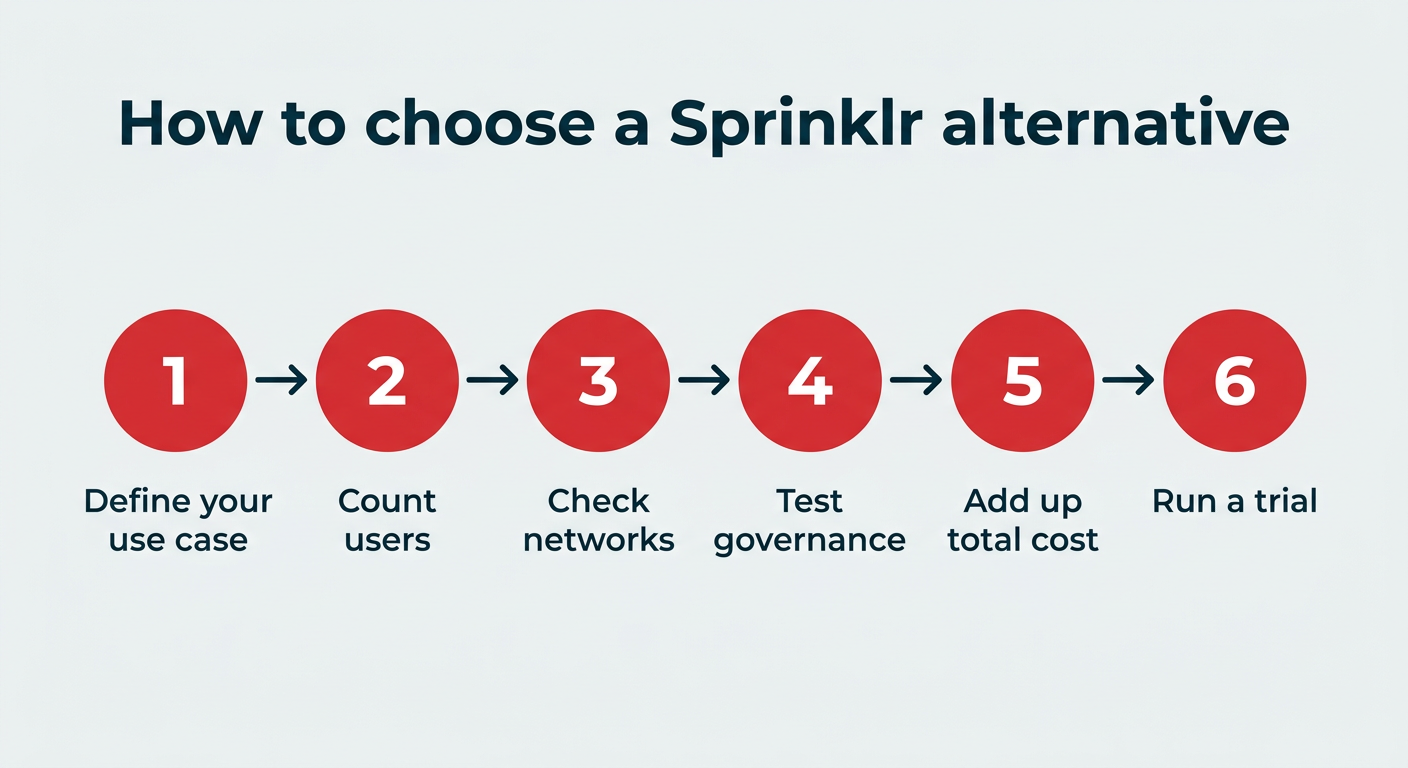
- Define your primary use case. Decide whether your core need is publishing, listening, customer care, or reporting. That single answer eliminates half the list.
- Count the people who need access. Many of the tools above charge by the user, so map out licence needs for social, care, comms, and regional teams before comparing prices.
- Check the networks you need. Confirm support for every platform in your plan, including regional networks. Hootsuite users can extend coverage through the app directory, including Chinese social network support and design integrations like Canva.
- Pressure-test governance. If you operate in a regulated industry or across multiple brands, verify approval chains, permissions, and audit trails. Forrester now lists audit-ready governance and compliance as a baseline social suite requirement.
- Add up total cost, not list price. Factor in onboarding, add-on modules, extra seats, and contract length. The cheapest entry plan is often not the cheapest year one.
- Run a real trial or demo. Most tools, like Hootsuite, offer a free trial so you can test with your own accounts. If a vendor will not let you trial it, ask for a live demo using your use case.
Here is the short version by use case:
- Best for enterprise social operations: Hootsuite, for enterprise-grade publishing, listening, care, and governance in one system.
- Best for listening and research: Brandwatch.
- Best for PR and earned media: Meltwater.
- Best for digital care and communities: Khoros.
- Best for mid-market publishing: Sprout Social.
- Best for social commerce: Emplifi.
- Best for small teams on a budget: Buffer, or Later if your content is visual-first.
- Best for CRM-led marketing: HubSpot, or Zoho Social if you already use Zoho.
Make the switch from Sprinklr
Hootsuite is the Sprinklr alternative that is easier to use, faster to deploy, and built to connect intelligence with execution. Lumen tells you what is happening, Perch and Nest let your team act on it, and Vigil keeps the whole thing governed. No six-month implementation required.
FAQ: Sprinklr competitors
Who is the competitor for Sprinklr?
What is Sprinklr best for?
Is Sprinklr worth the cost?
What is the cheapest alternative to Sprinklr?
How does Hootsuite compare to Sprinklr?
Can Sprinklr alternatives handle enterprise-scale operations?
What is the easiest Sprinklr alternative to set up?
Does Sprinklr offer a free trial?
What features should I look for in a Sprinklr alternative?
Is Sprinklr better than Hootsuite?
Save time managing your social media marketing strategy with Hootsuite. Publish and schedule posts, find relevant conversions, measure results, and more â all from one dashboard. Try it free today.









Post Comment