Google’s New Ads Consent Controls Could Change How Your Data Is Shared—Are You Ready?
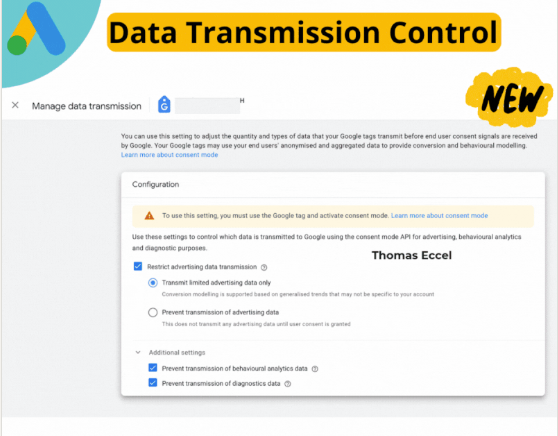
Ever wondered what happens to your ad data when users click “no thanks” on consent? Well, Google’s been working behind the scenes, quietly adding more finesse for advertisers to navigate this tricky dance. Introducing Data Transmission Control — a slick new layer on top of the existing Advanced Consent Mode in Google Ads that lets you get real granular about what data flows when consent’s limited. Imagine having the power to separately control advertising info, behavioral analytics, and diagnostic bits — choosing to either redact identifiers or halt data transmission altogether until users say “yes.” This isn’t just about ticking boxes; it’s about striking that elusive balance between respecting privacy and keeping your measurement game sharp—especially vital in today’s strict regulatory playground. Curious where this hidden gem lives in your dashboard? It’s tucked away deep in the Data Manager under Google Tag settings, easy to miss but a game-changer once flipped on. If you’ve wrestled with the push-pull of privacy vs. performance, this tweak might just be your new secret weapon. Ready to peek under the hood and see exactly what Google’s cooking? LEARN MORE.
Google is quietly giving advertisers more granular control over how data flows when consent is limited.
Driving the news. A new feature called Data Transmission Control is appearing in Google Ads, adding an extra layer on top of Advanced Consent Mode that determines how advertising, analytics and diagnostic data are actually transmitted.
What’s new. Advertisers can now independently restrict advertising data, behavioral analytics and diagnostic data. When ad_storage consent is denied, there are two options: allow limited advertising data with identifiers redacted (while still enabling conversion modeling), or block advertising data entirely until consent is granted. Behavioral analytics can still be allowed even if ad data is restricted, or blocked altogether if required.
Where to find it. The setting is buried in Data Manager → Google Tag (Manage) → Manage data transmission — and it’s easy to miss.
Why we care. Consent Mode has traditionally focused on signaling user choices. Data Transmission Control goes further by letting advertisers decide — at the tag level — what data is allowed to flow when consent is denied, offering more flexibility for privacy-first measurement strategies.
It also gives advertisers more precision in balancing privacy compliance with performance, especially in regulated markets or regions with strict consent requirements.
Key details. Consent Mode must already be active for the feature to work. Configuration is UI-only within Google Ads, Google Analytics or Campaign Manager 360, and it applies only to Google tags. If the feature isn’t enabled, nothing changes. Once a user grants consent, data transmission resumes automatically.
First seen. This update was first spotted by Google Ads specialist Thomas Eccel and shared the option he saw on LinkedIn.

The bottom line. Data Transmission Control adds a powerful — and subtle — new lever for advertisers who want tighter control over data collection without fully sacrificing measurement.
Search Engine Land is owned by Semrush. We remain committed to providing high-quality coverage of marketing topics. Unless otherwise noted, this page’s content was written by either an employee or a paid contractor of Semrush Inc.
About the Author