Unlock the Secrets Behind Google Ads Competitors with These Little-Known Tools!
Ever wondered what your competitors are REALLY up to with their Google Ads? Like peeking behind the curtain at the wizard’s secret moves? Well, a Google Ads competitor analysis lets you do just that — snoop around their campaigns, unravel their tactics, and snag some clever ideas to supercharge your own ads. It’s not just about a one-off glance; it’s about turning this peek into an ongoing, sharp-edged system that keeps you ahead of the pack. Whether you’re taking your first steps or want to refine a tried-and-true method, this guide breaks down the nitty-gritty of monitoring Google Search ads, Shopping ads, and Display Network placements — and how to connect the dots from insight straight to action. Ready to stop guessing and start strategizing? Let’s dive in. LEARN MORE.
A Google Ads competitor analysis involves monitoring and evaluating the advertising campaigns of competing businesses in your industry. The goal is to learn about their tactics and get ideas for your own campaigns.
Throughout this article, we’ll focus on Google Search ads, Google Shopping ads, and ads on websites that partner with Google through the Display Network.
Whether you’re running your first analysis or looking to turn a one-time exercise into a repeatable system, this guide covers both the step-by-step workflows and the framework to connect them.
Why you need to develop a competitor intelligence framework
Most advertisers run a Google Ads competitor analysis once, act on it, and move on. But the ones who consistently outperform their market treat it as a repeating, ongoing system.
A competitor intelligence framework is that system. It defines three things:
- What to monitor: Inputs such as keywords, ad copy, landing pages, spend, new competitors, etc.
- How often to check it: A consistent cadence like weekly, monthly, or quarterly, depending on what’s being tracked
- How findings feed back into campaign decisions: Performance outputs and analysis that lead to action
The step-by-step workflows below are building blocks you can use to create your own competitor intelligence framework.
If you’re new to competitive research, follow them to run your first full analysis. If you’ve done a competitor ads analysis before, the goal is to turn those steps into a consistent cadence that provides a clear path from insight to campaign action.
Why should you perform a Google Ads competitor analysis?
You should perform a Google Ads competitor analysis because studying your competitors’ Google Ads campaigns helps you find ways to boost your campaigns’ performance.
For example, you might discover competitors are bidding on keywords that you’re not targeting using Semrush’s Keyword Gap tool.

You can add those terms to your campaigns to capture potential customers you might have missed. And even convince them to choose you over a competitor.
Analyzing your competitors’ Google Ads also lets you:
- Learn what works and what doesn’t in their ads to avoid making similar mistakes
- Compare how much they spend on ads to help plan your advertising budget
- Keep up with changes in advertising trends that competitors are using
- Identify seasonal advertising opportunities you might be missing out on
How to perform a Google Ads competitor analysis
Follow these steps to analyze your competitors’ Google Ads (we’ll be focusing on search ads in the steps below):
1. Identify your Google Ads competitors
The first step is figuring out which businesses are your top Google Ads competitors by considering the following competitor types:
- Direct competitors: Businesses selling the same product or service to the same audience. They usually target the exact same bottom-of-funnel keywords you do.
- Indirect competitors: Businesses solving the same problem in a different way (e.g., a project management tool competing with a spreadsheet template site) have some keyword overlap
- Niche competitors: Businesses targeting a specific subset of your audience. They may not compete with you broadly, but they can dominate high-value segments and cover all the same keywords in those segments.
It’s worth identifying all three, but direct competitors deserve the most attention when you’re starting out.
New market entrants are also worth paying attention to, so you’re not blindsided by fast-growing competitors. These are the up-and-coming competitors who, over time, start to target the same keywords you do. You’ll identify these competitors more easily the more times you repeat this process.
To find which of your competitors are currently advertising on Google Search, enter your domain into Semrush’s Advertising Research tool and click the “Competitors” tab.

If your business is fairly new and you don’t have enough data here, try searching for one of the direct business competitors that you know already runs ads and targets the same keywords you would. Use their data as a proxy to help get you started with the process below.
If you’ve run ads before, scroll down to the “Paid Competitors” table to see which businesses are bidding on the same keywords as you. The table ranks competitors by keyword overlap and uses this to calculate a competition-level score.
The more keywords you share, the more directly they’re competing with you in paid search.

These are the competitors you’ll investigate in the steps below.
Usually, they’ll be your direct business competitors. Even if they’re not, you’re still competing for ad clicks. So you shouldn’t ignore the threat they may pose.
To spot rising competitors, export the “Paid Competitors” table and repeat the export monthly or quarterly. Save each export as a dated tab in a single spreadsheet (e.g., “April 2026,” “May 2026,” etc.), so you can track changes over time.
Once you have at least two exports, you can use an LLM like ChatGPT or Claude to surface patterns quickly:
- Copy the data from two or more exports into a single sheet and indicate the date of each export
- Paste that data into the LLM with a prompt like: “Here are two snapshots of my Google Ads paid competitors from [Date 1] and [Date 2]. Which competitors have grown the most in keyword overlap between these two periods? Rank them by growth rate and flag any new entrants.”
- Use the output to prioritize which competitors to focus on in the steps below. Newer or faster-growing rivals deserve extra attention, since they may signal a shift in how your market is being targeted.
2. Find your competitors’ paid keywords
Next, you’ll want to analyze the keywords your competitors bid on in Google Ads to find relevant terms to use in your own campaigns.
There’s no limit to how many competitors you choose to check. Start with new market entrants, direct business competitors, and those with high keyword overlap in existing ads.
Go to the “Competitors” tab in the Advertising Research tool. Click any of the competitors’ URLs to go to the “Positions” tab for their domain.

Then, look at:
- The competitor’s ad positions in search results (the “Pos.” column)
- The average number of searches each keyword gets every month (the “Volume” column)
- The average cost per click (CPC) for those keywords, which is the average amount advertisers are willing to pay for a click on their ads
- The estimated amount of traffic a given keyword drives to the specified competitor’s domain

Review the list of your competitor’s terms to look for valuable keywords.
You’ll want to choose keywords that align with your specific campaign plans. And ones that have attributes like:
- Decently high search volumes: Indicates many people search for it
- Specificity: Suggests terms that are often less competitive but can lead to higher conversion rates (called long-tail keywords)
- High traffic:Suggests the keyword is effective at driving traffic through ads
- Low CPC: Means a keyword is more affordable. What counts as “low” for you will largely depend on your budget and your industry.
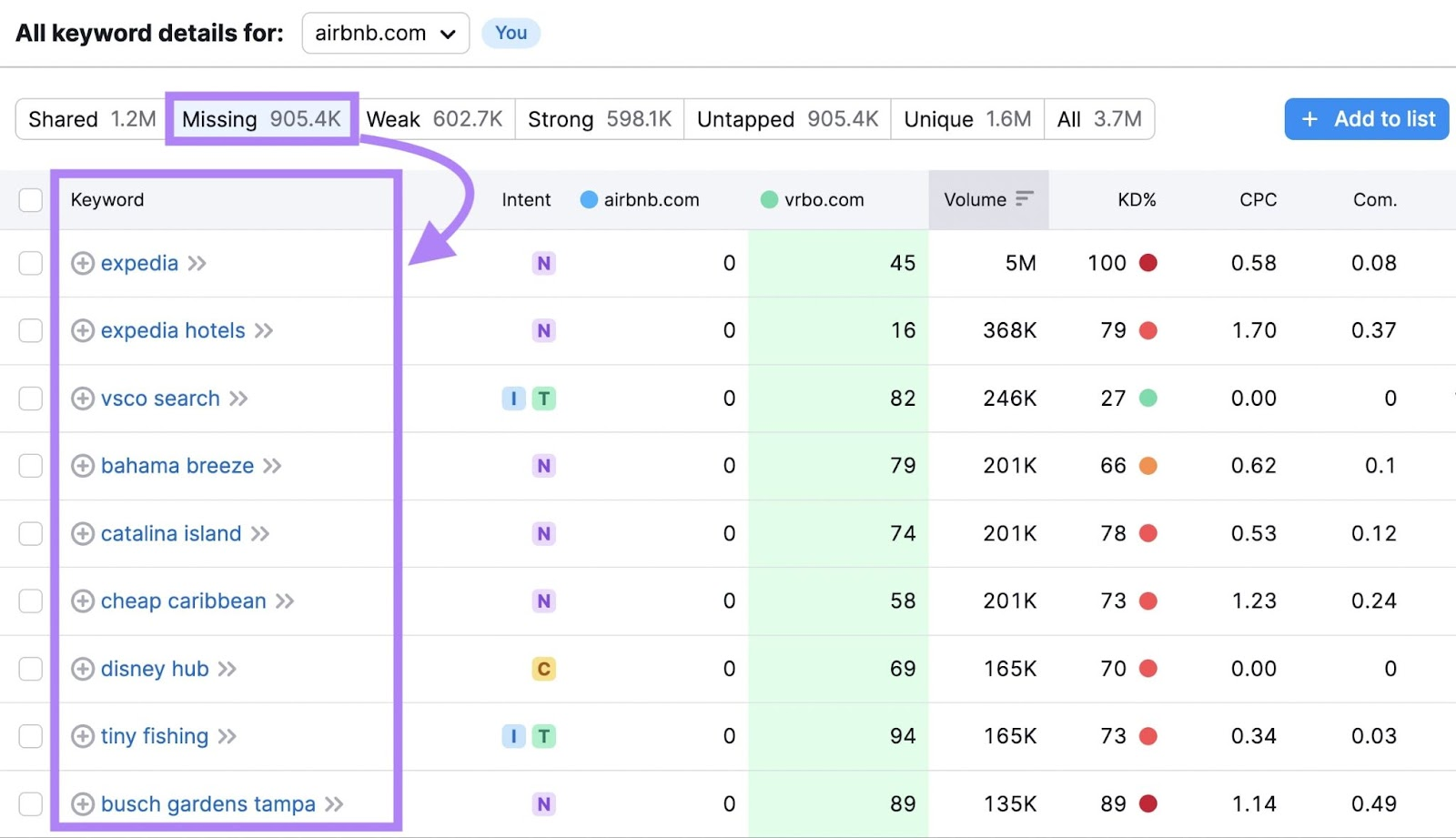
You can also use the Keyword Gap tool to find keywords your competitors bid on that you don’t by entering your domain and up to four competitors’ domains. Make sure to set the drop-downs on the right side to “Paid keywords.”
Scroll down to the “All keyword details for:” section. And click the “Missing” tab to see which keywords all of your competitors are ranking for but you’re not.

If you’ve entered more than one competitor, click the “Untapped” tab to see keywords for which you have no rankings but at least one competitor does.

Review these keywords you find via Keyword Gap against the same criteria as before. Target those that are relevant to your business, have high search volume and traffic potential, and (ideally) a low CPC.
3. Review rivals’ ad copy
Analyzing your competitors’ ad copy shows how they try to appeal to potential customers.
When reviewing rivals’ ad copy, you can see the messaging, unique selling points, and calls to action (CTAs) they use to drive clicks. To do this, head back to the Advertising Research tool, enter a competitor’s domain, and navigate to the “Ads Copies” tab to see the exact copy they use.

Click the arrow next to “Keywords” on any of the cards to view all the keywords that trigger the ad. Along with specific metrics like average monthly searches, estimated cost per click, and your competitor’s ad position for each keyword.

You can use this data to identify even more keywords you might want to target. And see how your competitor incorporates them into their ad copy.
To analyze your competitor’s product listing ads, go to the PLA Research tool, enter a competitor’s domain, and head to the “PLA Copies” tab to see the specified competitor’s PLA ads.

You’ll see a grid of product listing ads, along with a keyword drop-down for each one. Clicking one of these shows more data about the keywords that trigger that ad.

As you review your competitor’s ad copy, pay attention to:
- The key benefits they highlight
- Emotional triggers and pain points they mention
- Promotions like discounts or free shipping
- Calls to action that create urgency
The goal is to understand what motivates potential customers to click. And how your competitors are successfully gaining their attention.
Use these insights to create ad copy that showcases your product as the ideal solution for the same needs.
4. Review corresponding landing pages
Your competitors’ ad landing pages show you how they attempt to convince visitors to take action, and that can help you understand what motivates your shared audience.
You can view these from the “Ads Copies” report in Advertising Research if you want to take a closer look at which landing pages the top-performing ads go to.

If you want to get page-level metrics, check out the “Pages” tab for each competitor you’re analyzing to see top landing pages associated with those competitors’ paid ads. Click the gray icon next to an individual URL to view the page.

This is a good starting point for identifying which pages competitors are sending the most ad spend to. Review each of your competitors’ top ad landing pages and look for:
- Layout and design: Look for simple, clean designs that help visitors easily find what they need
- Headlines and copy: Check if the headlines include keywords while being attention-grabbing. And verify that the copy is clear and benefit-driven.
- Calls to action: Note the clarity and prominence of CTAs, and how they use action-oriented words to create urgency
- Social proof: Look for the presence of testimonials, reviews, and trust badges that add credibility
- Page speed: Consider the general responsiveness and loading speed of the pages
Then, take it a step further by mystery shopping and following the complete journey on each landing page as a real visitor would. Fill out the call to action as far as you can go without spending money (unless your budget allows it).
Also, pay attention to any follow-up email sequence that gets triggered by going through the landing page journey. Doing this reveals their full conversion strategy. Meaning how they move a visitor from click to customer.
The goal is to identify elements that make your competitor’s pages effective. You can then adapt those elements to your own message and offering to boost your conversion rate.
5. Estimate rivals’ ad expenses
Analyzing your competitors’ Google Ads spend gives you an indication of how much advertising costs to help you set a realistic budget.
Note that third-party tools (including the ones below) don’t have access to your rivals’ actual Google Ads spend data. The figures you’ll see are estimates based on keyword positions, search volumes, and average CPCs.
To see your competitor’s ad expense estimates, jump back into the Advertising Research tool with a competitor’s domain entered and head to the “Positions” tab.
First, look at the “Traffic Cost” data at the top. This is an estimate of how much it would cost each month to appear for the keywords that appear in the report.

You can also see traffic cost stats for individual keywords in the “Paid Search Positions” widget.
Check the “Costs” and “Costs %” columns to see approximately how much the competitor invested in each term over the past month. And what percentage of the total cost is attributed to individual keywords (higher percentages in the “Cost %” column can indicate which keywords are most valuable to that competitor).

If competitors are drastically outspending you on relevant terms, you may need to allocate more of your budget to maintain visibility.
But don’t just copy a competitor’s estimated ad spend. Because actual costs vary based on factors like ad relevance and targeting. And bigger budgets don’t always mean better results.
Instead, use the competitive insights about your competitors’ ad spend as a starting point. And let them guide your budgeting decisions along with your own data on which keywords yield the best results.
Tools to analyze competitors’ Google Ads
Here’s a quick overview of some good options for performing a Google Ads competitor analysis:
Advertising Research
Semrush’s Advertising Research tool shows which keywords your competitors bid on in Google Ads, the ad copy they use, how much they spend, and more.
Plus, you can track rivals’ ad positions over time to gauge how their strategies evolve.

Keyword Gap
Semrush’s Keyword Gap shows you which keywords your competitors show for that you don’t and which keywords their ads appear higher for than yours (if you use the “Weak” tab).

PLA Research
PLA Research gives you an inside look at your competitors’ Google Shopping campaigns — also known as product listing ads (PLAs).
PLA Research shows which products an entered competitor advertises the most, how they price and promote items, and keywords that trigger their product listing ads.

Google Search
Google Search provides a basic method for manually researching your competitors’ ads by entering target keywords.
This manual approach works for a quick, surface-level check that lets you evaluate headlines, descriptions, calls to action, offers, and ad assets. But you need specialized tools for a more detailed competitive ad analysis.
Google Ads Auction Insights
The Auction Insights report is a Google Ads feature that shows how your ads perform compared to other advertisers participating in the same auctions.
Auction Insights includes metrics like:
- Impression share: The percentage of impressions you (or a competitor) received out of the total you could have received
- Overlap rate: A measure of how often that competitor’s ads showed at the same time as yours
- Top of page rate: How often your ads (or your competitors’ ads) appeared at the top of the page above the organic (unpaid) search results
But know that you’ll only see data for keywords you’re already bidding on. And it’ll only show if your impression share is at least 10% for the selected time period.
Google Ads Transparency Center
Google’s Ads Transparency Center lets you view ads a specific advertiser has run across Google’s network.

You can also see the geographic regions where the ads were displayed. And when they were last shown. But it doesn’t provide data on keywords, bids, or performance.
How to analyze competitors running Performance Max campaigns
Performance Max (PMax) campaigns present a unique challenge for competitive research because they’re keywordless, so there aren’t specific search terms that trigger a competitor’s ad.
The best tool for PMax competitive research is the Google Ads Transparency Center. Search for a competitor’s domain to see the creative they’re running across Google’s network — including search, display, YouTube, and more.

This won’t tell you which audiences or signals triggered the ads, but it does show you what messaging and creative they’re investing in. Use that to understand their positioning and identify any offers or angles you’re not currently testing.
How to turn your Google Ads analysis into an ongoing intelligence system
The workflows in this article are only as valuable as the consistency with which you run them.
A one-time analysis gives you a snapshot. Running the same checks weekly, monthly, or quarterly gives you a picture of how competitors move, what they test, and where they’re investing over time.
Here’s a simple cadence to follow:
Task | Frequency | Tool(s) |
Check for shifts in competitor keyword positions and new entrants | Weekly | Auction Insights and Advertising Research |
Monitor competitor spend changes | Weekly | |
Surface new paid keyword opportunities | Monthly | |
Review competitor ad creative updates | Monthly | Google Ads Transparency Center |
Find new keywords to target | Monthly | |
Check for new competitors entering your auctions | Monthly | Advertising Research (the “Competitors” tab) |
Review competitor landing pages for messaging and offer changes | Monthly | Manual review |
Audit your negative keyword lists against competitor keyword data to check for unintended conflicts | Quarterly | Google Ads Editor and Keyword Gap |
Review competitor Shopping ads and PLA strategies | Quarterly |
The challenge is that manually running each of these steps across a large client or brand portfolio quickly becomes time-intensive. That’s where AI-assisted workflows can help.
Tools like the Semrush MCP can pull competitor keyword data directly into an LLM, which you can then use to run a Google Ads competitor analysis in a fraction of the time it would take manually.
For example, a simple AI-assisted keyword gap analysis approach might be:
- Use the Semrush MCP to pull competitor paid keywords, CPCs, and ad copy patterns into your LLM
- Export your own Google Ads data — keywords, negatives, and landing pages — and upload it alongside the competitor data
- Ask the LLM to compare both lists: Which competitor keywords are you missing? Which are already covered? Which are blocked by your negatives?
- Have the LLM clean and prioritize the output by intent, CPC, and competitor signal strength
- Pass the shortlist to a strategist for a final approve/reject/defer review
What might take half a day manually can be compressed into something reviewable in about an hour.
The specific implementation will look different depending on your AI tech stack, your clients, and how much you want to automate.
But the underlying principle is worth pursuing: Identify the steps in your competitive research process that are too time-consuming to repeat regularly and look for ways to systematize them. The cadence is what turns analysis into a competitive advantage.
FAQs
What is the best free tool for Google Ads competitor analysis?
The Google Ads Auction Insights report is the strongest free option for Google Ads competitor analysis and shows how your ads stack up against competitors in the same auctions, including impression share, overlap rate, and top-of-page rate.
The Google Ads Transparency Center is also free and lets you view any advertiser’s active creatives.
You can also try Semrush’s Advertising Toolkit for free to get a broader view of competitor keywords and ad copy beyond what Google’s native tools surface.
All three have limitations, but together they cover enough ground to run a solid first analysis.
How can I identify new keyword opportunities from competitor ads?
Use Semrush’s Keyword Gap tool and filter by “Paid keywords” to find new keyword opportunities.
The “Missing” tab shows keywords that all your competitors bid on that you don’t. The “Untapped” tab shows keywords that at least one competitor targets that you’re missing.
How can I evaluate competitor landing pages for PPC performance?
Use the “Pages” tab in Semrush’s Advertising Research tool to find which landing pages drive the most paid traffic.
Then assess the landing pages to see whether they match the corresponding ads, have prominent and specific CTAs, incorporate social proof, and minimize friction.