Unlock the Secret to Skyrocketing Your Website Traffic with Pillar Pages—Here’s How!
Ever found yourself desperately juggling keywords, only to realize your own pages are battling it out like gladiators in the Google coliseum — none winning, just clashing? Yeah, been there, done that. That’s because targeting a single keyword at a time often backfires: you end up with similar content competing against itself, scattering your SEO mojo all over the place. The real magic? Building authority around whole topics — and that’s where pillar pages come in. These content powerhouses don’t just cover a keyword; they conquer the entire subject, creating a solid fortress of expertise that both search engines and AI systems admire. Curious about how to craft these game-changing pages step by step? Stick around — I’m breaking down pillar pages, their SEO superpowers, and real-world examples that’ll light your content strategy on fire. LEARN MORE.
Planning content one keyword at a time often backfires: similar pages end up competing against each other in search results, and none of them builds enough authority to rank well for the broader topic they’re all part of.
Building authority at the topic level fixes that, and pillar pages are how you do it. Topic-level authority matters just as much now that AI systems evaluate it alongside search engines.
Below, we’ll cover what pillar pages are, how they strengthen your SEO, how to build one step by step, and real examples across the three most common types.
What is a pillar page?
Pillar pages — also called pillar posts or content pillars — are pieces of content that serve as the cornerstone of a topic cluster, which is a group of pages created to establish a website’s authority on a specific subject.
Where a typical blog post targets one keyword, a pillar page targets an entire topic. It provides a comprehensive overview of that topic and links to related content pieces.
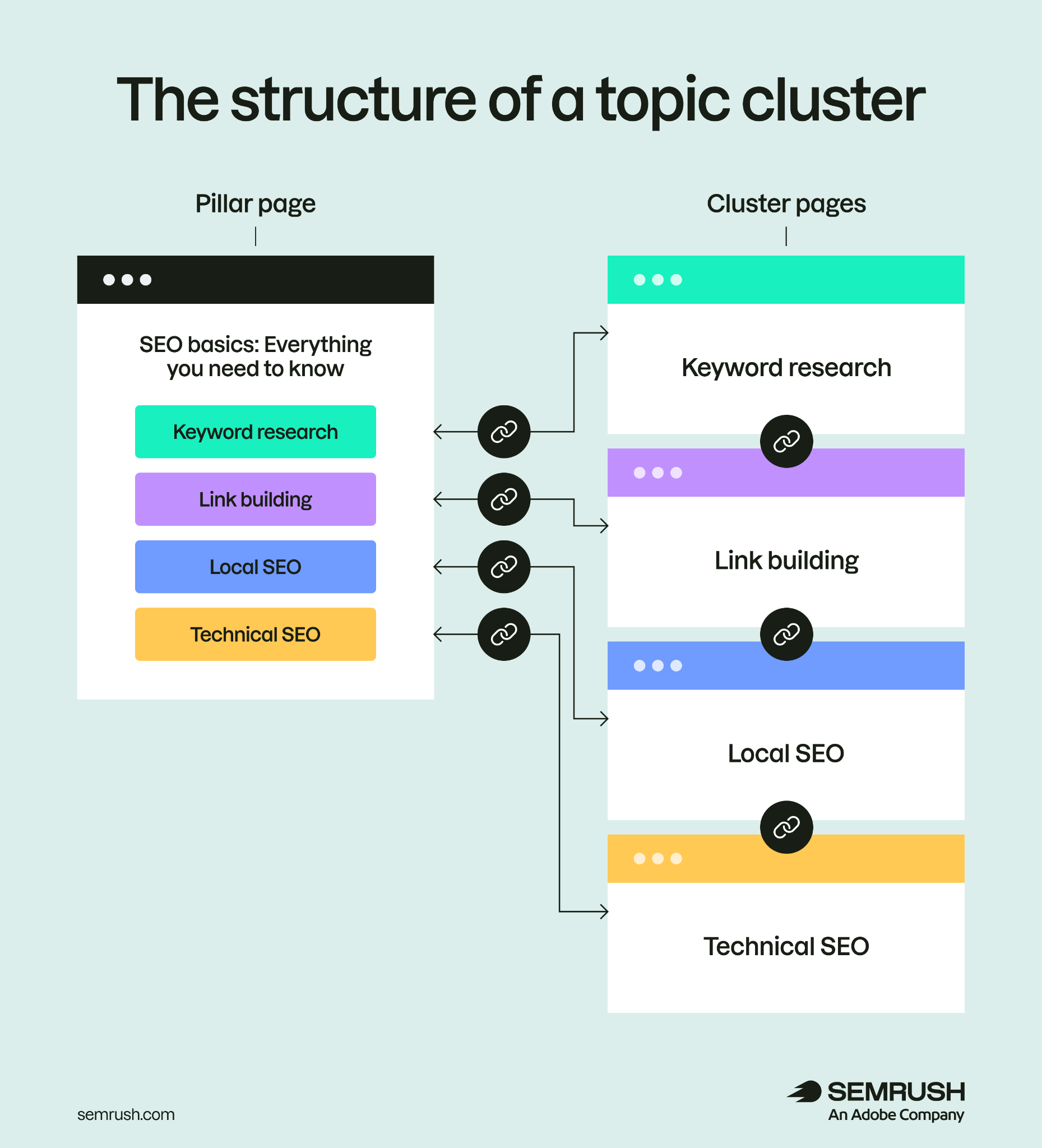
For example, let’s say you want to create a topic cluster on SEO.
Your pillar page could be a complete article covering SEO basics. Among other topics, you’d mention technical SEO, link building, and local SEO.
From your pillar page, you would add links to cluster pages. These would dive deeper into the subtopics mentioned on your pillar page.

Your pillar page acts as a content hub that guides users to more specific content pieces.
How pillar pages improve your SEO
Pillar pages improve your SEO by building your authority, improving your site’s structure, and helping bots (and users) navigate your site.
Here’s a closer look at how pillar pages help your search engine rankings.
Build topical authority
Pillar pages build topical authority by forcing you to cover a topic comprehensively: first as an overview on the pillar page itself, then in more detail on cluster pages.
As part of SEO, pillar pages and accompanying cluster content let you showcase your expertise and provide a clear signal to search engines that you’re an authority on the topic. That authority comes from how fully you cover the topic across all of its pages, not from any single page ranking well.
That signal matters just as much to AI search platforms. When ChatGPT, Perplexity, or Google’s AI Overviews decide who to cite on a topic, they’re looking for the same thing search engines are: a source that covers the subject comprehensively, not one that touches on it once. That’s why topical authority built with pillar pages tends to carry over into AI search visibility.
Simplify navigation
Pillar pages simplify navigation through internal links that make it easier for visitors and search engines to find related content and navigate your site.
And simplified navigation improves the overall user experience (UX), which is something Google aims to reward.
Clear structure helps AI systems, too. When each cluster page covers one clearly labeled subtopic, AI search platforms can pull the exact passage that answers a question, which makes your content easier to cite.
Avoid keyword cannibalization
Pillar pages help you avoid keyword cannibalization (multiple website pages competing to rank for the same keyword) since you’ll build your content around topics rather than keywords.
If you’re not using topic clusters, you’re likely creating content based on a list of keywords derived from doing keyword research. And some of the keywords from your list might have similar (or the same) search intent.
With pillar pages and topic clusters, you take a different approach and plan out your pages based on the information they need to include and the topics they need to cover. Instead of starting with keywords.
This helps you prevent keyword cannibalization in search because you can avoid getting into a situation where you’re creating two pages on the same topic.
Keyword cannibalization may also affect AI search. ChatGPT cites 1.26 pages per domain in a response, and similar pages can compete for inclusion within that response.
Improve your internal linking structure
Planning out topic clusters and pillar pages improves your internal linking structure as it requires you to be intentional about how your website pages will be connected.
If you do it right, the pillar page will link to all the pages within a topic cluster. And all the cluster pages will link to the pillar page. And some — if not all — of the cluster pages will link to each other.
This results in a more logical internal linking structure, which is easier for search engines to understand.
Generate more backlinks
Since pillar pages are in-depth takes on a topic, they often generate more backlinks compared to less comprehensive pieces of content.
Pillar pages get shared more often, so they also get cited more often. All of this results in more backlinks for the website.
How to create a pillar page
Create a pillar page by brainstorming topic ideas, organizing your pillar pages and subtopics, creating your content, and uploading the piece to your site.
Here’s each step with more details.
1. Brainstorm topic ideas
Brainstorm topic ideas by deciding which topics you want your website to be known for. Choose the core topics most relevant to your website and audience.
For example, the following might be core topics for a fitness blog:
- Strength training
- Weight loss
- Fitness supplements
All three could be potential pillar pages.
Let’s take the first topic as an example. To create a pillar page on strength training, you’ll want to cover every aspect of it. Here are some potential subtopics you could cover on this pillar page:
- Benefits of strength training
- Strength training exercises
- Strength training equipment
- Advanced strength training techniques
All of the above could also be standalone cluster pages.
The next step is organizing them into an actual content plan — including validating that they have real search demand before you commit to building around them.
Semrush’s Keyword Strategy Builder (covered in detail in the next step) does both at once: feed it your seed topics and it surfaces subtopic ideas backed by real search volume alongside the pillar-and-cluster structure itself.
2. Organize your pillar pages and subtopics
Your website will have multiple pillar pages, and every pillar page will have multiple subtopics. Use Semrush’s Keyword Strategy Builder to turn your topic list into a validated, organized content plan in one pass. Here’s how:
Enter up to five seed keywords representing your website’s core topics and click “Create.”

The tool will then generate a list of pillar page topics and their potential subpages.
You can see a visual overview of all the pillar pages and topic clusters in the “Topical Overview” section at the top.

Scroll down and you’ll see a list of pillar pages. Under each pillar page will be a list of subpages associated with it. The pages are broken down into the following categories:
- Best for Strategy: topics with low keyword difficulty and high search volume
- Quick Conversions: topics with a commercial focus
- More Potential Traffic: topics with high search volume
- All Pages: every page the tool generated

For each pillar page and subpage, you’ll be able to see:
From here, you can select specific pillar pages and subpages you’d like to include in your content plan by clicking on the checkbox next to each page.

Click “Actions” and select “Move to another keyword list.” Choose the destination list (or create a new one in Saved Keywords), then click “Send keywords.”

To view all your keyword lists, go to “SEO” > “Saved Keywords.”
Click the name of the one you’ve just created to review a list of all the keywords you added. From here, you can export all the keywords by clicking the “Export” button.
Use the list to start creating your pillar pages.
3. Create your content
Create your content by writing comprehensive posts that include internal links to cluster pages. Other than that, there isn’t a fixed set of rules to follow.
However, most great pillar pages share the following traits:
- They’re optimized for visibility. That means optimizing for search and AI by including keywords, analyzing search intent, and making content easy to read. Check out this SEO writing guide to learn how.
- They’re evergreen. Evergreen content stays “fresh” longer. You don’t need to update it every month, or possibly even every year, depending on the topic and how the content performs.
- They’re easy to read. Pillar pages are content-heavy because they cover many aspects of a topic. Simplify navigation and amplify UX using elements like tables of contents, images, and bulleted lists.
- They incorporate different types of content. Most pillar posts are text-based, but you can also include other formats, such as videos or infographics.
- They include useful links. Pillar pages act as content hubs and often include many internal links. Only include relevant links with optimized anchor text.
- They use relevant CTAs. Use compelling calls to action (CTAs) to encourage users to perform an action, such as creating an account or downloading an ebook.
You can also create content right in the Keyword Strategy Builder. Click “Generate content” for your chosen page.

Select “Article” and click “Generate SEO-rich article.” The Content Toolkit will write an optimized article for your site.

You’ll get an optimized first draft. Edit and refine it in the editor using the AI SEO and SEO tips in the Content Optimizer panel on the right.

Dive deeper into the content creation process to learn how to create the best topic clusters.
4. Upload it to your site and add internal links
Upload your finished page to your site and add internal links to all the cluster pages once those are published, too (and vice versa). You don’t have to create a custom design or make your pillar page look different from other pages on your site.
Ideally, you’ll want to use the primary keyword as the anchor text when linking to both the pillar page and the cluster pages. This will make it clear to search engines what each page is about.
If your cluster pages aren’t published and ready for internal links, you can publish your pillar post without them.
As you publish new cluster pages, edit your pillar post and add links to the recently created URLs.
This process is essential to building a logical website architecture.
Types of pillar pages (+ examples)
The three types of pillar pages are guides, what-is, and how-to.
Below, we explore different types of pillar posts and when to create each one. We also give you pillar page examples.
Remember that the divisions between these categories are not absolute. Some pillar pages might have elements of each type.
The guide pillar page
A guide pillar page is a comprehensive overview of a topic. It can be a 101 guide for beginners or an ultimate guide for advanced users.
“The complete guide to heatmaps” by Contentsquare
Contentsquare is an analytics tool that helps you understand how people use your site and app.
Contentsquare’s heatmaps guide is a great example of a pillar page that covers all the important aspects of a topic (in this case, heatmaps).
It contains information on:
- Benefits of heatmaps
- How to use heatmaps
- Heatmap examples
- How different teams can use heatmaps
- Heatmap best practices
- Heatmapping mistakes
And more.
Contentsquare’s guide covers everything you might need to get started with heatmaps, and it links to other articles that dive deeper into specific topics, like zone-based heatmaps. Plus, the link bar at the top helps users (and bots) find related pages quickly.

“The complete guide to time tracking” by Hubstaff
Hubstaff is a time tracking and productivity monitoring tool for remote and field teams. Since time tracking is one of the most important topics for the company, they decided to create a comprehensive pillar page on the topic.
It covers everything you might want to know about time tracking, including:
- The benefits of time tracking
- Time tracking methods
- How to choose time tracking software
- How to use time tracking data to improve performance
- How to get employee buy-in for implementing time tracking
The what-is pillar page
Users typically search for “What is + [topic]” when looking for information. A what-is pillar page responds to those search queries.
“What is dropshipping and how does it work” by Shopify
For an ecommerce platform like Shopify, talking about fulfillment models, such as dropshipping, makes a lot of sense. That’s why the company created a detailed pillar page on the topic.
It includes:
- What dropshipping is
- How it works
- Who it’s for
- Its benefits and drawbacks
- Frequently asked questions
Its structure — leading with the definition, then working through mechanics, participants, and trade-offs before closing with FAQs — is a template worth borrowing for any what-is pillar page.
This pillar page ranks for approximately 1,000 keywords, helping them earn visibility for topics around dropshipping.

“What is artificial general intelligence” by Zapier
Zapier is a popular automation solution that integrates with thousands of apps.
The company is fully supportive of AI and has implemented several AI features into its platform. Along with this, they write about various AI topics on their blog. And one of their pillar pages provides an in-depth overview of artificial general intelligence (AGI).
It covers all the important aspects of the topic, including:
- What AGI is and how it works
- The difference between AGI, artificial narrow intelligence (ANI), and artificial super intelligence (ASI)
- Types of ANI, such as chatbots, large language models, and voice assistants
- When AGI might arrive
This kind of page works well as a what-is pillar page precisely because AGI is a fast-moving topic — the pillar format lets Zapier update the core page as understanding evolves without having to rewrite a dozen separate posts.
The how-to pillar page
How-to pillar pages help your readers solve problems, often with step-by-step tutorials.
“How to start an online store” by Shopify
Shopify’s online store guide is another excellent pillar page that details everything you need to know about opening an online store.
It includes information on:
- Deciding on a target audience
- Finding a business idea and choosing products
- Choosing an ecommerce platform
- Designing a brand
- Determining the business structure
- Setting up an ecommerce website
- Launching and marketing an online store
Each step links out to its own deep-dive resource, which is what keeps a page covering this much ground from becoming an overwhelming wall of text.
Plus, this page alone has over 2,000 backlinks, helping Shopify build authority in the ecommerce space.

“How to use LinkedIn for business” by Buffer
Buffer offers social media management software that helps businesses manage their social media presence across a variety of platforms, including LinkedIn.
One of their pillar pages is an extensive guide to using LinkedIn for business, which covers topics such as:
- How to create a company page on LinkedIn
- How to optimize your LinkedIn presence
- How to get more LinkedIn followers
- The best types of content to post on LinkedIn
Organizing the guide around discrete LinkedIn use cases, rather than one continuous narrative, is what makes it easy to scan even at this length.
We can’t credit one pillar page for Buffer’s AI visibility. But pages like this one support it, and Buffer leads the social media scheduling space in AI search.

Pillar page FAQs
Can a product page be a pillar page?
A product page can be a pillar page if it comprehensively covers a broad topic and links out to more specific supporting content. But most product pages are built to drive a purchase rather than to educate, which makes them too narrow to do a pillar page’s job well. If you want a product-adjacent page to work as a pillar, build it as an educational hub about the broader category, then link to the product page as one supporting resource.
How long should a pillar page be?
There’s no fixed word count for a pillar page — length should match how much ground the topic actually requires to cover comprehensively, not a target number. In practice, most pillar pages run well beyond a typical blog post, often 2,000 words or more, because they’re covering an entire topic rather than one narrow angle of it. Use your cluster pages, not artificial padding, to handle depth a shorter pillar page can’t fit.
How many cluster pages does a pillar page need?
The number of cluster pages a pillar page needs depends on how many meaningful subtopics the broader topic breaks into — there’s no universal target. A useful gut check: If a subtopic has enough search demand and depth to justify its own dedicated page, make it a cluster page; if it only takes a sentence or two to cover, address it directly on the pillar page instead. Most pillar pages end up with somewhere between 5 and 15 cluster pages, though topics with especially broad scope can support more.
Create stronger pillar pages
Pillar pages can become a foundation of your content strategy if you follow these tips to build them well. Decide which topics you want to own first, then build one pillar page for each.
Use Semrush’s Keyword Strategy Builder to create a keyword strategy for your website based around relevant pillar pages and topic clusters in minutes.











Post Comment