Unlock the Secret Power Behind Google Ads’ Game-Changing New Strategy Tool!
Ever stumbled upon a tool that makes you wonder, “Why didn’t I have this yesterday?” That’s exactly the vibe I got when I discovered Google Ads’ new “Investment Strategy” feature — quietly rolled out but packing a punch for those of us obsessed with tweaking ad performance on the fly. Unlike the old-school budget simulators that look far into the crystal ball, this one zeroes in on just seven days ahead. Imagine having a bird’s-eye view of all your budget-capped campaigns right from your account dashboard, with projections showing what happens if those filters came off. It’s like having Google whispering in your ear about the short-term tactics to juice returns on your spend — but do you just take its advice blindly? I’m feeling a mix of curiosity and skepticism, flipping through the projected lifts in conversions and revenue, knowing full well that not every recommendation deserves a green light without a good old gut check. It’s fast, it’s focused, and frankly, it might just become the secret weapon for those high-stakes sales blitzes like Cyber Week. But hey, with all new tools, there’s room for improvement — I’m looking at you, missing fields for target CPA and ROAS. Still, consolidating budgeting smarts into one hub? That could be a game changer… or a cautionary tale if you’re not watching the dials closely. Ready to see if Google’s new kid on the block delivers or just talks a good game? LEARN MORE.
Google Ads quietly unveiled a tool in October called “Investment Strategy” that suggests short-term tactics to improve performance. Located in the Recommendations tab, the feature shows all campaigns and the impact of various budget changes.
Investment Strategy is akin to Google’s existing budget simulators, with two main differences. First, it focuses on the next seven days rather than a long-term forecast.
Second, it’s centralized at the account level; bid simulators apply to specific campaigns or portfolios. It displays all budget-restricted campaigns in one view and can run projections accordingly.
To launch Investment Strategy, first choose your primary campaign metric:
- Conversions,
- Conversion value [revenue],
- Clicks.
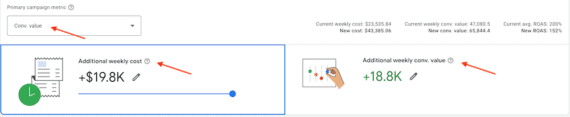
You’ll then see the projected impact on your account if all campaigns are unrestricted by budget.

The new Investment Strategy tool projects the performance impact assuming campaigns have unlimited budgets.
Choose which campaign changes are appropriate, as many likely won’t apply. The example below showcases the projected changes to “Avg. ROAS” and “Weekly conversion value” from Google’s recommendations.

Choose which campaign changes are appropriate, as many likely won’t apply.
I may or may not implement Google’s suggestions. I could instead toggle for the impact of varying budgets.
For example, say a client allocates an extra $10,000 for the remainder of the month. I can revise Google’s recommended budgets to determine which campaigns receive the spend.
Projection Tools
Google has long offered Performance Planner to recommend spending for a long-term outcome. Advertisers can view performance projections up to one year and optionally simulate the impact of custom conversion rates.
Thus Performance Planner is worthwhile for extended planning, while Investment Strategy recommendations are immediate and highly beneficial during, for instance, Cyber Week or back-to-school promotions.
Here’s an overview of Google Ads budget and strategy tools:
- Campaign budget and bid strategy. On-demand recommendations in individual campaigns.
- Performance Planner. Projections up to one year of performance by spend.
- Investment Strategy. The seven-day performance impact of budget changes to a campaign based on an advertiser’s primary goal.
I’m encouraged by the Investment Strategy tool because it’s quick and easy to understand. It projects the metrics that matter most: spend vs. performance. What’s missing are fields for target cost per conversion (tCPA) and target return on ad spend (tROAS). Both would help advertisers project incremental gains within their goals.
Google will likely consolidate all budgeting and bid strategy recommendations under Investment Strategy, resulting in a single portal for tactical and budgeting guidance.
Nonetheless, I advise caution. Google’s projections may not apply to your products, budget, or goals. Carefully determine which, if any, to implement and then monitor closely.