Unlock the Secret Blueprint Behind Every Successful Marketing Funnel—Are You Ready to Build Yours?
Ever wonder why, despite pouring your heart and soul into marketing, potential customers drop out of your funnel like it’s the last ride at the fair? It’s a baffling maze out there, right? The truth is, unless you pinpoint where folks bail, you’re basically throwing darts blindfolded when trying to fix your funnel. In this guide, I’m walking you through the nuts and bolts of the marketing funnel — from decoding each stage to tailoring strategies that actually work. Plus, I’ll spill the beans on a step-by-step blueprint to craft your very own funnel using Semrush. By the time you’re done, you’ll not only spot the leaks but also seal them up to crank those conversions higher than ever. Ready to turn casual browsers into loyal buyers? Let’s dive in! LEARN MORE.
People enter your marketing funnel every day. Your goal is to turn as many of those people as you can into customers. But many leave along the way, and unless you know which stage they leave from, you can’t tell which fix will pay off.
In this guide, you’ll learn how the marketing funnel works and which strategies fit each stage. Then, you’ll follow a step-by-step example of how to build a marketing funnel with Semrush: identify your audiences, map keywords and content to each stage, and measure where leads drop off.
By the end, you’ll know how to optimize your own funnel so you can increase conversion rates.
What is a marketing funnel?
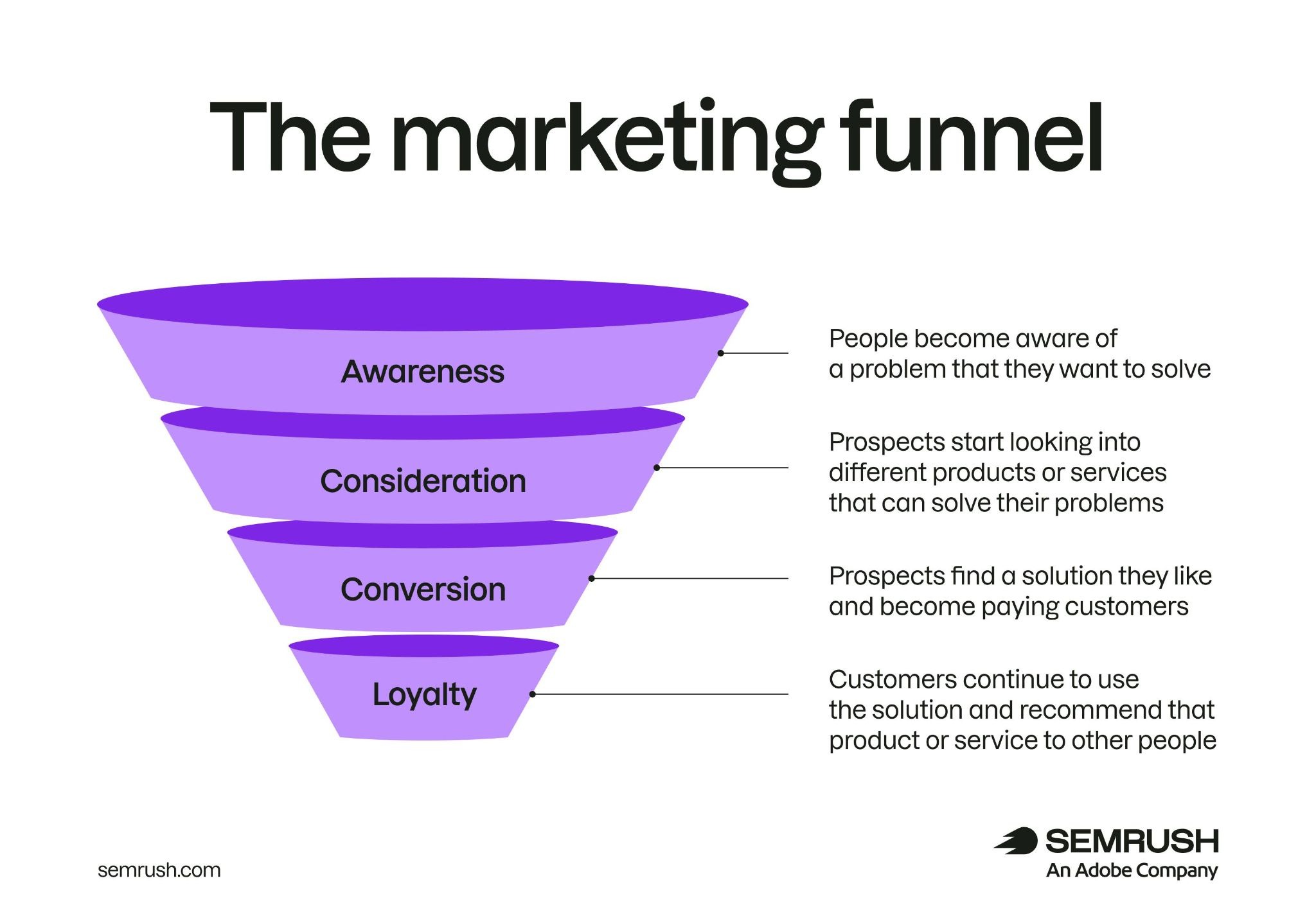
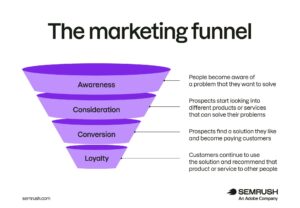
A marketing funnel is a model of the customer journey that shows how people move from discovering a brand or product to making purchases and becoming loyal advocates.
Some potential customers will drop out at each stage of the funnel, with your highest-quality leads reaching the end.

Customer journeys can be complex. The marketing funnel simplifies them so you can build a better strategy. The funnel also helps you:
- Understand your audience and tailor your marketing approach
- Identify and address weaknesses in the customer journey
- Contextualize your marketing results
Why are marketing funnels important?
Marketing funnels are important because they help you create effective marketing strategies and understand where leads are in their buying journey, so you can deliver the right message at the right time.
Marketing funnels also show where leads drop off, letting you fix elements that are driving prospects away (like irrelevant content, mismatched messaging, or poor user experiences).
Comparing the number of leads at each stage shows where the most leads drop off, which tells you which stage to fix first. Then, you can adjust your marketing strategy to match your potential customers’ needs.
For example, if most leads disappear after the consideration stage, your comparison content or messaging isn’t convincing them to move forward. If most leads disappear at the awareness stage, your content might not be answering their questions.
Later in the article, we’ll show you how to build a marketing funnel so you can easily measure where people drop off.
3 types of marketing funnels and their stages
The three types of marketing funnels are basic marketing funnels, AIDA marketing funnels, and granular marketing funnels.
1. Basic marketing funnel
A basic marketing funnel is great for beginners because it keeps things simple and easy to track. It helps you see how people move from just hearing about you to becoming paying customers.
The three stages in a basic marketing funnel are:
- Top of the funnel (ToFu): People become aware of the problem you can solve
- Middle of the funnel (MoFu): Prospects want a solution and consider their options
- Bottom of the funnel (BoFu): Prospects decide on a solution and become customers

Further reading: ToFu, MoFu, BoFu: A Practical Guide to the Conversion Funnel
2. AIDA marketing funnel
The AIDA marketing funnel is a classic model that clearly outlines how to capture attention and drive action. The stages of the AIDA marketing funnel are:
- Awareness: Potential customers discover your brand
- Interest: They develop curiosity about your offering
- Desire: They prefer your brand and consider purchasing
- Action: They make a purchase or take another desired action

3. Granular marketing funnel
The granular marketing funnel dives deeper into each stage, giving you more control over how you engage with customers. It’s ideal if your customer journey is complex and you want to nurture long-term relationships.
The specific stages of the granular marketing funnel are:
- Awareness: People learn about your brand
- Consideration: They compare your products or services to alternatives
- Conversion: They decide to buy
- Loyalty: They make repeat purchases
- Advocacy: They recommend you to others

Strategies for each stage of the marketing funnel
You need different strategies for each stage of the marketing funnel because customers are more likely to move to the next stage (and eventually become a buyer) if the stages are tailored to their needs.
Here are strategies that can help.
Top of the funnel (ToFu)
Potential customers at the ToFu stage have just become aware of a problem. They are starting to look for the right solutions.
This is the ideal time to introduce your business, service, or product as the solution they want.
To properly address leads at the ToFu stage, define your target customers (people who are most likely to become paying customers) and increase brand awareness.
Here’s how.
Define your target customers
Define your target customer by analyzing your existing customers and identifying the kinds of people who have already purchased your product or service.
Find out using Google Analytics 4 (GA4) and its “User attributes overview” report. Then, note your existing customers’ age ranges, genders, countries, cities, languages, and interests. Age, gender, and interest data only appear if you’ve turned on Google signals in GA4, and GA4 may hide small groups to protect user privacy.

Next, compare segments in the “Demographic details” report to see which audiences are most likely to engage and convert:

In this example, 25- to 34-year-olds bring in the most revenue of any known age group.
After that, perform market and competitor research with the Semrush Traffic & Market Toolkit. You can gather data about your potential audience, like:
- Age
- Sex
- Household size
- Income level
- Employment status
- Education level
- Social media usage
- Interests
- Device usage
Use the tool to analyze up to five domains at the same time. The tool offers several dashboards, like the Demographics and Audience Overlap dashboards, to help you see what competitor audiences look like and what sites they also frequent.
In this example, Prada, Dior, and Gucci are most popular among 25- to 34-year-olds, while Fendi’s audience skews slightly older.

Using the Audience Overlap dashboard, we can see how these domains’ audiences overlap with one another, and also check what other domains the market audience frequents.

Use the information to create buyer personas — profiles describing your main customers. Then, craft marketing messages that speak directly to these personas.
Increase brand awareness with inbound marketing
Increasing brand awareness with inbound marketing (a tactic that attracts your target market’s attention by creating content that is relevant to them) helps your target audience find your brand.
This method often feels less promotional than advertising. It can also deliver a better return on investment at this stage.
Here’s an example.
IKEA has a blog post about choosing a mattress. The post includes step-by-step tips — not a hard sales pitch.

The goal of this article is not to sell a product. It’s to increase brand awareness by:
- Discussing a broad but relevant topic that potential customers are interested in
- Ranking on Google so potential customers can easily find the brand
And this tactic works. According to Semrush’s Organic Rankings tool, the mattress article from IKEA gets around 1.5K visitors per month.

The blog post is also frequently cited by AI platforms.

Start your inbound marketing strategy by finding the keywords and prompts your prospects use.
Use Semrush’s Keyword Magic Tool for keywords and then Prompt Research to find prompts related to your keywords. Then, target those keywords and prompts with valuable content that naturally draws potential customers to your business.
Here’s the exact workflow you can use.
Open the Keyword Magic Tool. Enter a keyword related to your product or service. Also, enter your domain name for AI-powered, personalized keyword data. Then, click “Search.”

At the ToFu stage, people typically look for general information. So they often use keywords with informational intent.
To find these keywords, click on the “Intent” filter. Select “Informational,” and click “Apply.”

You now have a list of informational keywords. Look through the following columns:
- Volume: How many searches a keyword gets per month. We recommend focusing on keywords with volumes higher than 100.
- PKD %: How easy or difficult it may be for your site to rank for a keyword, as calculated by AI. We recommend focusing on keywords with PKD% below 50%.
From the list above, Casper could write a blog post around “which side should you sleep on” to attract more people into their marketing funnel.
Now that you have your list of keywords, the next step is to find prompts for each keyword.
Enter one of your keywords in the Prompt Research tool and click “Analyze.”

Scroll to “Related topics” and click “Prompts.”

Look for relevant prompts and include them (with answers) in your content.
Once you have keywords and prompts, it’s time to write search-friendly content. This content can help you secure visibility in search and AI platforms like ChatGPT and get more people into your marketing funnel.
However, search isn’t the only channel for brand awareness. You should also consider:
- Digital PR: Earn media coverage on sites your prospects visit
- Social media marketing: Create engaging, shareable content
- Online communities: Answer relevant questions on sites like Reddit and Quora
- Guest blogging: Write helpful articles for sites your audience visits
- Events: Speak at or organize events your target audience attends
- Email marketing: Keep in touch with prospects who sign up for your emails
Try not to spread yourself too thin. Focus on one or two tactics when starting out. The best strategy depends on your buyer personas and resources. Testing and measuring will help you allocate time and money more efficiently.
Middle of the funnel (MoFu)
People research solutions when they’re at the MoFu stage. Prospects know they have a problem, and they want to decide which product or service solves it.
Two MoFu tactics include:
- Educating your prospects
- Managing your reputation online
Educate your prospects
Educate your prospects by showing your expertise with educational content to build trust and clarify how you differ from competitors (and why prospects should choose you over rivals).
Consider creating a strong support team that can also answer questions via live chat, phone, email, or social media. And offer self-serve resources (like success stories or product overviews) highlighting your product’s usability.
Example: Casper’s mattress size comparison guide attracts prospects seeking the right mattress. The guide draws more than 107.8K organic visits a month from Google.

To find MoFu keywords, open Semrush’s Keyword Magic Tool, enter your topic, and set the “Intent” filter to “Commercial.” Commercial-intent keywords often include modifiers like “best,” “vs,” “reviews,” and “alternatives,” which signal that a searcher is comparing options.
Create a comparison guide, review roundup, or product overview for each keyword so prospects get an answer that leads to your product. Then, track average engagement time and the click-through rate (CTR) from these pages to your product pages to confirm they move readers forward.

Manage your reputation online
Managing your reputation online (through things like reviews and testimonials) helps people feel confident buying from you and shapes how AI platforms describe and recommend you.
People often look for reviews, ratings, or user feedback at the MoFu stage. Negative or unaddressed reviews can deter them.
To check your brand’s reputation:
- Search for your brand on Google and examine reviews
- Search for “best [product]” or “[service] reviews” to see if your brand appears in the top results
- Use Semrush’s Media Monitoring to track brand mentions online
- Use Brand Performance in the AI Visibility Toolkit to see how AI platforms like ChatGPT describe your brand and which sources they draw on
- If you have a local business, use Semrush’s Listing Management tool to manage your listings and reviews

Bottom of the funnel (BoFu)
Prospects decide to buy within the BoFu stage. People may search for transactional keywords like “buy mattress” or “mattress store near me.”
You want prospects to click on your site or go directly to your product pages.
Find keywords that signal buying intent
Find keywords that signal buying intent with a keyword tool that can group keywords into different intents.
We’ll show you how to do that with the Keyword Magic Tool.
Open the Keyword Magic Tool, search for a keyword, and set the “Intent” filter to “Transactional.” Look for modifiers like “buy,” “discount,” “pricing,” and “near me.” (Click a certain word in the “Groups” section to further filter keywords.)

BoFu keywords typically have lower search volume and higher cost per click (CPC) than ToFu keywords because each searcher is closer to buying. So, look for keywords likely to convert for you, rather than ones with the highest traffic.
Build landing pages that convert
Build landing pages with conversion in mind so more people turn into buyers. A landing page’s quality also affects organic and paid rankings and bounce rates.
Here are some tips when building high-converting landing pages:
- Write a compelling headline and body copy that engages users
- Use high-quality imagery of your product
- Optimize content for target keywords
- Reduce barriers to purchase (like pop-ups or buttons that aren’t “add to cart”)
- Reassure customers by highlighting benefits and social proof
And use Semrush’s Site Audit to find technical and on-page issues that slow your landing pages down or keep them from ranking and appearing in Google and AI search systems.

Turn buyers into loyal customers
Turn buyers into loyal customers so they continue to buy from you rather than competitors and recommend you to their friends.
Loyalty and advocacy belong at the bottom of the funnel because the buyer’s journey should continue after purchase.

Loyalty or referral programs should reward customers for coming back or recommending you. If you choose not to have a loyalty program, offer great aftercare. For example, Casper shares a mattress maintenance guide.

Use email and social media to keep customers engaged and remind them of your brand after a purchase.
Marketing funnel metrics
Track one or two marketing funnel metrics for each stage, then calculate the conversion rate between stages so you can see where leads drop off more than they should.
Common funnel metrics include:
Stage | Metric | Description | Where to find it |
|---|---|---|---|
ToFu | Impressions | How many times your search listings or social media posts appear | Google Search Console, social platform analytics |
Click-through rate (CTR) | The percentage of users who click your site in the search engine results pages | Google Search Console | |
Page views and sessions | Views of, and visits to, your top-of-funnel pages | GA4 | |
Keyword rankings | Your position for the keywords mapped to this stage | ||
AI brand mentions | How often AI platforms mention your brand for tracked prompts | ||
MoFu | Average engagement time | How long visitors actively spend on your page | GA4 |
Bounce rate | The percentage of visits that leave without a next action | GA4 | |
Click-through to product pages | Visitors who click from a middle-of-funnel page to a product page ÷ visitors to that page × 100 | GA4 | |
Google star rating | Average rating on your Google Business Profile | Google Business Profile | |
Returning users | Number of users who have previously visited your site based on a selected date range | GA4 | |
BoFu | Conversion rate | The percentage of users who took a specific action, like buying a product | GA4 key events |
Return on ad spend (ROAS) | Revenue from ads divided by ad spend | Your ad platform (like Google Ads or Meta Ads Manager) | |
Loyalty | Repeat purchase rate | The percentage of customers who buy again | Your ecommerce platform or CRM |
Customer lifetime value (CLV) | Average revenue a customer generates over the whole relationship | Your CRM or analytics platform | |
Retention rate | The percentage of customers who keep buying from you over a set period | Your ecommerce platform or CRM | |
Every stage | Stage-to-stage conversion rate | The percentage of visitors that move on to the next stage in your funnel | GA4 funnel exploration |
Use GA4 for most funnel metrics. Refer to our Google Analytics guide for help, and see our guide tov marketing attribution to connect results to the channels that produced them.
How to build a marketing funnel with Semrush (step-by-step example)
To build a marketing funnel, define your audiences, map keywords and content to each stage, set up tracking, and measure the conversion between stages to find where leads drop off.
The example below follows a fictional online store that sells ergonomic office chairs. Keyword data comes from Semrush (US database, November 2026). The funnel numbers in Step 5 are sample data for illustration only, not benchmarks.
Step 1: Identify your audiences and set stage goals
To identify your audiences, find out who already buys from you and who your competitors attract, then give each audience a goal at the stage where they enter your funnel.
Start in GA4 with the “User attributes overview” report to see who buys.
Then, open the Traffic & Market Toolkit and use the Demographics and Audience Overlap dashboards to compare competitors’ audiences with yours.
Say the store finds that most buyers are remote workers aged 30-45, and that two competitors’ audiences share the same profile and overlap with home-office and wellness sites. Turn those findings into personas, and give each one a stage goal.
Figure out persona goals by reviewing support logs and customer data. For example, you might put a survey on your site that asks visitors what brought them to your site. Their answers can give you insight into their goals.
Audience | Where they enter the funnel | Stage goal |
|---|---|---|
Remote workers with back pain | ToFu, searching for posture and pain relief | Read a posture guide |
Remote workers comparing chairs | MoFu, searching for “best” and “reviews” | View a comparison page and click through to a product |
Office managers buying for a team | MoFu, then BoFu, with a longer buying cycle | Request a team quote |
Writing a goal for each stage gives you a clear target for the metrics you’ll track in Step 5. For more help, see our guides to creating buyer personas and mapping the customer journey.
Step 2: Map keywords to ToFu, MoFu, and BoFu
To map keywords to ToFu, MoFu, and BoFu, group them by search intent: informational keywords belong at ToFu, commercial keywords at MoFu, and transactional keywords at BoFu.
In Keyword Magic Tool, enter your seed keyword (we’ll use “ergonomic office chair” for our example) and use the “Intent” filter to select a range of relevant keywords that fit into each of the three intents (informational, commercial, and transactional). Map those keywords to the appropriate funnel stage.
Here’s how that looks for our fictional example:
Stage | Example keyword | Keyword type | Monthly searches | Keyword difficulty |
|---|---|---|---|---|
ToFu | ergonomic sitting posture | Informational | 320 | 42% |
ToFu | how to relieve back pain from sitting | Informational | 90 | 62% |
MoFu | best office chair for back pain | Commercial | 18,100 | 49% |
MoFu | ergonomic office chair reviews | Commercial | 170 | 39% |
BoFu | buy ergonomic office chair | Transactional | 20 | n/a |
The BoFu keyword has the lowest search volume (20), which is typical. Fewer people search for it, but each searcher is closer to buying, so judge BoFu keywords by conversions, not traffic.
Buyers also ask AI platforms questions at each stage. Use Prompt Research to find the prompts people enter in ChatGPT and Google AI Mode, such as “what is the best chair for lower back pain” at MoFu, and add them to the same stage map.
Step 3: Match a content type and CTA to each stage
To match a content type and CTA to each stage, give each keyword one page type and one CTA that moves visitors to the next stage.
For example:
Stage | Keyword | Content type | CTA | Metric it feeds |
|---|---|---|---|---|
ToFu | ergonomic sitting posture | Guide: how to sit at a desk with good posture | Link to the chair comparison page | Page views and sessions |
MoFu | best office chair for back pain | Comparison page with the store’s chairs rated by back-pain type | “See this chair” button to the product page | Click-through to product pages |
BoFu | buy ergonomic office chair | Product page with reviews, shipping details, and return policy | “Add to cart” button | Conversion rate |
Without a next-step CTA, a reader who is ready to move forward has nowhere to go. So they leave, and that shows up as a drop-off in your data.
For more on content by stage, see our guide to the content marketing funnel.
Step 4: Set up tracking before you publish
Set up tracking before you publish so you can capture a baseline for your marketing funnel and its stages.
To track a marketing funnel, tag your links with UTM parameters, set up key events in GA4 for each stage, and add your stage keywords to a rank tracker.
- UTM parameters: Tag links in emails, ads, and social posts so GA4 shows which channel sent each visitor
- GA4 key events: Mark one key event for each stage change, such as a click from a comparison page to a product page, “add to cart,” and “purchase.” Then, build a GA4 funnel exploration with these steps to see the number of users at each stage.
- Position Tracking: Add the keywords from your map to Semrush’s Position Tracking and label each one ToFu, MoFu, or BoFu, so you can read rankings by stage
- Prompt Tracking: Track your ToFu prompts in Prompt Tracking (AI Visibility Toolkit) to count how often AI platforms mention your brand
Step 5: Measure each stage and find where leads drop off
Find where leads drop off by dividing the number of visitors at each stage by the number at the previous stage to get the conversion rate, then subtract it from 100% to get the drop-off rate.

Stage change | Visitors in → out | Conversion rate | Drop-off rate |
ToFu → MoFu | 10,000 → 2,500 | 25% | 75% |
MoFu → BoFu | 2,500 → 300 | 12% | 88% |
BoFu → customer | 300 → 120 | 40% | 60% |
Overall, 1.2% of visitors become customers (120 of 10,000). Large drops at the top are expected because awareness content attracts casual visitors, so compare each stage change with your own previous period and with the other stages instead of a universal benchmark.
In this sample, the biggest leak is between MoFu and BoFu: 88% of visitors who reach a comparison page never reach a product page. Fix the largest leak first:
- Leak between ToFu and MoFu: Your content attracts visitors who aren’t looking to buy. Revisit keyword intent, and add links and CTAs from awareness content to comparison pages.
- Leak between MoFu and BoFu (this example): Comparison pages don’t lead visitors to products. Add product links and “See this chair” buttons next to each recommendation, and add reviews and social proof to the page.
- Leak between BoFu and customer: Something blocks checkout. Show shipping and return details earlier, shorten the checkout form, and retarget visitors who leave with ads.
After you make a change, compare the same stage change over the next 30 days to confirm the leak shrank. For more ways to fix a leaking stage, see our guides to sales funnel optimization and lower-funnel marketing.
Marketing funnel FAQs
What is the difference between a marketing funnel and a sales funnel?
A marketing funnel covers the whole customer journey, from first awareness through loyalty and advocacy, while a sales funnel starts when a lead enters the sales process and ends at the purchase. Marketing teams usually own the earlier stages and sales teams the later ones. The terms are often used interchangeably.
Is the marketing funnel dead?
No, the marketing funnel is not dead. Customers often move back and forth between stages and use several channels before they buy, so their journey isn’t a straight line. The funnel still works as a measurement model because it shows where leads drop off. Use it to find leaks, and use a customer journey map to understand the messy path in between.
How many stages does a marketing funnel have?
A marketing funnel has three stages in the basic model (ToFu, MoFu, and BoFu), four in the AIDA model, and five in the granular model. Choose the model whose stages you can measure. For specific business types, see our guides to the lead generation funnel and the ecommerce funnel.
What is full-funnel marketing?
Full-funnel marketing is a strategy that plans and measures marketing for every funnel stage, from awareness to loyalty, instead of focusing only on bottom-of-funnel conversions. It matches each stage’s content, channel, and metric to the buyer’s needs at that point.
Create your marketing funnel
Building a marketing funnel involves more than drawing stages. You must understand your target customers, how their needs change, and how to serve them at every stage. Start with the stage that leaks the most leads in your data.
That’s why many marketers use Semrush to build a marketing strategy. Semrush’s digital marketing toolkit provides the data you need to understand your audience and optimize your strategy — every step of the way.
Try Semrush for free today to start building your marketing funnel.








Post Comment