Unlock Instagram’s Hidden Goldmine in 2026: 12 Unexpected Ways to Cash In!
Think Instagram’s just a playground for selfies and brunch pics? Think again. What if I told you that behind every scroll and like lies a goldmine of income opportunities—without needing to be a celebrity or amass millions of followers? Yeah, Instagram offers at least a dozen legit ways to turn your usual posts, Reels, Stories, and live videos into cold, hard cash in 2026. It’s not just about throwing ads at your audience anymore; this is about smart monetization strategies that even micro-influencers can tap into. Whether it’s brand deals, affiliate marketing, or selling digital products, you don’t have to be a household name to cash in. Curious about how to set this up, keep your account in tip-top shape, and start collecting a paycheck for your creativity? Ready to ditch the myth that you need a massive following before the money flows? Let’s dive into the savvy steps and strategies that can make your Instagram hustle pay off, big time. LEARN MORE.
Table of Contents
Key takeaways
- Instagram offers at least 12 working monetization paths in 2026, from Reels ad revenue and Subscriptions to brand deals, affiliate links, and digital products.
- You do not need hundreds of thousands of followers. Several tools open up at low thresholds, and brand deals, affiliate marketing, and UGC licensing have no official follower minimum.
- Setting up a Professional account and opting into Creator Marketplace are the first steps to unlocking Instagram’s built-in earning features.
- Pricing brand deals on engagement rate, usage rights, and exclusivity helps you earn fair rates at any follower count.
What is Instagram monetization?
Instagram monetization means earning money from the content you already publish on the platform: posts, Reels, Stories, and live video. That can take many forms, from working with brands and earning ad revenue on Reels, to accepting tips during a livestream, to charging a monthly fee through Instagram Subscriptions.
There’s a key difference between monetization and selling, though. For creators, monetizing an Instagram account traditionally didn’t mean selling physical or digital products to a social audience. It meant getting paid for the content itself.
Selling products and services directly on social media, for example through Instagram Shops or by connecting your online store, is social commerce. In 2026 that line has blurred. Plenty of creators now treat shops and digital products as core revenue, so this guide covers both.
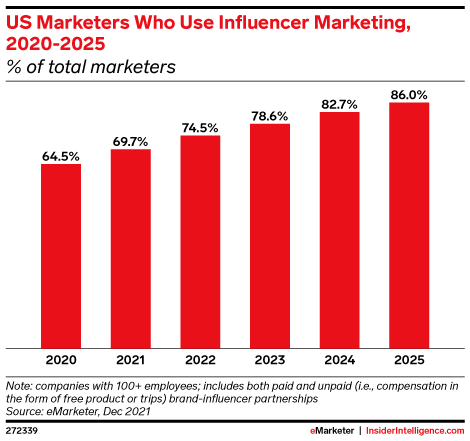
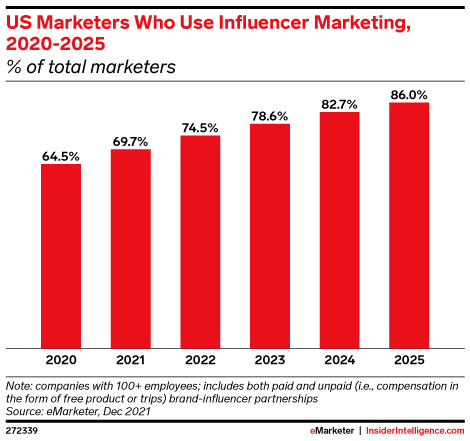
Instagram remains one of the most popular platforms for creator earnings, with 80.8% of US marketers using it for influencer campaigns, and the money behind it keeps growing. US influencer marketing spend reached $10.52 billion in 2025, according to eMarketer, and Instagram continues to capture the largest share of that spend among social platforms.
All that money isn’t reserved for celebrities, either. Most Instagram creators earning from brand partnerships sit well below the 100,000 follower mark. According to Statista data on Instagram influencer distribution, Instagram influencers with 1,000 to 10,000 followers made up the largest share of influencer accounts worldwide in 2024.
Many people are already earning full-time incomes from social media, and demand from brands continues to climb. eMarketer expects US influencer marketing spend to keep growing, projecting $13.7 billion by 2027.
Source: eMarketer
Bonus: Download a free checklist that reveals the exact steps a fitness influencer used to grow from 0 to 600,000+ followers on Instagram with no budget and no expensive gear.
How do you set up your Instagram for monetization?
Before you can earn anything, your account needs to be set up correctly. Instagram’s built-in tools only appear for accounts that meet a few baseline requirements, so it’s worth spending 10 minutes here.
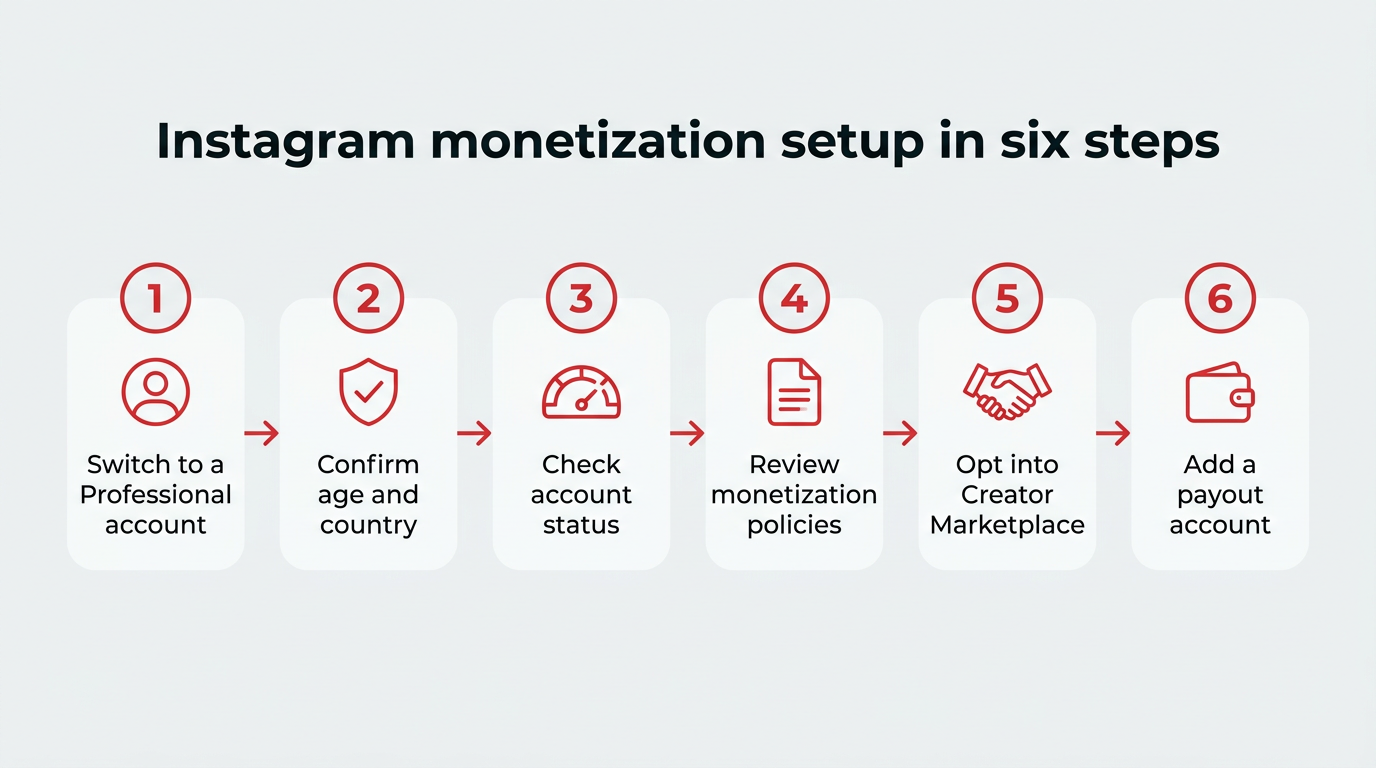
Here’s the order to do it in:
- Switch to a Professional account (Creator or Business).
- Confirm you’re 18 or older and based in a country where monetization tools are available.
- Check your account status in the Professional Dashboard for any content or monetization restrictions.
- Review Instagram’s Partner Monetization Policies and Community Guidelines.
- Opt into Creator Marketplace so brands can find you.
- Add a payout account so Instagram can actually pay you.
Switch to a Professional account
Personal accounts can’t access monetization features, so this is step one. Go to Settings, then Account type and tools, and select Switch to professional account.
You’ll be asked to choose between Creator and Business. Pick Creator if you’re an individual publishing content: influencers, artists, photographers, and public figures. Pick Business if you’re selling products or services under a brand name. Both unlock insights and the Professional Dashboard, but Creator accounts get access to more flexible category labels and creator-specific tools.
Check your monetization eligibility and join Creator Marketplace
Open your Professional Dashboard and look for Account status. This is where Instagram tells you whether your account is eligible for monetization, whether any posts have been flagged as ineligible, and whether your content is recommendable to non-followers. Fixing issues here before you apply for anything saves a lot of frustration later.
From the same dashboard, you can opt into Creator Marketplace. This is Instagram’s native matchmaking tool: you build a profile with your niche, audience data, and the brands you want to work with, and brands search it to find creators for paid campaigns. Partnership messages arrive in a dedicated folder in your inbox so they don’t get lost. It’s one of the lowest-effort ways to get in front of brands without cold pitching.
12 ways to monetize your Instagram account
The ways to monetize your Instagram fall into three buckets:
- Platform-native tools that pay you through Instagram
- Brand partnerships that pay you directly
- Independent revenue streams where you own the offer
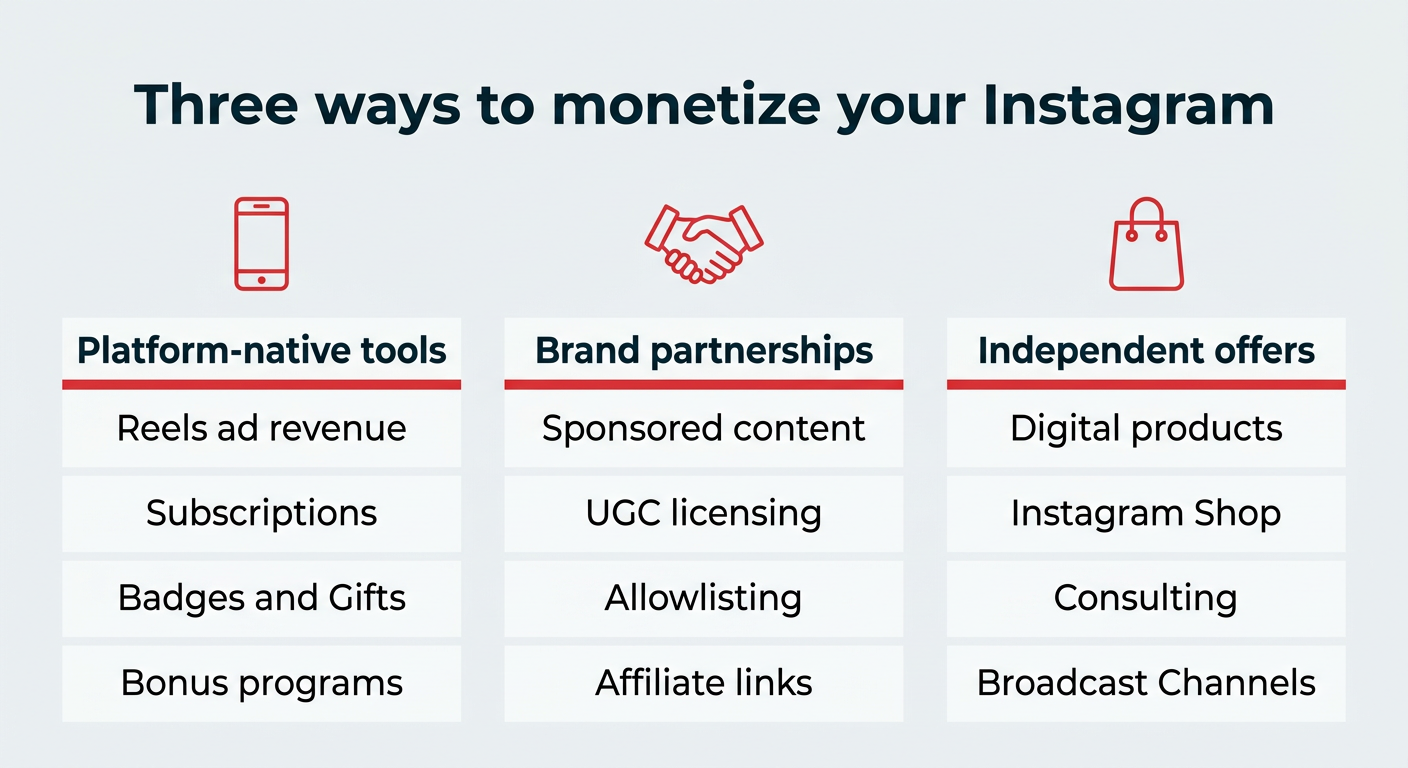
Here’s the full list before we get into the detail:
- Work with brands on sponsored content
- Join an affiliate marketing program
- Earn ad revenue from Reels
- Turn on Instagram Subscriptions
- Use live Badges and Gifts
- Sell digital products
- Set up an Instagram Shop
- License your content to brands
- Use Broadcast Channels to drive revenue
- Offer consulting and coaching
- Sell exclusive access through Close Friends
- Apply for Instagram bonus and creator programs
1. Work with brands on sponsored content
This is likely what most people think of when the topic of Instagram monetization or influencer marketing comes up. A brand could pay you for an in-feed photo or video, Story content, a Reel, or any combination of the above.
We’ve all seen the quintessential Instagram sponsored post where a creator posts a styled shot of the product, chats up how great it is, and tags the brand.
With today’s tools like Reels ads and Stories, branded content is more creative, interesting, and authentic than ever. As a creator, your unique voice is everything, and the posts that perform best usually look nothing like a traditional ad. Think a genuine get-ready-with-me that happens to feature a sponsor’s product, or a day-in-the-life Reel where the partnership is woven into the story rather than bolted on.
Brand work is one of the easiest ways to monetize your Instagram because you’re in control. You can reach out to a brand proactively, negotiate your campaign fee and terms, and ultimately, do as many brand deals as you can get.
You can also let brands come to you. Creator Marketplace is now the primary way many brands discover creators for Instagram campaigns, which means a well-filled-out marketplace profile does some of the pitching for you.
Yes, you need some marketing savvy in the way you approach deals. But anyone can get started working with brands, including creators with a few thousand followers in a specific niche. Micro- and nano-influencers claim 45.5% of spend in 2026.
Eligibility requirements
- Disclosure label: In-feed, Reel, or Story content that’s sponsored through either payment or free product must use the “Paid partnership with” label.
- FTC compliance: The FTC requires sponsored content to carry a clear disclosure such as #ad or #sponsored.
- Follower count: No official minimum. Many creators land their first paid deals between 1,000 and 5,000 followers if engagement is strong.
- Pitch materials: Be prepared to show brands why they should work with you: audience demographics, engagement rate, and past results, not just follower count.
2. Join an affiliate marketing program
Affiliate marketing has been around almost as long as the internet. You share a trackable link to a product, a customer buys through your link, and you receive a commission for referring the sale. Easy.
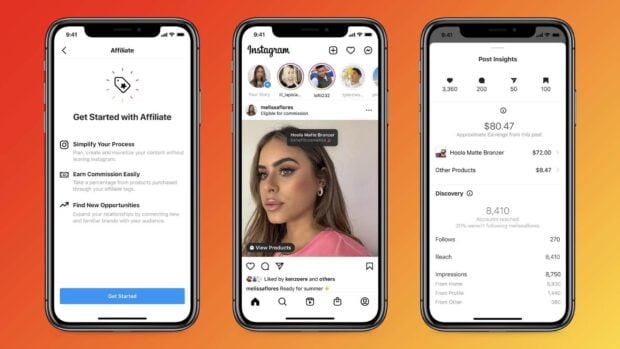
Two Instagram changes made this far more practical for creators: link stickers became available to everyone in Stories regardless of follower count, and profiles can now hold multiple links in bio.
Instagram’s own affiliate tool never rolled out broadly, so most creators earn commissions through external programs instead. The most common routes are Amazon Associates, LTK, ShareASale, Impact, Rakuten, and individual brand affiliate programs. You place affiliate links in three places: Story link stickers, your link in bio (or a link hub page), and Broadcast Channel messages.
Source: Instagram
Affiliate income compounds. A Reel that keeps getting views can keep generating commissions for months, which makes it one of the few monetization methods that pays you again for work you already did.
Eligibility requirements
- Program approval: Each affiliate network sets its own criteria. Amazon Associates and LTK are among the most accessible for smaller accounts.
- Policy compliance: Comply with Instagram’s content guidelines and monetization policies.
- Disclosure: Be honest with your audience and disclose when you’re sharing an affiliate link. The FTC recommends a simple hashtag like #ad, or saying, “I earn a commission through sales placed with this link.”
3. Earn ad revenue from Reels
Instagram pays some creators a share of the ad revenue generated around their Reels. The program works on a revenue share model rather than a flat rate per view, so earnings depend on ad demand in your niche, where your viewers are located, and how many qualifying plays a Reel gets.
Instagram retired in-stream video ads for standard video posts and rebuilt its video monetization around Instagram Reels, which remain the format most likely to reach people who don’t already follow you. Access to Reels ad revenue is invitation-based and rolled out by region, so the practical move is to check your Professional Dashboard for a monetization tab and keep publishing original Reels in the meantime.
Payouts vary widely. Creators typically report earnings in the range of a few dollars to low double digits per 100,000 plays, which means Reels revenue works best as one layer of income rather than the whole plan.
Eligibility requirements
- Invitation: Access is offered by Instagram through the Professional Dashboard. Follow the @creators account for rollout news.
- Account standing: A Professional account in good standing, compliant with Partner Monetization Policies and Community Guidelines.
- Original content: Reels must be original. Reposting content with visible watermarks from other platforms can make a Reel ineligible.
- Format: Use a 9:16 aspect ratio and keep important text clear of the app’s overlays.
4. Turn on Instagram Subscriptions
Instagram Subscriptions let followers pay a recurring monthly fee for exclusive access to you, all inside the app. It’s been publicly available to eligible creators for a while now, and it’s one of the most reliable earners on this list because the income is predictable.
You set your own price, typically anywhere from $0.99 to $99.99 per month. Subscribers get a purple badge next to their username, plus access to whatever you choose to gate:
- Subscriber-only Stories: Behind-the-scenes content, early looks, and casual updates.
- Subscriber Lives: Smaller, more intimate livestreams for paying members only.
- Subscriber Reels and posts: Content that only appears for subscribers.
- Subscriber chats: Group conversations with up to 30 members at a time.
- A subscriber home tab: A dedicated space on your profile where everything gated lives.
Instagram’s subscriptions tools mirror what’s been available on Facebook for years, and the appeal is the same on both platforms:
- Consistent, predictable monthly income.
- The ability to market it to your existing audience, who are more likely to turn into paid subscribers.
- Room to grow your business with new tools and offerings for this core group of supporters.
Unlike monetization methods that depend on view counts or algorithm luck, you control how many subscribers you get. It doesn’t matter how many people you market to, as long as you have the right offer. Ask what people want to see from you and why they follow you, then give them more of it behind the subscription.
Eligibility requirements
- Account type: Professional (Creator) account.
- Age and location: 18 or older and in an eligible country.
- Audience: Typically at least 10,000 followers, though Instagram has extended access to smaller accounts in some markets.
- Standing: Compliance with Partner Monetization Policies and Community Guidelines.
5. Use live Badges and Gifts
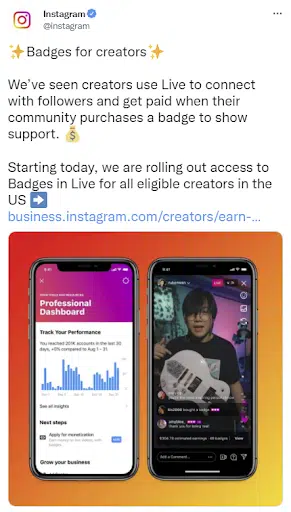
During live videos, viewers can buy Badges to support you. These come in $0.99, $1.99, and $4.99 increments, and a heart icon appears next to the supporter’s name in the comments. Once you switch the feature on, it’s available for every live video you host.
Gifts work similarly but apply to Reels rather than Lives. Viewers send virtual gifts on eligible Reels, and you receive a share of the value as earnings. Both features reward creators whose audiences feel genuinely connected to them, so it pays to mention the option during a live and thank the people who use it.
To turn on Badges, open your profile and go to your Professional Dashboard. Click the Badges tab and switch it on.
After that, you’ll need to set up a payout account via your bank or PayPal. Then, just go live.
Source: Instagram
Eligibility requirements
Badges launched in the US and have since expanded to a number of additional countries. Availability still varies, so check your Professional Dashboard to confirm.
- Location: Be in a country where Badges or Gifts are available.
- Account type: Have a Creator or Business account.
- Age: Be over 18.
- Policies: Adhere to Instagram’s Partner Monetization Policies and content guidelines.
6. Sell digital products
Selling your own digital products is often the highest-margin option on this list, because you keep almost everything after payment processing. Once a product exists, every additional sale costs you nothing to fulfil.
The products that sell well on Instagram tend to solve a problem your content already demonstrates:
- Presets and templates: Lightroom presets, Canva templates, and Notion systems for photographers, designers, and productivity creators.
- Courses and workshops: Structured teaching on the skill your audience follows you for.
- Ebooks and guides: Recipe collections, training programs, travel itineraries, or niche how-to guides.
- Digital art and assets: Fonts, illustrations, sound packs, and stock footage.
Instagram supports this through link stickers in Stories, multiple links in bio, pinned posts that act as a storefront, and DM automation that sends a checkout link when someone comments a keyword. The pattern most creators follow is simple: post free content that proves you know the subject, then point people to the paid version for the full system.
7. Set up an Instagram Shop
If you sell physical goods, an Instagram Shop lets people browse and tag-to-buy without leaving their feed. Product tagging works across posts, Reels, and Stories, so a product can be discoverable in every format you already publish.
This sits closer to social commerce than pure content monetization, but it belongs in any complete guide because so many creators now run both. Merch, prints, and physical product lines are a natural extension once you have an engaged audience, and a shop removes the friction of sending people off-platform.
To set one up you’ll need a Professional account, a connected commerce account, and products that meet Instagram’s commerce eligibility requirements. Once approved, your shop appears as a tab on your profile.
8. License your content to brands (UGC and allowlisting)
Brands will pay for your content even when they don’t want it posted on your feed. There are two versions of this, and both are growing fast.
UGC licensing is when a brand pays you to create content they post on their own channels or use in ads. You’re being hired as a content creator rather than as a media channel, which means follower count matters far less than the quality of what you produce. Plenty of UGC creators earn well with a few hundred followers.
Allowlisting (sometimes called whitelisting) is when you grant a brand permission to run paid ads from your handle. Your post appears as an ad, with your name and face attached, targeted at audiences the brand chooses. Because the brand is buying your credibility and your usage rights, this commands a premium on top of your base content fee.
Price both separately from organic posting. Common practice is to charge a base creation fee, then add a percentage of that fee for each additional month or channel of usage rights.
9. Use Broadcast Channels to drive revenue
Broadcast Channels are one-to-many messaging threads where you post and followers react or vote in polls. They don’t pay you directly, but they’re one of the most effective revenue drivers Instagram has released because messages land in the inbox rather than competing in the feed.
Creators use them to share affiliate links with people who actively opted in, give subscribers early access to drops, promote digital products to a warm audience, and test ideas before committing to a full launch. The audience in a Broadcast Channel is self-selected, which makes conversion rates noticeably better than a standard post.
You can create a channel from your inbox if you have a Professional account. Keep it consistent: channels that go quiet lose the attention that made them valuable.
10. Offer consulting and coaching
If your content demonstrates expertise, some of your audience will pay for direct access to it. This is the fastest route from zero to real income because there’s nothing to build first.
Options range from one-off audits and micro-consults to ongoing coaching retainers and paid mentorship. Photographers sell portfolio reviews, marketers sell strategy sessions, fitness creators sell custom programming. Book calls through a link in bio, and use Stories to share anonymised results so prospective clients can see the value before they pay.
11. Sell exclusive access through Close Friends
Close Friends started as a privacy feature, but creators use it as a manual subscription tier. You collect payment outside Instagram, then add paying members to your Close Friends list so they see gated Stories and posts.
It’s less polished than Subscriptions and you handle billing yourself, but it works in countries where Subscriptions isn’t available yet, and it has no follower minimum. Treat it as a way to validate demand for paid content before you commit to a formal subscription tier.
12. Apply for Instagram bonus and creator programs
Instagram periodically runs bonus programs that pay creators for hitting performance milestones, usually tied to Reels plays or live video engagement. These are invitation-only and change often, so treat them as upside rather than a plan.
If you’re eligible, offers appear in the monetization section of your Professional Dashboard with the specific targets and payout attached. The way to become eligible is unglamorous: post consistently, lean into the formats Instagram is pushing, and keep your account in good standing.
How much should you charge for brand deals?
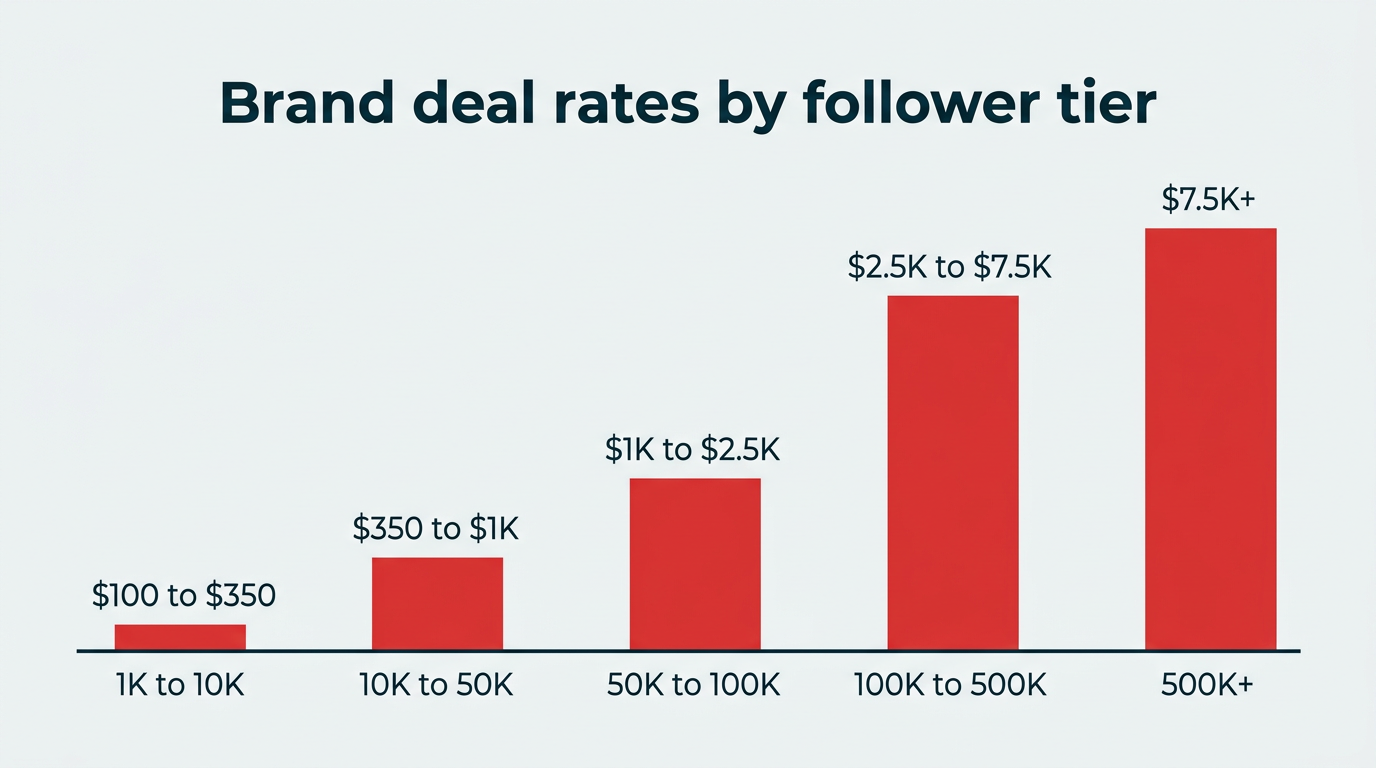
There’s an old rule of thumb that says a good starting point is $100 per 10,000 followers for a sponsored in-feed photo post. With creative formats like Reels, carousels, and multi-frame Stories now standard, that benchmark undersells most creators. Use it as a floor, not a target.
A more useful approach is to set base rates by content type and follower tier, then adjust up for engagement, usage rights, and exclusivity. Here’s a working starting point:
Follower tier | In-feed post | Reel | Story set (3 frames) | Carousel |
|---|---|---|---|---|
1K to 10K | $75 to $250 | $100 to $350 | $50 to $150 | $100 to $300 |
10K to 50K | $250 to $750 | $350 to $1,000 | $150 to $450 | $300 to $900 |
50K to 100K | $750 to $1,500 | $1,000 to $2,500 | $450 to $900 | $900 to $1,800 |
100K to 500K | $1,500 to $5,000 | $2,500 to $7,500 | $900 to $3,000 | $1,800 to $6,000 |
500K+ | $5,000+ | $7,500+ | $3,000+ | $6,000+ |
Typical Instagram brand deal ranges by content format and audience size. Rates vary by niche, region, and engagement.
Pricing by engagement rate
A more precise method is charging by engagement rate, which rewards creators whose audiences actually pay attention. Nano-influencers deliver an average engagement rate of 6.23% compared to 0.61% for macro-influencers.
Average price per IG post (CPE) = Recent average engagements x $0.16
Most creators use anywhere from $0.14 to $0.20. Engagements are the total number of likes, comments, shares, and saves.
So if your recent posts each averaged:
- 2,800 likes
- 25 shares
- 150 comments
- 30 saves
Then your calculation would be: 3,005 x $0.16 = $480.80 per post
Negotiating usage rights and exclusivity
Your base rate covers posting content on your own channels for as long as it stays up. Anything beyond that is a separate line item, and forgetting to charge for it is the most common way creators leave money on the table.
- Paid amplification: If the brand wants to run your post as an ad, add 25% to 50% of the base fee per month of ad usage.
- Cross-channel usage: Charge separately for use on the brand’s website, email, retail displays, or other platforms.
- Exclusivity: If you can’t work with competing brands for a set period, price that lost opportunity in. Three months of category exclusivity commonly adds 20% to 30%.
- Perpetual rights: Avoid granting these by default. If a brand insists, charge a multiple of your base fee.
How much money can you make on Instagram?
Realistically, Instagram earnings range from a few hundred dollars a month for a small, engaged account to six figures a year for creators who stack several methods. The variable that matters most isn’t follower count. It’s how many revenue streams you run at once.
Here’s what each method typically pays:
Method | Typical earnings | What drives the number |
|---|---|---|
Brand deals | $75 to $7,500+ per post | Audience size, engagement rate, niche, usage rights |
Affiliate marketing | $50 to $5,000+ per month | Commission rate, audience purchase intent, link placement |
Instagram Subscriptions | $0.99 to $99.99 per subscriber, per month | Subscriber count and price point |
Reels ad revenue | Low single digits to low double digits per 100K plays | Ad demand in your niche, viewer location |
Live Badges and Gifts | $0.99 to $4.99 per badge | Live audience size and loyalty |
Digital products | $0 to unlimited | Price point, audience trust, conversion rate |
UGC and licensing | $150 to $2,000+ per asset | Production quality, usage terms, exclusivity |
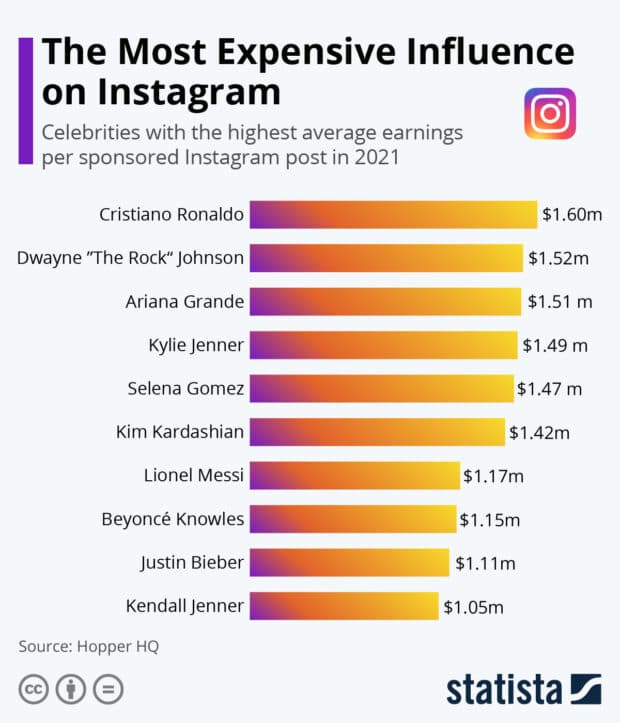
A few data points for context. Our guide to making money on Instagram provides a deeper breakdown of what different creator tiers actually bring in.
Source: Statista
The pay gap in influencer marketing
Unfortunately, racism and bias are factors in how much creators earn, across all platforms. Adesuwa Ajayi started the @influencerpaygap account to expose the disparity between pay for white and Black creators. Seeing what brands are offering for different kinds of content campaigns allows creators to set more informed rates, and, more importantly, for Black, Indigenous, and creators of color to receive equal pay.
The practical takeaway for any creator: share rate information where you can, and check public rate databases before you accept a first offer. Pay transparency is the most effective tool creators have against underpricing.
How to grow your Instagram for better monetization
Every method on this list pays more with a bigger, more engaged audience, and several only unlock once you cross a follower threshold. Growth isn’t the goal in itself, but it’s the lever that raises the ceiling on everything else.
- Pick a specific niche: Brands pay a premium for defined audiences. “Sustainable home cooking on a budget” is worth more per follower than “lifestyle.”
- Post consistently: A predictable schedule trains both your audience and the Instagram algorithm to expect you.
- Lead with Reels: Reels still reach non-followers better than any other format, which makes them your main discovery engine.
- Engage back: Reply to comments and DMs. Saves, shares, and comments influence reach more than likes.
- Know when organic runs out: Understanding organic versus paid reach helps you decide when promoting a post is worth the spend.
- Work from a plan: A documented social media marketing strategy keeps content tied to the revenue you’re trying to build.
Instagram monetization policies and disclosure requirements
Monetization access depends on staying compliant, and violations can cost you eligibility across every feature at once. These are the rules worth knowing before you take your first paid deal.
- Partner Monetization Policies: Apply to your account as a whole. Repeated violations can remove access to Subscriptions, Badges, and bonus programs.
- Community Guidelines: Apply to individual posts. Content that breaks them can be made ineligible for monetization even if your account stays in good standing.
- Content recommendation guidelines: Instagram’s recommendations guide explains what keeps content from being shown to non-followers, which directly affects reach and earnings.
- Paid Partnership label: Required on any content where you received payment, free product, or another benefit.
- FTC disclosure: Disclosure must be clear, conspicuous, and hard to miss. Put #ad near the start of the caption, not buried after a hashtag block, and say it out loud in video content.
- Affiliate disclosure: State plainly that you earn a commission. A branded-content tag alone is not enough.
- Original content: Reused or watermarked third-party content can be disqualified from ad revenue and bonus programs.
Label everything, keep your content original, and check your account status in the Professional Dashboard regularly so problems surface before they cost you a payout.
FAQ: Instagram monetization
Does Instagram pay per 1,000 views?
How many followers do you need to monetize on Instagram?
How many followers do you need to make $1,000 per month on Instagram?
Does an Instagram account monetize automatically?
What is the Instagram Creator Marketplace?
How do Instagram Subscriptions work?
What are the FTC disclosure requirements for sponsored Instagram posts?
Can you monetize Instagram without a large following?
What is UGC licensing on Instagram?
How do you track your Instagram monetization earnings?
Save time managing your social media marketing strategy with Hootsuite. Publish and schedule posts, find relevant conversions, measure results, and more â all from one dashboard. Try it free today.












Post Comment