Unlock Hidden Keywords in Google Analytics 4 That Could Transform Your Website Traffic Overnight
Ever wondered why Google Analytics 4 (GA4) hides your keyword data like it’s some kind of secret treasure? Well, you’re not alone. Unlike the old-school Universal Analytics, GA4 doesn’t just tuck keyword insights away in a different menu—it doesn’t show them by default at all! But here’s the kicker: you can still unlock that crucial organic search query intel by hooking up GA4 with Google Search Console (GSC). After all, knowing which keywords drive traffic, spotting where you’ve lost ground, and understanding how people chat about your product or service can be a game-changer. Stick with me through this article, and I’ll walk you through finding your site’s keywords in GA4, leveraging that data to boost your performance, and tackling those pesky “not provided” keywords that keep SEO folks scratching their heads. Ready to demystify GA4’s new way of showing keyword data? Let’s dive in. LEARN MORE.
Google Analytics 4 (GA4) shows keyword data in a different way than older versions of Google Analytics. And it hasn’t just moved to a new menu — it’s not there by default. But you can easily add in keyword data to GA4.
Using GA4’s keyword reports shows you which terms drive the most users to your site, reveals traffic decreases that need to be addressed, and helps you understand the terms people use to talk about your product or service.
By the end of this article, you’ll know how to find your website’s keywords in GA4, how to use that information to improve your site, and what to do about the “not provided” keywords you may still run into.
Can you see keyword rankings in Google Analytics 4?
No, you can’t see keyword rankings in GA4 by default.
The previous version of Google Analytics (called Universal Analytics) showed keyword information directly, similar to a basic keyword rankings report. But Google removed it to better protect user privacy.
However, you can see some information about organic keywords if you connect your Google Search Console (GSC) account to GA4.
Once you do, you’ll be able to see GSC data on impressions, clicks, average position, and click-through rate (CTR) directly in GA4.
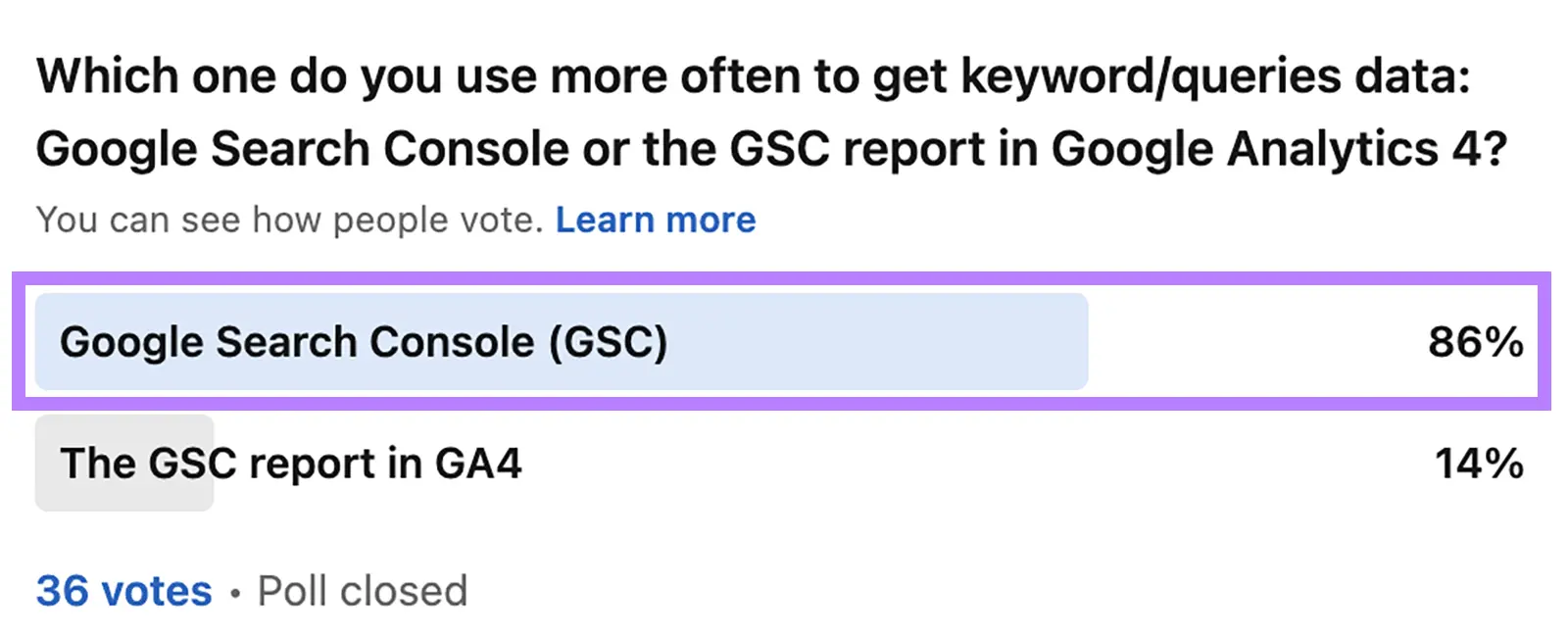
That being said, most marketers prefer to use GSC for this data rather than GA4. In a poll we ran on LinkedIn for this article, we asked marketers which tool they prefer: GSC or the GSC report in GA4?
Out of 36 respondents, 86% said they use GSC directly, and only 14% said they use the GA4 option.

This is obviously a small sample size, but it does suggest that marketers currently underuse the GSC integration, even though it makes performance reporting and analysis more convenient by unifying data.
What does “not provided” mean in Google Analytics keywords?
“Not provided” in Google Analytics keywords means Google withheld the search term behind an organic visit, so you can’t see which keyword brought that visitor to your site. The label dates back to Universal Analytics.
Google started encrypting search referrer data for logged-in users in October 2011 to protect user privacy, which meant Universal Analytics could no longer identify most of the search terms sending you organic traffic.
Those visits showed up labeled “(not provided)” instead. By late 2013, Google had extended this to virtually all organic Google searches, so most Universal Analytics properties eventually saw “(not provided)” as their single largest keyword.
GA4 still shows the label in places like the Manual report’s “Session manual term” dimension, but it doesn’t have a keyword report built around it the way Universal Analytics did. GA4’s only source for organic keyword data is the GSC integration covered below. So instead of working around a “(not provided)” bucket, you’re working within GSC’s own limits: a 16-month data window and query-level thresholds Google applies for privacy.
For a fuller picture of your organic keywords that doesn’t depend on GSC’s data window, use Semrush’s Organic Rankings report. Enter your domain to see the keywords Semrush has independently identified your site ranking for, without the 16-month cap or the GA4 linking setup.
How to see organic keyword data in GA4 (via Google Search Console)
See organic keyword data in GA4 by connecting your GSC account to your GA4 property. Here’s how.
1. Verify your site in Google Search Console
To verify your site in GSC, log in to GSC with the same Google email you use for GA4 if you’ve already set up your account.
If you don’t have an account yet, sign up.
Then, GSC will prompt you to add your property. Select “Add a website.”

After selecting the website option, you can choose between two property types:
- Domain: Collects data for all URLs on your domain and requires verification through your domain name system (DNS) provider
- URL prefix: Collects data only for URLs under a specific website section. You can verify your property through the GA4 tracking tag on your website.

Once you choose a property type, follow the instructions in our GSC setup guide to complete the process.
2. Connect Google Analytics and Google Search Console
To connect GSC and GA4, log in to your GA4 account and click “Admin” > “Search Console links.” (This appears under the “Product links” section.)

Go to “Link” to start the process.

Choose the property you want to connect to GA4 by clicking on “Choose accounts.”

Select the correct property and click “Confirm.”

Select “Next.”

Under “Select Web Stream,” choose a provided data stream and click “Next.”

The last step is to review your choices and click “Submit.”

Your GSC property is now connected to GA4.
3. Enable the Search Console reports
Enable the Search Console reports, as GA4 won’t display GSC query data by default.
Go to “Reports” and click “Library” in the bottom-left corner. Then, find the “Search Console” report, click the three dots, and select “Publish.”

After completing this step, you should be able to see “Search Console” in the GA4 reports menu.

4. Access keyword data
To access keyword data, wait 48 hours for data to be available, then click “Queries” to view the keywords driving people to your site, along with data on:
- Clicks: The number of clicks you get for a specific query
- Impressions: The number of times users saw your results for a given query
- Click-through rate (CTR): The percentage of impressions that led to clicks
- Average position: The average ranking you have for a specific keyword

Note that historical GSC data is available only for the past 16 months.
Further reading: How to Connect GSC to GA4 | How to Use GSC for Keyword Research
3 tips for using GA4 keyword data to optimize your website
Use GA4 keyword data to optimize your website by creating topic clusters, finding content refresh opportunities, and optimizing underperforming pages.
Create topic clusters
Creating topic clusters (a group of pages on your website that cover a similar theme) builds topical authority that can give you credibility with search systems (including AI search platforms).
A cluster consists of a pillar (main) page and multiple cluster pages (subpages).

For example, you could have “indoor plants” as a pillar page. And “best indoor plants for beginners,” “indoor plants for air purification,” and “indoor plants for children” as cluster pages.
Google keyword analysis reveals which queries you already rank well for, which you can use to build topic clusters around proven traffic.
To find your top-performing keywords, sort the GA4 organic keywords report by clicks:

Go through the list and look for patterns.
Let’s say you have a bicycle shop site that gets many visits from purchase-related queries, such as “best mountain bikes” and “best bikes for beginners.”
That means creating additional content on bicycle buying guides would likely be great for SEO. Covering the full range of ways people search around a topic — not just your single best-performing query — also makes AI systems more likely to include your content when they break a search into related sub-queries, a process known as query fan-out.
You can use Semrush’s Keyword Magic Tool to find numerous keywords you can use for your topic cluster strategy.
To start, type in a seed keyword such as “best bikes.” And click “Search.”

Select “Broad Match” to see options that are a variation of your seed keyword.
Select the “KD %” drop-down and enter a custom range of 0 to 49. This applies a keyword difficulty filter that focuses only on terms you can feasibly rank for.

Check the box to the left of every suitable keyword. We recommend selecting a minimum of 50 keywords to ensure you have enough ideas.
When you’re done, click “Send keywords” > “Saved Keywords” > “Apply” to save them for later.

Next, group your topic’s keywords into clusters.
To do so, open the Keyword Strategy Builder and select “Seed Keyword-Based.” Enter your seed keyword (“best bikes”), and click “Create.” You can add up to five seed keywords if you want a broader strategy.

The tool automatically groups related keywords into topics. Under “Topics and pages,” you’ll see each topic broken into a pillar page and the subpages (cluster pages) that support it.

Expand any page to see the keywords it should target.

Then, it’s just a matter of deciding which pages you want to publish on your site. The keywords you saved in Keyword Magic Tool can help you prioritize which cluster pages to tackle first.
Find content refresh opportunities
Find content refresh opportunities by looking for pages that used to perform well but don’t anymore. Then, update these pages to make them more relevant to searchers to improve their performance.
To find refresh opportunities, go to the “Queries” report.
Click the date in the top-right corner, turn on the “Compare” feature, and select “Last 90 days” — this gives you enough data to work with.
Click “Apply.”

The table now displays how much the performance for each metric changed over the selected period.

Identify queries where you lost the most clicks.
Enter each of those queries in Google and analyze the top-ranking content to see where your page falls short. And brainstorm ways to make your content more helpful than the top-ranking pages.
For more ways to mine GA4 data for content decisions, see How to Use Google Analytics for SEO: 6 Best Practices.
Optimize underperforming pages
Optimize underperforming pages (pages that get many impressions but comparatively few clicks) by making them more enticing.
To find these pages, go to GA4 and click “Search Console” > “Google organic search traffic.” Look at the impressions column and find pages with high impressions but low CTR.

Optimize these pages to better stand out by adjusting their title tags (HTML that specifies the page title and may show in search results) and meta descriptions (HTML that provides a page summary and may show in search results).
The best place to start is by Googling the query a page ranks for and analyzing the title tags of the top-ranking pages. Try to emulate (but not copy) them and keep them to between 50 and 60 characters.
Just make sure the title accurately represents the page’s content. If your title promises “10 free SEO tools” and half the list requires a paid plan, people may click, but they’ll leave quickly. You’ll see it in GA4 as a high CTR paired with a low engagement rate, which is a sign the page isn’t delivering what the title promised.
Your meta description should provide a brief and accurate summary of the page that’s around 105 characters.
Both the title tag and description should include the primary keyword whenever possible.
High impressions paired with low clicks increasingly reflect competition from AI Overviews, too — when Google’s AI-generated answer already satisfies the query above the organic results, even a well-optimized listing can lose the click.
For pages where that’s the likely cause, Semrush’s Content Optimizer flags the specific content gaps hurting your visibility in AI Overviews and other AI search results, so your content has the best chance of earning visibility no matter where people search.

How to get more detailed keyword data
Get more detailed keyword data by pairing GSC and GA4 with additional keyword tools, like Semrush’s Position Tracking tool.
To check keyword rankings in Google Analytics, look at the “Average position” column in the GA4 Queries report. But if you want to check your keyword rankings over time rather than just glance at current data, GA4 alone won’t do it. It doesn’t notify you when your rankings change, and it doesn’t let you track performance for a specific group of keywords.
The Position Tracking tool monitors your rankings, including on AI-powered search surfaces like ChatGPT and Google AI Mode, alongside traditional Google and Bing results.
To set it up, enter your domain and click “Set up tracking.” Select your targeting (we’ll choose Google for this example).
Then, add the keywords you want to track in this project.
Note that Position Tracking can import keywords directly from GSC. Just click the “Import from…” button, select “Google Search Console,” and confirm which keywords to add.
When you’re done adding keywords, click “Add keywords to campaign” and then “Start Tracking.”

The “Landscape” report shows a brief summary of changes over your chosen period, along with information on your overall visibility, an estimate of your site’s organic traffic, and the average position you rank in for your chosen terms.

The “Overview” tab lets you add your competitors’ domains to see how they compare to you.

Scroll down to the table to see your and your competitors’ specific rankings and how those rankings are changing.

Use this information to proactively adjust your SEO strategy to remain competitive.
Further reading: How to Track Keywords: The Ultimate Guide
Centralize your organic search performance data
Whether you’re working in-house or at an agency, integrating GSC with GA4 will give you a clearer overview of your organic search performance. Plus, you’ll save time switching between tools.
Take it a step further by using Semrush’s Position Tracking tool, so you can immediately spot changes.
Get started with Position Tracking and many more SEO tools with a free trial.











Post Comment