The Surprising Shift in UK Social Media Marketing Demographics by 2026 That No One Saw Coming
Ever wondered which age group is really calling the shots on UK social media? Spoiler alert: It’s the 25-to-34-year-olds, wielding serious purchasing power and dominating the digital landscape. But here’s the kicker — while YouTube and TikTok steal the spotlight among the 18-24 crowd, Facebook quietly continues to reign supreme for the more seasoned 45-plus audience. And talk about contrasts, TikTok’s userbase tilts heavily female, with over 60%, whereas X (you know, formerly Twitter) swings the other way, favoring males. From discovering your next favorite product to hitting that checkout button, social media’s no longer just a place to chat; it’s the nerve center of modern shopping journeys. If you’re itching to decode these shifting sands and tailor your marketing mojo to nail your audience every time, then you’re in the right spot. Dive in, and let’s turn these demographics from mere stats into your next big breakthrough. LEARN MORE.
Summary
- Most active age group: In the UK, the 25-34 age group represents the largest segment of active social media users, holding significant purchasing power.
- Top network for youth vs. mature audiences: YouTube and TikTok dominate the 18-24 demographic, while Facebook remains the most effective platform for reaching UK consumers aged 45 and above.
- Gender splits: TikTok heavily skews female with 61.5% vs. 38.5% male users. This sharply contrasts with X (formerly Twitter), which has 67.8% male vs. 32.1% female users.
From product discovery to checkout, social media defines the modern customer journey. With 43% of UK consumers using social search daily, it’s no longer just a networking tool, it’s a primary search engine. And for younger demographics, this shift is even more pronounced.
Why understanding UK social media demographics matters for marketers
A winning digital strategy knows who it’s talking to. And for UK audiences, those conversations happen on social media. According to Sprout Social’s UK Index, 91% of UK consumers keep up with trends and cultural moments through social media.
British people place a high value on authenticity, cultural relevance and timeliness in brand communications. This means your content needs to reflect these values and what they mean to different demographics.
What feels culturally relevant and timely to a 19-year-old university student differs greatly from what resonates with a 43-year-old parent of two. Yet both demographics are highly active on social media and expect content that speaks to them.
Alternatively, there are differences in how the same audience uses different platforms. For instance, the 43-year-old might use LinkedIn for professional research but Instagram to shop for kids’ clothes.
This is why understanding demographics is essential, as it dictates the format, tone and objective of the content you produce.
Getting it right allows you to:
- Craft social media content that resonates with specific communities
- Adjust your strategy based on what your community wants
- Choose influencers whom your target demographic connects with
- Tailor your content and strategy for specific platforms
Both the challenge and the opportunity lie in uncovering how and where your target demographic uses social media.
UK social media usage by age and generation
In the UK, social media platforms attract large audiences across age groups and daily social media usage is high.
Before getting into the particulars of each social network, it’s worth viewing the broader picture of UK social media trends relating to age and generation.
Social media use is the highest among younger populations. According to Statista, 98% of Gen Zs were using social media in the UK as of September 2024. Millennials follow close behind at 97%. Meanwhile, 92% of Gen X and 86% of Baby Boomers were using social media.
When it comes to specific platforms, WhatsApp has the highest penetration across all age groups as reported in the Ofcom Online Nations Report 2025. Facebook, YouTube and Instagram follow behind respectively. The main deviation is with users aged 55 and above, who use Facebook Messenger more than Instagram.
But when you look at the time spent on different social media platforms, you can get a better idea of how different age groups use each platform differently.
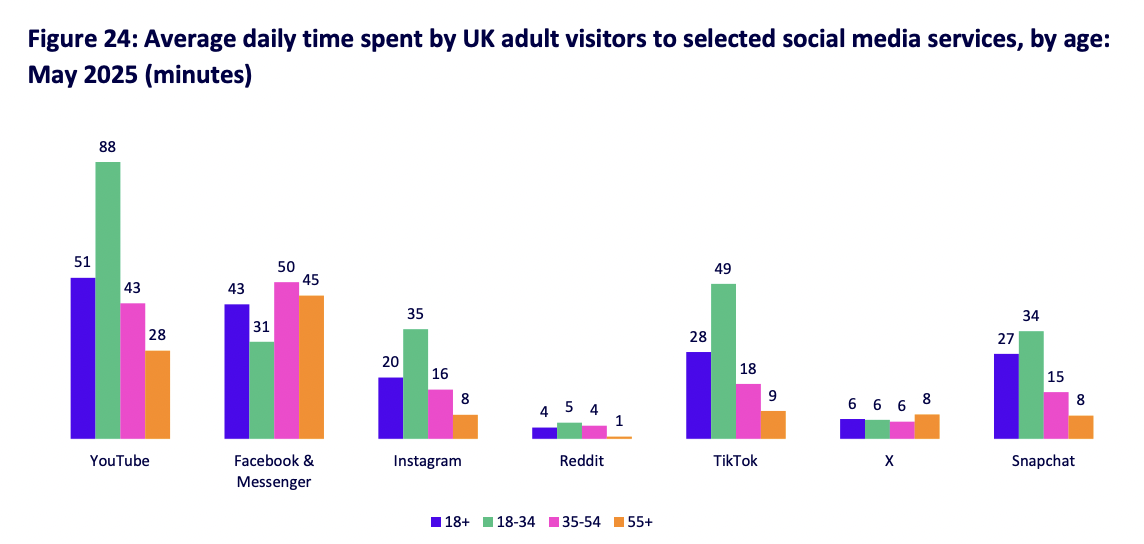
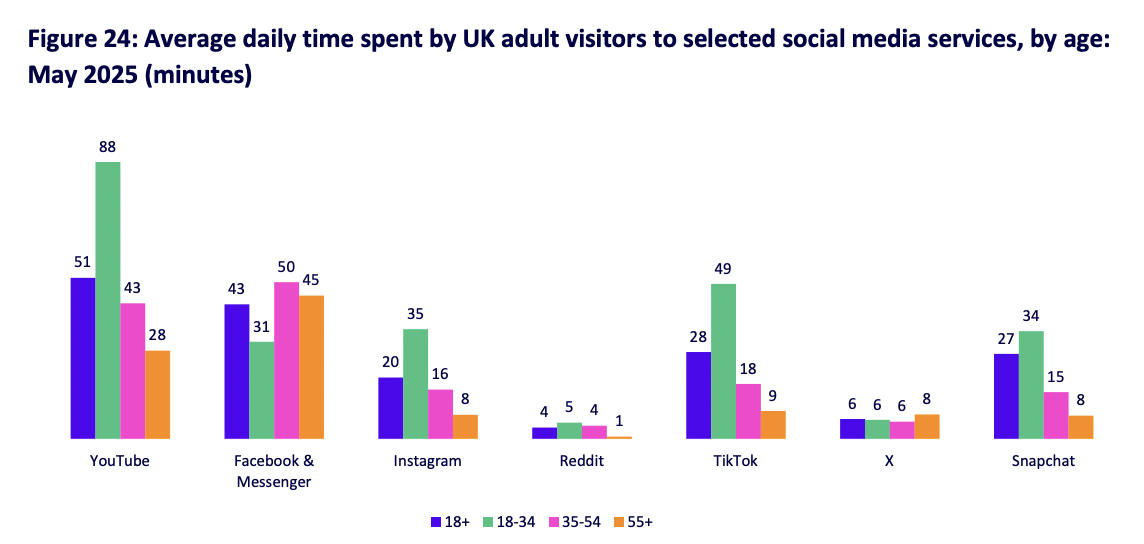
- YouTube: the most used platform for users aged 18-34 years, with an average of 88 minutes spent daily. TikTok is the second most used platform, with 49 minutes spent per day on average, followed by Instagram at 35 minutes.
- Facebook and Messenger: popular among users aged 35-54 years, with an average of 50 minutes spent daily. YouTube comes next, with 43 minutes spent per day on average.
- Facebook and Messenger: also dominate the time spent on social media for users aged over 55 years. This age group spends an average of 45 minutes per day on these platforms. YouTube is the second most used social media platform, with 28 minutes spent per day on average.
Source: Ofcom
Looking at these patterns, you can see how Facebook and Messenger are popular choices for Millennials and Gen Xers—the two generations with the highest disposable income in the UK.
Meanwhile, YouTube and TikTok dominate for Gen Zs, who are most likely to use social media for product discovery.
UK Social Media Platform Dominance by Age Group (2026)
| Age Group | Most Used Platform (Daily Time Spent) | Most Popular Platform (Penetration) | Primary Marketing Use Case |
|---|---|---|---|
| 18-34 years | YouTube | Brand Awareness | |
| 35-54 years | Facebook + Messenger | Social Commerce | |
| 55+ years | Facebook + Messenger | Social Commerce |
Platform-by-platform demographic breakdown for the UK
Understanding the demographics of different social media platforms gives you an idea of where your target audience is and how they use each platform. So you can tailor your platform-specific strategies accordingly.
Facebook demographics in the UK
According to DataReportal, the UK has a total of 38.8 million Facebook users. That’s around 55% of the total population. It’s well past the explosive growth stage seen on TikTok, but the good news is that usage is still going strong. That’s particularly true in social commerce, where new features are added every day.
In fact, Facebook and its corresponding Messenger app are where older Millennials and Gen X populations spend the most time.
That said, it’s less popular among Gen Z and younger Millennials.
The average amount of time UK users spend on the app is 43 minutes per day. Users aged 18 to 34 years spend an average of 31 minutes per day on Facebook and Messenger.
Facebook user demographics in the UK by Age:
| Age Group | Percentage of UK Users |
|---|---|
| 18–24 | 15% |
| 25–34 | 8% |
| 35–44 | 8% |
| 45–54 | 7% |
| 55–64 | 8% |
| 65+ | 12% |
The average age of Facebook users is between 25 and 44 years, with this age group making up almost half of the platform’s user base.
It skews older than other platforms because the audience has matured. And that could be a good thing. Older millennials and Gen X have the highest median disposable income per household in the UK. So, if you have high-ticket products or luxury items, Facebook might be your best bet.
With features like Marketplace and Facebook Groups, the platform is also great for marketing to a local audience and building communities.
For more detailed insights, Sprout Social’s Facebook Analytics tool has you covered.
Instagram demographics in the UK
DataReportal shows that the UK has a total of 35.5 million users. That’s 50.9% of the total population and 59.5% of the eligible population (over the age of 13).
The latest UK Instagram stats show that Brits spend an average of 53 minutes per day, or around six hours a week, on the platform. This is a sharp contrast from the Ofcom data, which shows that UK users spend an average of 20 minutes per day on Instagram.
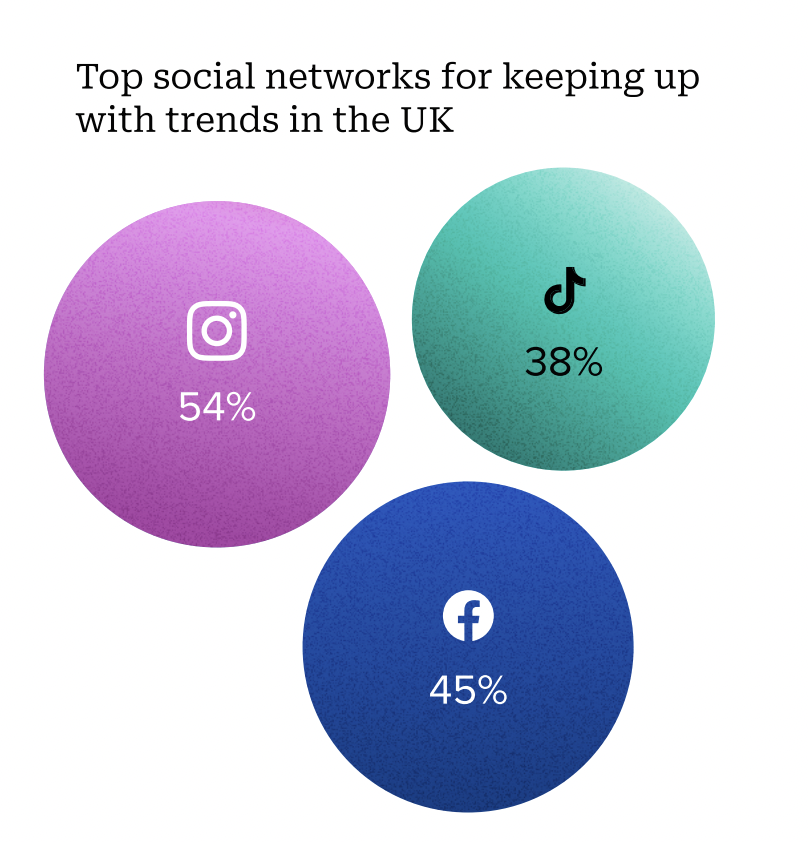
Either way, you can clearly see that the UK has a strong appetite for Instagram content. In fact, Sprout’s UK Index shows that it’s the top platform for keeping up with trends, with 54% of UK consumers using it for this purpose.
Most UK Instagram users are Gen Z and Millennials, but Gen Xers and Boomers are still active on the platform.
Instagram age demographics in the UK by age:
| Age Group | Percentage of UK Users |
|---|---|
| 18–24 | 19% |
| 25–34 | 5% |
| 35–44 | 7% |
| 45–54 | 8% |
| 55–64 | 8% |
| 65+ | 2% |
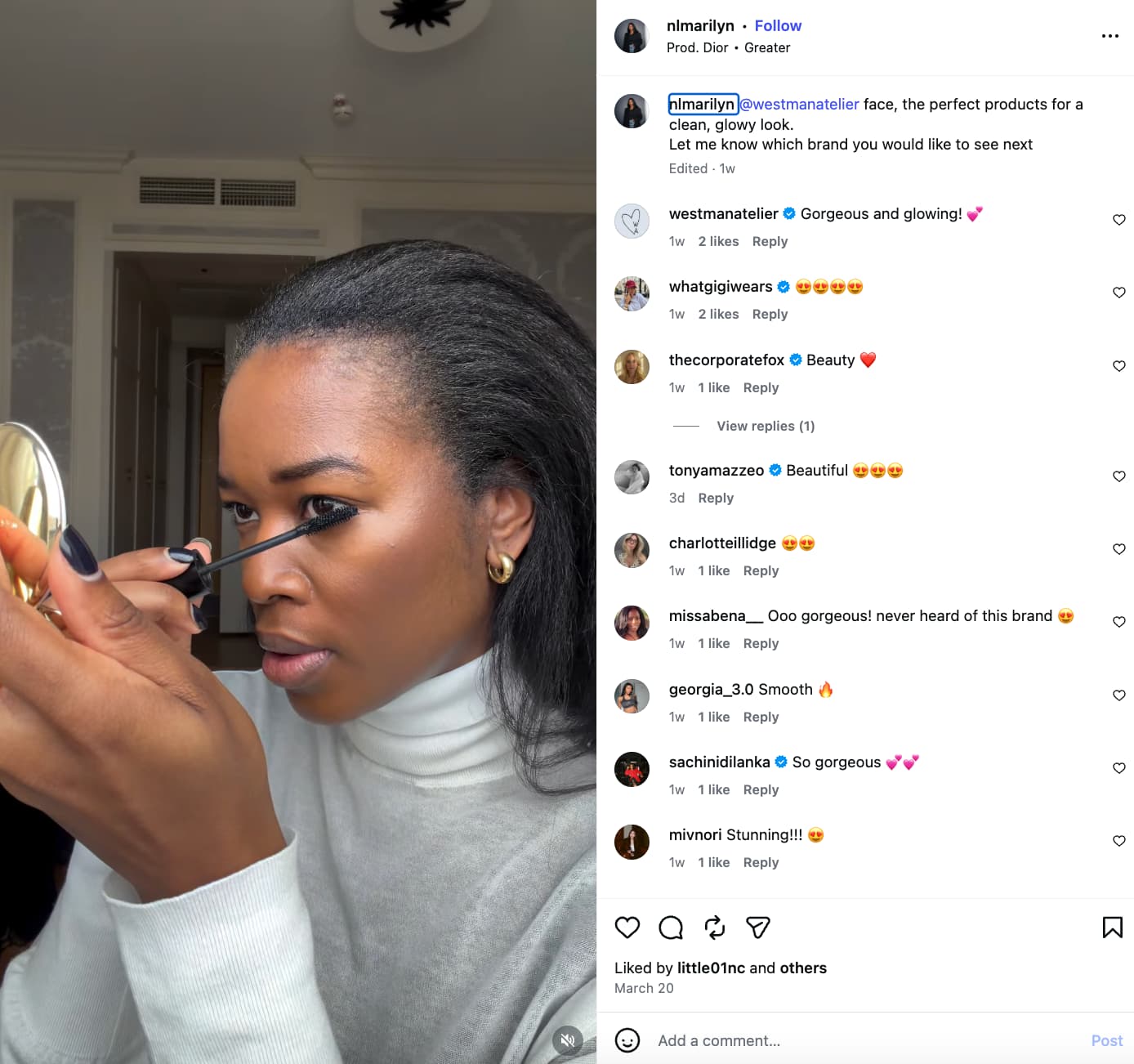
Due to the visual nature of the platform, brands whose chief appeal lies in aesthetics typically do best. Think fashion, beauty and skincare, health and wellness, as well as retail brands.
And with Instagram’s built-in shopping tools, it’s easier than ever for users to go from product discovery to checkout.
Instagram is also where Millennials and Gen X are most likely to engage with influencer content. So it’s an excellent platform to partner with UK influencers.
Source: Instagram
Need a hand scheduling your IG content? Check out Sprout Social’s Instagram Scheduling tool.
TikTok demographics in the UK
With 26.8 million active users in the UK, TikTok is in the rapid growth stage. It saw a 12.5% increase in ad reach between 2024 and 2025, making it one of the fastest growing social networks in the UK.
The latest TikTok stats also show that UK users spend an average of 49 hours and 29 minutes per month on TikTok, well above the global average of 34 hours.
While Ofcom reports a daily average time spent of 28 minutes, DataReportal shows that UK users spend an average of 88.5 minutes per day on TikTok. Either way, TikTok is one of the most used social media platforms in terms of time spent.
Older demographics are also increasingly adopting the platform and, in turn, increasing the buying power of the average TikTok user in the UK.
TikTok demographics in the UK by age:
| Age Group | Percentage of UK Users |
|---|---|
| 18–24 | 4% |
| 25–34 | 8% |
| 35–49 | 5% |
| 45–54 | 9% |
| 55+ | 4% |
Interestingly for brands, most users are scrolling, not posting. Despite a global user base of almost 2 billion, users post only 16,000 videos per minute (or 23 million videos per day). This means less competition and a better chance for brands to cut through.
Like Instagram, TikTok is a highly visual platform, but there are some slight differences in the overall vibe. These differences alter which content rises to the top of the algorithm.
For instance, eMarketer reports a 391% YoY increase in video views for wellness content. Consumer packaged goods (CPG) and retail also do exceptionally well with a 132% and 126% growth in views, respectively.
Beauty continues to shine (110%), as do home (91%) and fashion (83%).
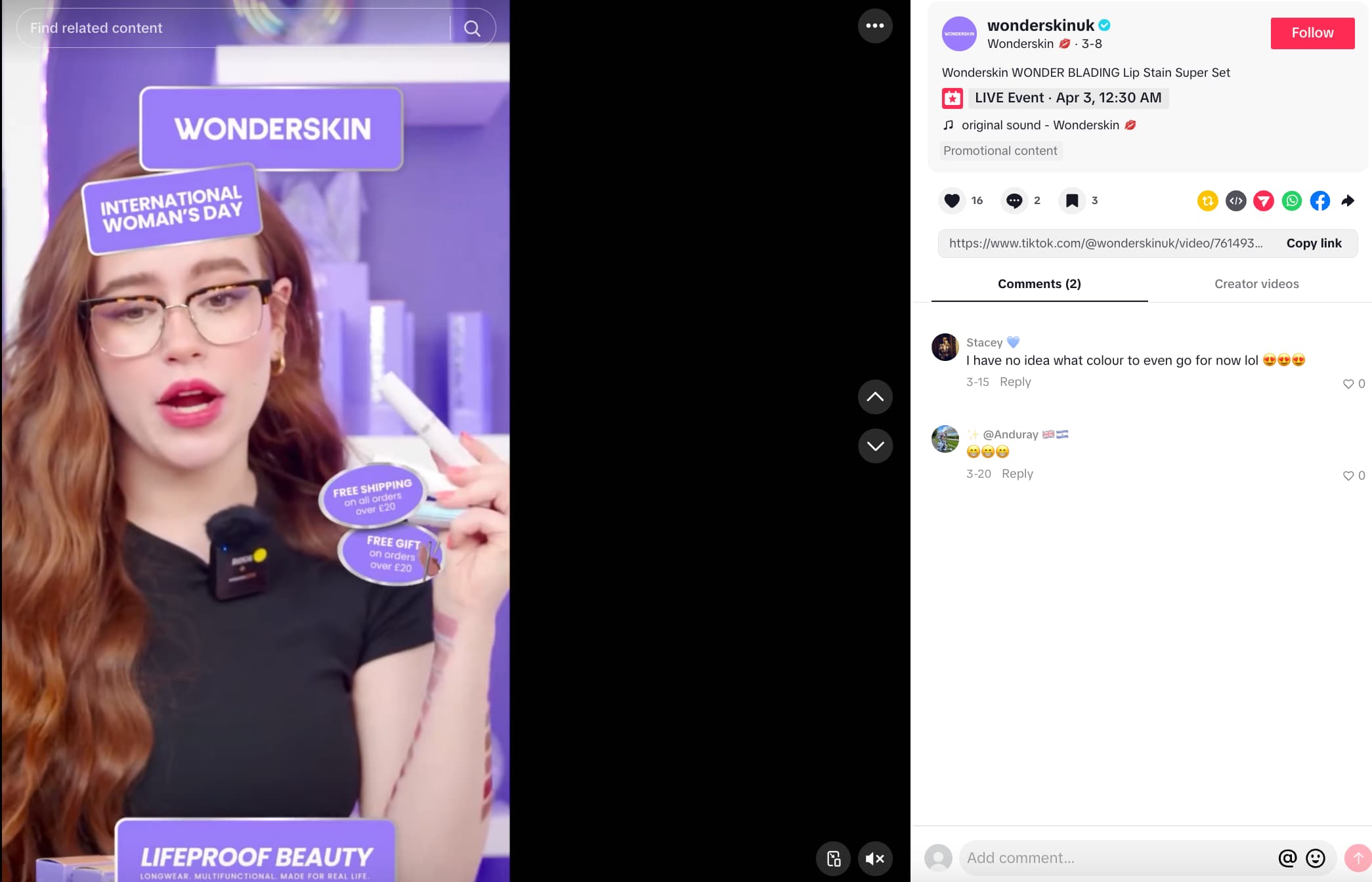
With TikTok driving viral product trends and supporting in-app purchases, it’s a place where UK consumer brands can drive top-of-funnel awareness and conversions. Brands like Wonderskin managed to sell over 413,000 units on TikTok Shop UK in 2025.
Source: TikTok
LinkedIn demographics in the UK
LinkedIn has 1.3 billion members globally, with 48 million in the UK. That’s almost 70% of the country’s total population.
LinkedIn is exceptional in that, age and gender notwithstanding, its user base is largely homogeneous. It is a platform designed for white-collar professionals, and people use LinkedIn for career-related purposes only.
LinkedIn users in the UK by age:
| Age Group | Percentage of UK Users |
|---|---|
| 18–24 | 1% |
| 25–34 | 3% |
| 35–54 | 2% |
| 55+ | 4% |
We can see that the bell curve skews slightly young, but the meat of it lies in older Gen Z and Millennials. As seniority level often correlates to age, these are the age brackets typically associated with middle management and the C-suite.
This makes LinkedIn the perfect platform to engage key decision makers with high-quality content. In particular, the platform is great for reaching B2B consumers in management, IT, finance and sales. Use it to showcase expertise through brand stories, thought leadership content and industry insights.
Check out more LinkedIn post ideas for UK brands to inspire you.
YouTube demographics in the UK
YouTube has a total of 55.5 million active users in the UK, making up almost 80% of the total population. As you’d expect in a case of mass adoption, the gender split is razor-thin: 50.2% female vs. 49.8% male.
YouTube is one of those platforms with a broad appeal across all age groups. Based on the latest YouTube stats, it’s the third most popular social network globally. And the same holds true for the UK.
The Ofcom data reveals YouTube is the third most popular social media app across different age groups:
- Age 18-34: 84% reach
- Age 35-54: 75% reach
- Age 55+: 60% reach
It’s also the most used social media app in terms of daily time spent. UK consumers spend an average of 51 minutes per day on the platform, with younger populations spending significantly more time. Even the least active age group (55+) spends at least 28 minutes per day on YouTube.
Given its ubiquity, virtually all demographics are represented. In that sense, you can think of YouTube as the opposite of the hyper-specialised LinkedIn. YouTube delivers content for every niche imaginable.
And the platform’s focus on audio-visual formats makes it perfect for informative content that guides both B2C and B2B buyers throughout their journey.
Think: product demos, influencer vlogs, how-to guides, factory/store tours and unboxing videos.
X (formerly known as Twitter) demographics in the UK
With 19 million users, X is one of the least-used social media platforms in the UK. This marks a 12% decrease in its UK user base between late 2024 and late 2025, equating to a loss of 5.05 million users. While 10% have left, 33% of UK users have considered leaving, citing changes to the platform in recent years.
That said, its heavily male-skewed user base (67.8% and 32.1% female) offers specificity for male-focused brands.
The data on X (formerly Twitter) demographics in the UK indicates that it’s a great place to reach tech professionals and sports fans.
Beyond this, X continues to drive real-time conversations around trending topics and news. So it’s the platform for UK brands to tap into cultural moments.
The real-time engagement opportunity also makes it suitable for prompt social media customer service.
Age-related data specific to the UK is not currently available, but here is X’s global age breakdown:
| Age Group | Percentage of Global Users |
|---|---|
| 13-17 | 2% |
| 18–24 | 1% |
| 25–34 | 5% |
| 35–49 | 1% |
| 50+ | 3% |
For detailed insights, check out Sprout Social’s Twitter Analytics tool.
WhatsApp demographics in the UK
WhatsApp is the biggest social media platform in the UK in terms of reach, with 90% of adults using it in May 2025, up from 87% in 2024. It has a near-universal penetration across all age demographics:
- 18-34: 92% reach
- 35-54: 91% reach
- 55+: 93% reach
Additionally, the gender split is almost even with 52% women vs. 48% men.
UK consumers are also spending more time on the app, with each individual using it for around 17 minutes per day. And 74% of online adults in the UK access the app daily.
Being the “great equaliser,” WhatsApp is a platform where UK brands need to maintain a presence. With its instant messaging tools, it’s an excellent channel for conversational commerce. Your WhatsApp marketing strategy could involve sending opt-in broadcasts and handling complex customer care queries.
As the platform introduces new business tools, it has moved on from being just a peer-to-peer chat app and now serves as a primary revenue and retention channel.
Audience Profiles of Major Social Media Platforms (UK)
| Social Media Platform | Age | Gender Skew | Marketing Objective |
|---|---|---|---|
| 25–34 | 52.7% female vs. 47.3% male | Social commerce, community building | |
| 25–34 | 54.2% female vs. 45.8% male | Social commerce, influencer marketing | |
| TikTok | 25–34 | 61.5% female vs. 38.5% male | Brand awareness, social commerce |
| 25–34 | 45.5% female vs. 54.5% male | B2B lead generation | |
| YouTube | 18-34 | 50.2% female vs. 49.8% male | Brand awareness, customer education |
| X (formerly Twitter) | 25-34 | 32.1% female vs. 67.8% male | Real-time cultural relevance, customer care |
| All age groups | 52% female vs. 48% male | Conversational commerce, personalised customer care |
How to use demographic insights to improve your UK strategy
Here’s how you can use these key UK social media demographics to inform your 2026 strategy:
1. Prioritise platforms based on your target audience
Effective social media marketing is all about reaching your audience where they are. You don’t need to be everywhere all at once. Just focus on the platforms that make the most sense by matching your buyer persona to the demographic data above.
For instance, Facebook for targeting older Millennials and Gen X-ers with luxury offerings or local services. Or TikTok for targeting Gen Zs and younger Millennials with beauty or fashion products.
2. Tailor voice, format and post timing
The biggest difference with the above social media platforms is the overall style and content format.
A 25-year-old on TikTok may engage with entertaining bite-sized videos in trending styles like get-ready-with-me and POV. But a 45-year-old on LinkedIn may seek out insightful thought leadership text posts from industry leaders.
You must tailor the voice and format of your content according to the audience demographic and trending content style of each platform.
Timing is another factor to consider, with user activity varying by time of day across platforms. Make sure to time your posts so they reach your audience when they’re active on a specific platform.
Use Sprout’s data on the best times to post on social media in the UK to guide your publishing schedule. Then look into platform-specific analytics to see what timings work best for you.
3. Align influencer partnerships with precise audience data
Audience demographics can significantly vary across creator profiles.
For example, an Instagram influencer may have 84% female followers, with 45% of followers aged between 35 and 44. So they may not be the best fit for a brand that wants to reach mostly male users aged between 25 and 34.
Before investing in a UK influencer campaign, make sure to get the creator’s audience breakdown to ensure it aligns with the high-converting demographics identified in your overarching strategy.
How to use Sprout Social for smarter audience targeting
Having a general idea of key UK social media demographics helps you understand where to focus your efforts. But you need to dig deeper into your audience demographics to understand what works with your unique audience.
From the trends that matter to the content styles they engage with, your audience insights can show you how to win market share in the UK.
And that’s exactly what you can do with Sprout’s Social Listening tools and audience demographics reporting features. The in-depth audience demographics breakdown and conversational insights tell you exactly who your audience is and what matters to them right now.
Try Sprout Social free with a 30-day trial
Ready to turn your audience insights into strategy? Get Sprout for free for 30 days.