The Surprising Digital Marketing Shift Turning Private Jet Charter Companies Upside Down in 2026
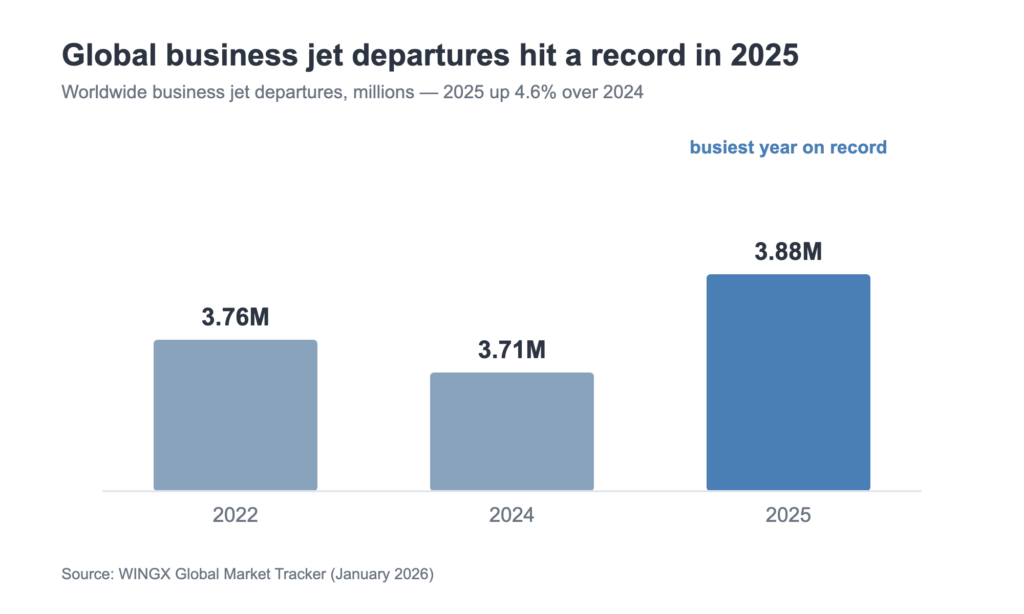
Ever wondered if booking a private jet has become as meticulous as hunting for your next smartphone or that dream car? Well, buckle up—because since 2020, private aviation stopped being the exclusive playground of a select few and transformed into a savvy shopper’s game. With a record-shattering 3.8 million business jet departures in 2025, according to WINGX’s Global Market Tracker, today’s charter clients don’t just take anyone’s word for it. They dig deep—comparing safety ratings, decoding jargon, and researching operators the exact way you’d scrutinize a major purchase. For charter brokers, this means the game’s changed: it’s no longer just who you know—it’s who’s visible, informative, and lightning-fast on the search engine starting line. Ready to dive into how the private jet market is pivoting into a high-speed, content-driven era? LEARN MORE.
Private aviation clients now research charter operators the way they research any major purchase.
The private aviation boom that began in 2020 permanently changed who flies private. Thousands of first-time charter clients entered the market, and they did not quietly go back to the airlines. According to WINGX’s Global Market Tracker, 2025 was the busiest year on record for business aviation, with more than 3.8 million business jet departures worldwide. Those flyers comparison-shop, read safety ratings, and research operators the way they would research any major purchase. For charter companies and brokers, that means the next client is far more likely to start with a search engine than with a referral.
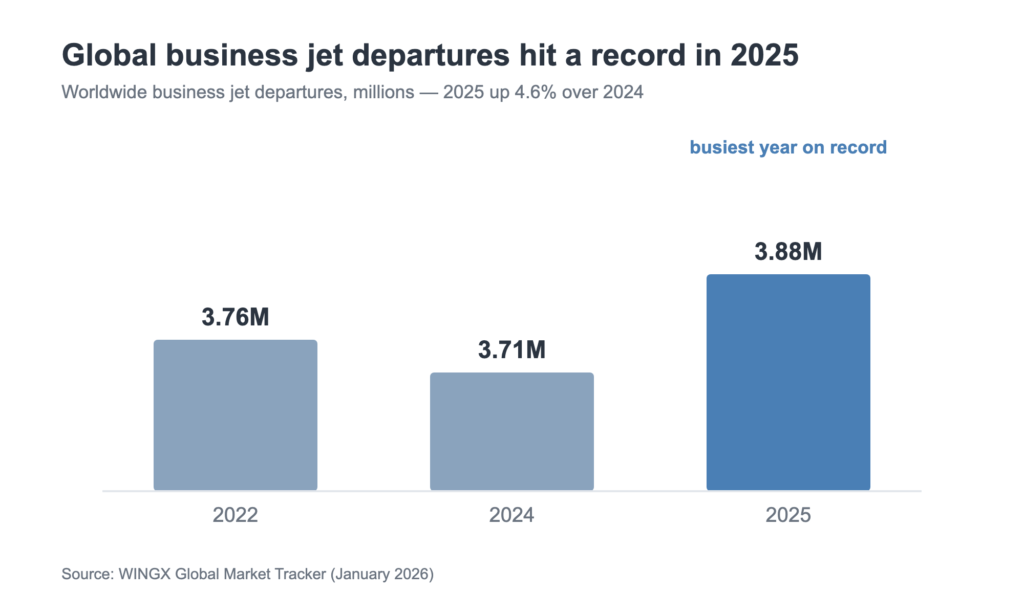
Business aviation activity set a new record in 2025, beating the previous high from 2022.
The Brochure Website Era Is Over
For decades, none of that mattered much. Charter sales ran on relationships, repeat clients, and word of mouth, and most operator websites reflected it: a fleet gallery, a phone number, and a quote form. That model is showing its age. When a prospective client searches for how empty-leg pricing works, what an ARGUS or WYVERN safety rating actually means, or the difference between jet cards and on-demand charter, the operators who answer those questions in plain language are the ones who get the inquiry. The ones with brochure sites never enter the conversation.
The shift is being compounded by AI-powered search. A growing share of high-net-worth travelers now ask ChatGPT, Gemini, or Google’s AI Overviews to compare charter options and explain industry terms before they ever click a website. Those AI engines cite the sources that explain things clearly and authoritatively. A website that only says “call for a quote” is invisible to them.
Educate Like a B2B Company
The charter companies growing right now treat content the way sophisticated B2B firms do: structured libraries of genuinely useful answers about safety auditing, pricing mechanics, and aircraft selection, built out over time and interlinked so that both search engines and AI assistants can follow the expertise. Aviation buying cycles are long, and the nurture has to match. In a recent brief prepared for aircraft brokers ahead of EBACE in Geneva, our team found that the brokers winning multi-year deals are the ones whose educational content keeps them in front of buyers between transactions.
Respond Like a Concierge
The second half of the equation is speed. A charter inquiry is one of the most perishable leads in any industry; a trip request that goes unanswered for half a day is usually booked elsewhere. The classic Harvard Business Review audit of more than 2,200 companies found that firms contacting a new web lead within an hour were roughly seven times as likely to qualify it as firms that waited even one hour more — and sixty times as likely as those that waited a day. Charter operators are pairing their content programs with automated lead routing and follow-up so that a quote request at 9 p.m. on a Friday gets a response in minutes, not Monday morning.
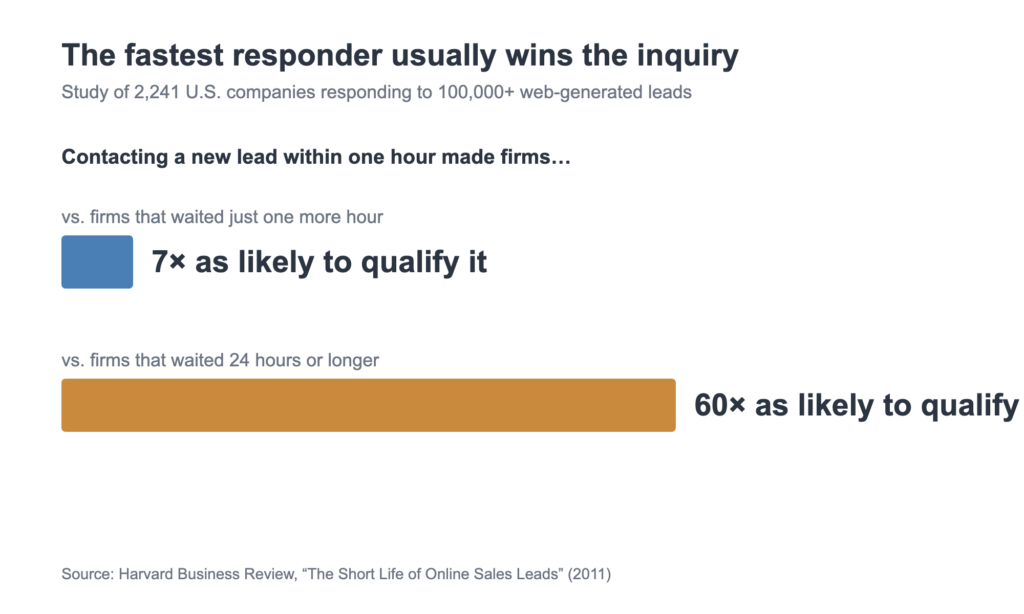
Response speed compounds: the operator who answers first usually wins the trip.
Specialization Is Replacing Generic Marketing
None of this looks like generic small-business marketing, which is why charter companies are increasingly turning to specialists. BlakSheep Creative built its private jet charter marketing practice around exactly this playbook: deep educational content clusters, optimization for AI-driven search, and response automation tuned to how charter clients actually buy. The firms it works with range from boutique brokers to multi-aircraft operators, and the common thread is a belief that expertise should be visible online, not locked in a sales team’s heads.
The operators who win the next phase of this market will not necessarily be the ones with the largest fleets. They will be the ones a nervous first-time flyer can find, understand, and trust at 11 o’clock at night, three weeks before a trip they have never booked before.
Clint L. Sanchez is the founder of BlakSheep Creative, a Louisiana-based digital marketing agency serving service businesses, aviation companies, and professional firms nationwide. A veteran firefighter turned marketer, he writes about practical digital strategy for industries that traditional marketing overlooks.
By Clint L. Sanchez, BlakSheep Creative
SME Paid Under