The Shocking Truth Behind AI Visibility Scores No One Told You About
Ever wonder if those flashy AI visibility scores you see actually tell the real story? Tools like Profound and Peec AI promise to track how often a business pops up in AI-generated responses, handing out neat little scores like candy. But here’s the kicker: these scores are often as reliable as a weather forecast from a fortune cookie. If the prompt mentions your business name, boom—100% visibility. Sounds too easy, right? It’s like scoring points for answering your own questions in a game show. What we really need are metrics that mirror what real folks type when they’re searching for answers, not just scripted shout-outs. In this whirlwind of AI citations, the real game-changers focus on what content actually influences consumers, how competitors shape the conversation, and the subtle dance between visible and “invisible” citations. So, how do you cut through the smoke and mirrors and craft a content strategy that truly speaks to your audience in the age of generative AI? Let’s dive deeper. LEARN MORE.
AI visibility-tracking tools such as Profound and Peec AI monitor specific prompts and report a business’s visibility in the responses. The tools then assign scores to measure how often the business appears.
But the visibility scores depend entirely on the prompts and are highly manipulated (as some agencies are doing). For example, a response will include a business’s name if the prompt contains it, resulting in a visibility score of 100% and elevating the overall average.
More helpful metrics would reflect what consumers actually enter.
Helpful AI Tracking
Most cited domains
Marketers focus too much on citations and build strategies to appear in all responses to relevant prompts. But citations are dynamic and can vary for the exact same prompts from the same user.
A better approach is to analyze sites with citations across multiple generative AI platforms. The strategy enables an actionable focus on:
- User-generated content and social media platforms that impact AI answers.
- Publications trusted by large language models.
- Competitors that are frequently cited (for analysis).
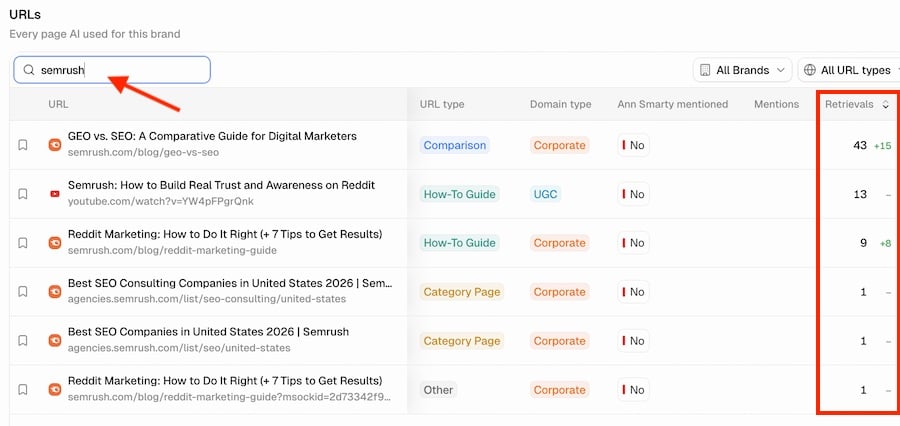
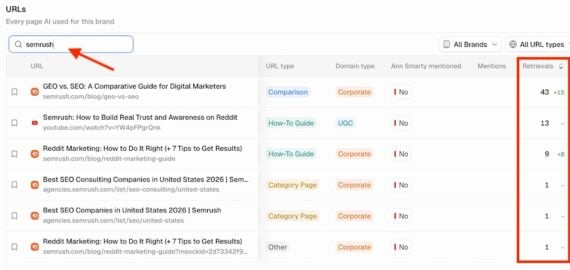
This report from Peec AI shows the platforms that cited “semrush” by name. Click image to enlarge.
Competitor citations
AI tracking tools can inform a business’s content gap beyond keywords. A site that fails to address prospects’ concerns will not appear in many responses. Study competitors that excel at informing shoppers on-site, and then spot their pages in responses to relevant prompts.
The result is a content strategy that responds to a business’s target audience.
Cited but not visible
“Invisible citations” can be confusing.
The term refers to AI answers that link to pages inline (or in a separate panel) without naming the source. The links apparently receive few clicks, judging from how little traffic genAI platforms produce.
Conversely, “visible citations” mention a brand or business by name. In my testing, those citations drive buying decisions and should be the focus of genAI optimization.
Yet invisible citations are opportunities to improve on-site content with branded answers, which genAI could then show alongside the link.
Branded prompts
The key strategy for AI visibility is to provide genAI platforms with information about your business. Branded prompts can inform whether a site does this effectively.
I use these prompts and look for detailed and up-to-date responses:
- What is [your business name]?
- [Your business name] versus [competitor’s name].
- [Your business name] reviews and complaints.
- Is [your business name] trustworthy?