The Secret World of Affiliates: What You’ve Never Been Told
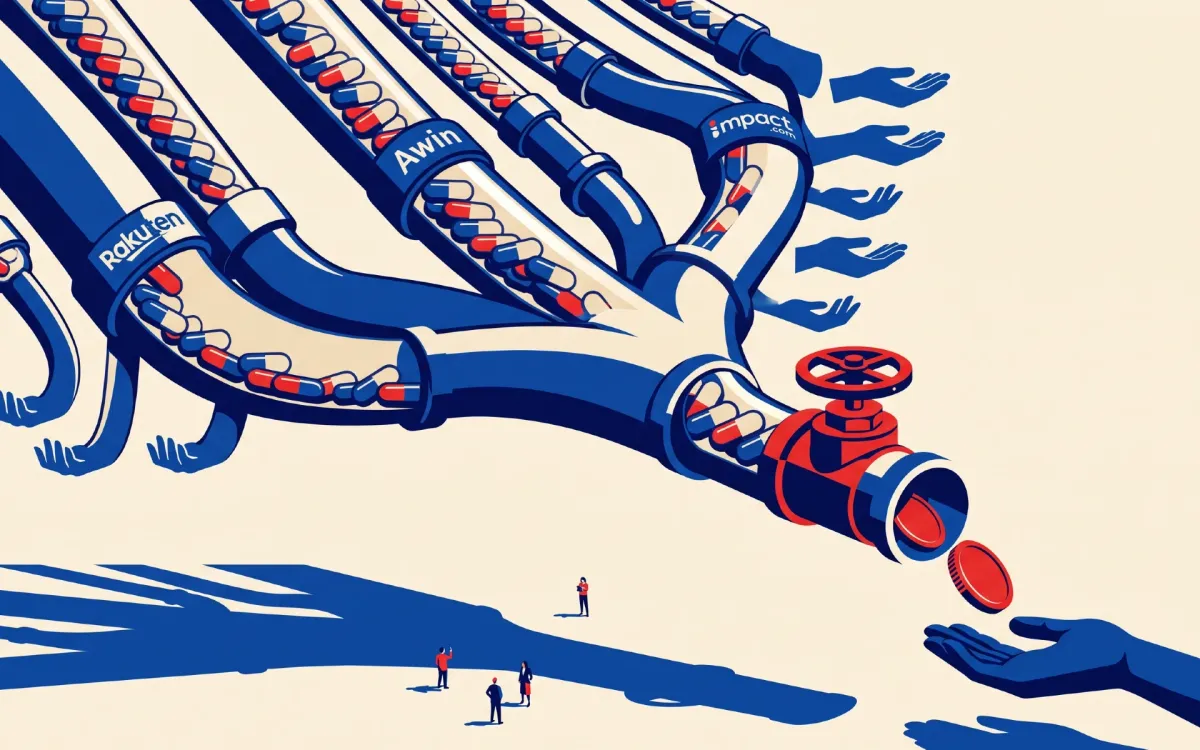
Ever wonder why some links on the web mysteriously pay out only after a customer buys something—and not a penny before? Welcome to the world of affiliate marketing, where trust, tech, and a pinch of patience come together to make digital magic happen. Unlike traditional ads that demand upfront cash for eyeballs, affiliates get their cut only when real results land in the merchant’s cart. It’s performance marketing at its finest—think of it as the ultimate no-win, no-fee hustle. But behind this seemingly simple dance lies a complex trio: advertisers who set the rules, publishers who plant the seeds, and networks that invisibly track every click and sale. Over three decades, this model has evolved from cookies to server-side wizardry, battling fraud, shifting browser rules, and leveraging the creator economy’s explosive growth. So, how exactly does this age-old system still fuel billions in online sales, and why is everyone from YouTube creators to tech giants scrambling to get their piece of the pie? Let’s dive into the mechanics, the drama, and the future of affiliate marketing’s ever-turning wheel. LEARN MORE.
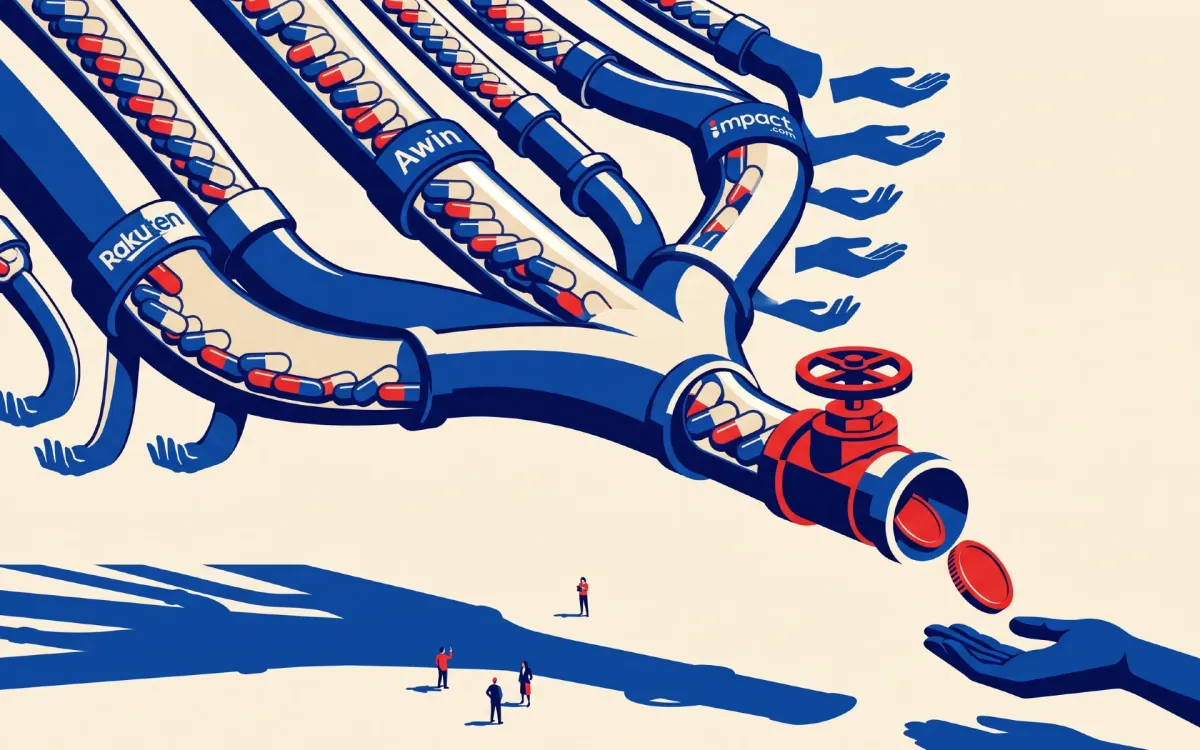
An affiliate is a publisher paid a commission when a customer it refers completes a purchase or another agreed action. The word covers the party and the payment model at once. Money moves after the outcome, not before it, which is why the channel sits under performance marketing rather than media buying. A display campaign is bought on exposure. An affiliate is bought on results, and a programme that sells nothing costs nothing beyond the platform fee.
Four roles make up the structure. The advertiser, also called the merchant, runs the programme and sets the rates. The publisher, historically the affiliate and in current platform language the partner, places the tracked link. A network or platform sits between them, issuing links, recording clicks, matching sales and moving payment, all of it invisible to the customer.
How a commission is earned
The mechanics have barely changed in thirty years, though the plumbing has moved server side. A publisher receives a link carrying its own identifier and, usually, an optional SubID field for granular reporting: a page, a campaign, an individual video. The click does not go straight to the merchant. It passes through the network’s tracking domain, which records the click, writes a cookie and redirects the browser to the merchant’s landing page with a click identifier appended to the URL.
At checkout the merchant fires the second half of the pair. A tracking tag on the order confirmation page, or increasingly a server-to-server postback from the merchant’s backend, transmits an order reference, order value, currency, a commission group identifying the product category and, where relevant, the voucher code used. The network matches that record to the stored click. The sale then enters a pending state, sometimes called validation, while the advertiser checks it against returns, cancellations, duplicate claims and fraud. Declined sales vanish, and the publisher carries the loss.
The cookie window governs how long a click stays eligible. Thirty days is the common default across consumer retail programmes, but the range is wide. Amazon’s Associates operating agreement runs a session of only 24 hours from the click, ending sooner if the customer orders or clicks another associate’s link, with a separate 89-day allowance for items added to a cart. Semrush, at the other end, migrated in November 2025 from a proprietary system carrying a ten-year cookie and first-click attribution to impact.com’s platform using 120-day cookies and last click, reporting a 400% rise in new sign-ups within six months.
Last click is the industry default and the source of most of the channel’s disputes. Whichever tracked link is touched most recently before the purchase collects the whole commission, regardless of which publisher created the demand.
Browser policy forced the tracking layer to change. Apple’s Intelligent Tracking Prevention 2.1, released on February 21, 2019, capped every persistent cookie written through document.cookie at seven days, according to WebKit. Networks moved to server-side click storage, first-party tracking subdomains and postback conversion feeds, restoring measurement on Safari but shifting the integration burden onto merchant engineering teams.
Payment models and rates
Commission as a percentage of order value, known as cost per sale or revenue share, dominates. Cost per action and cost per lead cover categories where the conversion is a form rather than a basket: insurance quotes, mortgage enquiries, software trials. Cost per click survives in comparison networks. Semrush prices the two events separately, paying $10 for a trial activation and $200 for a new sale. Rates track margin, with fashion and general retail in single-digit percentages and software or financial products higher. Platform programmes devolve the decision: YouTube leaves commission to the retailer, shows it in the tagging interface, and pays through AdSense between 60 and 120 days after purchase to absorb returns.
Origin and evolution
The model predates the commercial web. William J. Tobin’s PC Flowers & Gifts ran on Prodigy from 1989 and moved to the internet in 1994 with IBM, reaching roughly 2,600 affiliate partners by 1995. Tobin filed a patent application on January 22, 1996; US patent 6,141,666 was granted on October 31, 2000, and a second, 7,505,913, on March 17, 2009. CDNow’s BuyWeb programme, which let music review sites link directly to albums, launched in November 1994.
Amazon Associates opened in July 1996 and made the model famous. Amazon filed its own affiliate patent application in June 1997 and received the grant in February 2000. Networks followed. LinkShare and Commission Junction built the intermediary layer through the late 1990s, and Rakuten agreed to buy LinkShare for $425 million in September 2005, according to Internet Retailer.
The first credibility crisis arrived early, as adware and toolbar publishers overwrote legitimate referrals at scale. Commission Junction and LinkShare both published codes of conduct against the practice in December 2002. Automatic link rewriting then became a business of its own: Sovrn acquired VigLink, whose JavaScript converted ordinary outbound publisher links into affiliate links, on December 13, 2018.
Why the channel matters to marketers
Scale is the first reason. impact.com reported $270 million in projected annual recurring revenue in January 2026, roughly $120 billion in partner-referred gross merchandise value and about 350,000 active partnerships, within a performance marketing market it put at $600 billion. Creator-driven revenue on the platform rose 51% year over year during Cyber Week 2025.
The second is that affiliate has become the settlement layer for creator commerce. YouTube cut the entry bar for its Shopping affiliate programme from 10,000 subscribers to 500 in March 2026, after enlisting 45 specialist agencies across nine countries in June 2025 to broker creator-brand deals. A survey of 1,000 US creators published in June 2026 found that 36.4% choose where to send shoppers based on which destination pays best, the single largest factor, while only 7.1% route on brand request alone.
Disclosure obligations are the third. The Federal Trade Commission’s revised endorsement guides, effective July 26, 2023, treat an affiliate link as a material connection requiring clear and conspicuous disclosure. Sweden’s consumer regulator has pursued around 100 influencer labelling cases with fines reaching 1.5 million kronor per violation, ahead of a Digital Fairness Act expected from the European Commission.
Limitations and disputes
Last-click attribution invites interception, and the clearest demonstration involved PayPal’s Honey extension. An investigation published in December 2024 showed the extension replacing creators’ tracking cookies with PayPal’s own affiliate codes at checkout, including when it found no discount at all. The networks acted a year later: Rakuten Advertising terminated Honey on January 12, 2026, impact.com suspended it on January 16, and Awin confirmed policy breaches on January 21, including the addition of 146,000 retailers without consent. “Transparency and trust matter, especially when our industry is under scrutiny,” Awin chief executive Adam Ross said.
Fraud is structural rather than exceptional. Lunio, launching affiliate fraud detection in May 2026, put US affiliate click fraud losses at $2.8 billion for 2025 and invalid traffic at 24% of affiliate clicks. The channel never acquired the pre-payout verification layer that programmatic display built years ago.
Incrementality is the older complaint. Cashback, coupon and extension publishers frequently appear at the last click on purchases that were already going to happen, which is why advertisers apply commission tiering, deduplication rules and partner-level attribution overrides. Terms can also change under publishers: OnlyFans operator Fenix International faces a class action filed on August 12, 2026 over its withdrawal of a 5% lifetime referral commission, capped retroactively at 12 months and $50,000 from May 1, 2020.
Disambiguation
Affiliate and influencer marketing overlap but pay differently. A brand deal pays a flat fee for content whether or not anything sells; an affiliate arrangement pays per outcome. Creators increasingly run both on the same post.
An affiliate network aggregates advertisers and publishers into a shared marketplace and handles payment. An affiliate platform licenses the tracking technology while the advertiser recruits its own partners. Rakuten Advertising and Awin are networks; impact.com and Partnerize began as platforms and added marketplaces.
Referral programmes reward existing customers for introductions, usually with account credit, and typically sit outside network tracking.
In corporate documents, an affiliate is a company under common control with another, a usage unrelated to marketing that surfaces in the same contracts.
Recent developments
Consolidation arrived in April 2026, when Rakuten International and impact.com announced an alliance combining Rakuten Advertising’s managed services and Rakuten Rewards shopping data with impact.com’s platform, citing tracking, attribution and incrementality as focus areas. Rakuten also published an open-source stand-down SDK on May 6, 2026, a 6KB TypeScript package detecting affiliate redirect chains so extensions can suppress their own tracking, and reinstated Honey the same day. Litigation continues: Judge Beth Labson Freeman denied PayPal’s motion to dismiss on June 22, 2026, and Honey’s merchant count has fallen from roughly 35,000 to just above 28,000.
Platform expansion has not slowed. YouTube opened its Shopping affiliate programme to UK creators on August 6, 2026 with Wayfair, Currys, Debenhams, Boots, M&S and Etsy, passing 100% of merchant commissions to creators during the launch period. Amazon began placing Sponsored Products campaigns into creator content on August 10, 2026 through its Influencer Program.
The larger question is what agentic shopping does to the last click. Google’s Universal Cart, announced on May 19, 2026, tracks deals and applies codes inside Google’s own surfaces, and industry analysts have flagged the consequence for coupon and deal publishers: when the discount is found and applied before any navigation, the affiliate site loses the click and the commission even if the code originated in its network. OpenAI’s Instant Checkout, launched on September 29, 2025 with Stripe, charges merchants on completed purchases inside ChatGPT. Both route the transaction around the tracked redirect the model depends on.
Timeline
- 1989: PC Flowers & Gifts launches on Prodigy
- November 1994: CDNow starts its BuyWeb affiliate programme
- 1995: PC Flowers & Gifts reaches roughly 2,600 affiliate partners on the web
- January 22, 1996: William J. Tobin files the first affiliate marketing patent application
- July 1996: Amazon Associates opens
- June 1997: Amazon files its own affiliate patent application
- February 2000: Amazon’s affiliate patent is granted
- October 31, 2000: US patent 6,141,666 is issued to Tobin
- December 2002: Commission Junction and LinkShare publish codes of conduct against predatory adware publishers
- September 2005: Rakuten agrees to acquire LinkShare for $425 million
- December 13, 2018: Sovrn acquires VigLink and its automatic link rewriting technology
- February 21, 2019: Apple’s ITP 2.1 caps client-side cookies at seven days, pushing networks server side
- July 26, 2023: Revised FTC endorsement guides take effect, treating affiliate links as material connections
- December 22, 2024: Investigation into Honey’s commission diversion is published
- September 29, 2025: OpenAI launches Instant Checkout in ChatGPT
- November 2025: Semrush completes migration to last-click attribution with 120-day cookies
- January 12 to 21, 2026: Rakuten Advertising, impact.com and Awin cut off or suspend Honey
- March 2026: YouTube lowers Shopping affiliate eligibility to 500 subscribers
- April 28, 2026: Rakuten International and impact.com announce their alliance
- May 6, 2026: Rakuten publishes an open-source stand-down SDK and reinstates Honey
- May 19, 2026: Google announces Universal Cart
- June 22, 2026: A US court allows the creators’ class action against PayPal to proceed
- August 6, 2026: YouTube opens its Shopping affiliate programme in the United Kingdom
- August 10, 2026: Amazon places Sponsored Products campaigns into creator content
Summary
Who. Advertisers fund the programmes, publishers and creators place the links, and networks and platforms such as Rakuten Advertising, Awin, impact.com and CJ operate the tracking and payment layer. Agencies and outsourced programme managers run recruitment and compliance on the advertiser’s behalf.
What. A performance arrangement in which a third party earns a commission, typically a percentage of order value, only when a referred visitor completes a purchase or another defined action, matched through a tracked redirect and a conversion tag or server-side postback.
When. In continuous use since PC Flowers & Gifts in 1989 and CDNow’s BuyWeb in November 1994, standardised by Amazon Associates from July 1996, patented between 1996 and 2009, and rebuilt around server-side tracking after Apple’s ITP restrictions from 2019.
Where. Across content sites, coupon and cashback services, comparison engines, browser extensions, email and, since the mid-2020s, inside platform-native programmes on YouTube, TikTok Shop and Amazon.
Why. It converts media risk into a variable cost, gives smaller publishers a revenue line that does not require an ad sales team, and now underwrites much of creator commerce. Its dependence on the last recorded click is also its weak point, which is where the Honey affair, the fraud estimates and the arrival of agentic checkout all land.


![[DAY 1] Marketing 2030: Preparing for the Next Generation of Growth](https://onlinecashshop.com/wp-content/uploads/2026/10/day-1-marketing-2030-preparing-for-the-next-generation-of-growth-300x225.jpg)