London’s Financial Giants Chase Digital Gold Boom as Tokenized Holdings Surge 48%—What’s Driving the Rush?
So, JPMorgan, HSBC, and StoneX just pulled off something pretty wild in London—they completed the first-ever live wholesale trades of fractional tokenized gold. Sounds fancy, right? But here’s the kicker: they didn’t move a single gold bar out of the vaults. Instead, they used this digital gold as collateral, aiming to keep London’s massive gold market a step ahead of its Asian competitors. It’s like turning gold into a digital asset without losing the old-school sparkle. But what does this mean for the future of trading—will gold finally act like a true digital asset? And what about those crypto gold tokens we’ve been eyeing? This could be a game changer or just another shiny experiment. Either way, it’s a fascinating peek into where the bullion market might be headed next. Curious to dive deeper? LEARN MORE.
JPMorgan, HSBC and StoneX completed the first live wholesale trades of fractional tokenized gold in London last week. The test is meant to keep the world’s largest gold market ahead of Asian rivals. The three firms also used the digital gold as collateral, without moving a single bar out of the vaults.
Bloomberg reported the trades on Tuesday. They ran on a system built by the World Gold Council (WGC), the industry body that led the project. David Tait, the WGC’s chief executive, called it “a historic step forward for the gold market.”
JPMORGAN $JPM, HSBC AND STONEX COMPLETE THE FIRST LIVE WHOLESALE TRADES OF FRACTIONAL DIGITAL GOLD IN LONDON, ALSO USING IT AS COLLATERAL pic.twitter.com/bwVAdrpkXh
— The Wolf Of All Streets (@scottmelker) November 24, 2026
The banks did not say how much gold changed hands. The system is still in testing, and there is no date yet for a wider launch. The timing is awkward for gold itself. The metal trades near $3,626 an ounce, 32% below its January record and 11% lower than a year ago.
What changes for London’s bullion market, and does it matter for crypto’s own gold tokens?
London Wants Gold to Trade Like a Digital Asset
The WGC calls the new format “pooled gold interests.” Each one is a fractional, electronically transferable share in a pool of physical bars held in approved London vaults.
That fills a gap. Most London trades today are in unallocated gold, which is cheap to hold but leaves buyers as creditors if their bank fails. Allocated gold means owning specific bars, which is safer but costly and hard to split. The WGC proposed the pooled model with law firm Linklaters in September 2025 as a third route between the two.
The collateral piece matters most. Banks could pledge gold for loans and margin as easily as they post bonds, without trucks or vault transfers.
London has a lot riding on it. Its over-the-counter market handles more than $180 billion of gold trades a day, and its vaults held $1.4 trillion of gold in August. Hong Kong, working with the Shanghai Gold Exchange, began testing its own gold clearing system in July.
Market Intelligence: Crypto Analyst Predicts Best Low-Cap Crypto
Tokenized Gold Is Growing, but It Still Has a Long Way to Go
The London pilot is a closed, bank-only system. Crypto has run its own version for years with Tether Gold (XAUT) and PAX Gold (PAXG), and those tokens have been growing fast.
We read the supply of both tokens straight from their Ethereum contracts, where each token equals one troy ounce. We compared that with CoinGecko’s figures from a year ago.
- Tether Gold: 827,418 ounces, up 58% from about 522,000 a year ago.
- PAX Gold: 442,957 ounces, up 33% from about 334,000.
- Combined: 1.27 million ounces, or 39.5 tonnes, up 48%. That is worth about $4.6 billion at today’s price.
So crypto’s digital gold kept adding ounces even as the gold price fell. Still, the two tokens hold about 0.33% of the value of gold sitting in London’s vaults. The whole tokenized gold category traded about $329 million in the past 24 hours on CoinGecko, against London’s $180 billion a day.
Explore: RLUSD Surpasses Trump’s USD1 Stablecoin but XRP Still Sinks 26%
PAXG Price Analysis: Gold Tokens Test the Lows
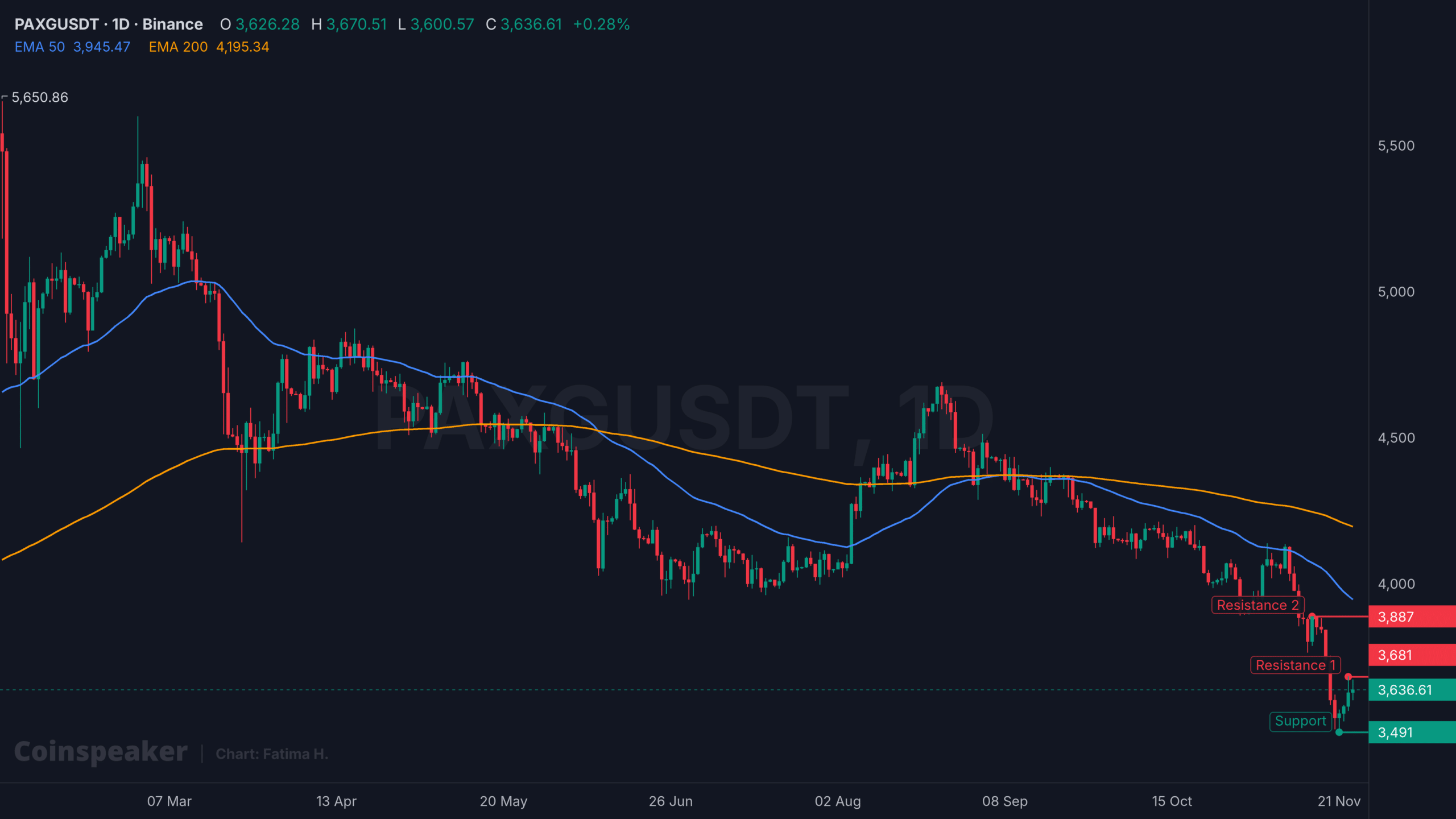
PAX Gold tracks the metal closely. On Binance, PAXG trades at $3,637, below its 50-day exponential moving average (EMA), an average that gives recent prices more weight, at $3,945, and its 200-day EMA at $4,195.
Last week’s sell-off pushed it to $3,491 on Saturday, its lowest level in 300 days. Sellers led on Binance’s spot market, where the token itself changes hands. Orders that sold at the market price right away outweighed buyers by a net $13.4 million over the past seven days.
- Resistance: $3,681, Monday’s high. Above that, $3,887, the cap from November 15 to 17.
- Support: $3,491, Saturday’s low.

| Outlook | Trigger | Level to watch |
|---|---|---|
| Rebound | A daily close above $3,681 | $3,887, the mid-November cap |
| Holding pattern | Price stays between $3,491 and $3,681 | A base after last week’s drop |
| Sell-off | A daily close below $3,491 | $3,400, the next round level |
Market Intelligence: Crypto Analyst Reveals Upcoming Coinbase Listings
The WGC still has to settle governance rules and a launch date. If the big banks adopt digital gold for collateral, the gap between London’s vaults and crypto’s gold tokens could start to close.
Disclaimer: Coinspeaker is committed to providing unbiased and transparent reporting. This article aims to deliver accurate and timely information but should not be taken as financial or investment advice. Since market conditions can change rapidly, we encourage you to verify information on your own and consult with a professional before making any decisions based on this content.

Daniel Frances is a technical writer and Web3 educator specializing in macroeconomics and DeFi mechanics. A crypto native since 2017, Daniel leverages his background in on-chain analytics to author evidence-based reports and deep-dive guides. He holds certifications from The Blockchain Council, and is dedicated to providing “information gain” that cuts through market hype to find real-world blockchain utility.












Post Comment