I Reviewed G2’s Top 7 Security Awareness Training Software
You can patch a system quickly, but changing human behavior takes effort—and is even more critical. A recent report reveals that 95% of data breaches stem from human error, such as falling for phishing emails, reusing passwords, or neglecting multi-factor authentication. People remain the most vulnerable and unpredictable element in your security defenses.
To address this, I evaluated over 20 platforms to identify the best security awareness training software that goes beyond generic content and outdated phishing tests. I focused on tools that genuinely drive behavioral change across organizations, not just dashboards and completion rates.
Here are the seven standout solutions known for thoughtful design, real-time insights, and support for both small IT teams and large security programs. Whether you need scalable enterprise solutions or flexible options for mid-sized teams, this list covers it.
Top 7 Security Awareness Training Software in 2026:
KnowBe4 Security Awareness Training — Best for enterprise-grade simulations: Offers customizable phishing campaigns, automated user risk scoring, and strong compliance support. Starting at $1.30 per seat/month.
Hoxhunt — Best for behavior-driven training experiences: Uses gamification and real-time phishing simulations that adapt to user behavior and engagement. Custom pricing.
SoSafe — Best for human risk scoring: Features engaging microlearning, attack simulations, and data-driven insights tailored to region and risk. Custom pricing.
Arctic Wolf — Best for managed security services integration: Combines security training with 24/7 SOC capabilities, ideal for managed detection and response strategies. Custom pricing.
MetaCompliance Security Awareness Training — Best for compliance-focused organizations: Integrates policy management with training to meet frameworks like ISO, GDPR, and HIPAA. Custom pricing.
Proofpoint ZenGuide — Best for threat intelligence-driven training: Provides content based on real-world threat intelligence, role-based training, advanced phishing simulations, and adaptive learning paths. Custom pricing.
Huntress Managed Security Awareness Training — Best for SMB-focused, security-first training: Delivers practical, easy-to-deploy programs with realistic phishing simulations and clear reporting designed for lean IT teams. Custom pricing.
These platforms are top-rated according to the latest G2 Grid Spring Report 2026.
Detailed Overview of the Best Security Awareness Training Software
While firewalls and strict permissions are vital, if employees aren’t trained to recognize phishing attempts, your security remains vulnerable.
You can patch a system in minutes, but patching human behavior? That takes work.
And it’s more important than you think. According to a recent report, 95% of all data breaches are caused by human error. Whether it’s falling for a phishing email, reusing passwords, or skipping multi-factor authentication, people remain the weakest (and most unpredictable) link in your security stack.
That’s why I spent time evaluating over 20 tools to find the best security awareness training software. The ones that go beyond generic content and outdated phishing tests. I wasn’t just looking for dashboards and completion rates; I wanted to know which tools drive real behavior change across organizations.
The seven tools in this list stood out for their thoughtful design, real-time insights, and ability to support both lean IT teams and global security programs. Whether you need something scalable for an enterprise rollout or flexible enough for mid-sized teams, you’ll find a solution that fits.
TL;DR: Based on my research and G2 reviews, the 7 best security awareness training software are KnowBe4 Security Awareness Training, Hoxhunt, SoSafe, Arctic Wolf, MetaCompliance Security Awareness Training, Proofpoint ZenGuide, and Huntress Managed Security Awareness Training.
7 best security awareness training software in 2026
- KnowBe4 Security Awareness Training: Best for enterprise-grade simulations:
Offers customizable phishing campaigns, automated user risk scoring, and strong compliance support. (Starting $1.30/per seat/month). - Hoxhunt: Best for behavior-driven training experiences:
Uses gamification and real-time phishing simulations to adapt to each user’s behavior and engagement level. (Custom Pricing). - SoSafe: Best for human risk scoring:
Provides engaging microlearning modules, attack simulations, and data-backed insights tailored by region and risk. (Custom Pricing). - Arctic Wolf: Best for managed security services integration:
Pairs security training with its 24/7 SOC capabilities, ideal for companies using a broader managed detection and response strategy. (Custom Pricing). - MetaCompliance Security Awareness Training: Best for compliance-focused organizations:
Combines policy management with awareness training to meet regulatory frameworks like ISO, GDPR, and HIPAA. (Custom Pricing). - Proofpoint ZenGuide Best for threat intelligence-driven training:
Delivers content based on real-world threat intelligence, with role-based training, advanced phishing simulations, and adaptive learning paths. (Custom Pricing). - Huntress Managed Security Awareness Training: Best for SMB-focused, security-first training:
Delivers practical, easy-to-deploy training with realistic phishing simulations, short-form content, and clear reporting designed for lean IT teams. (Custom Pricing).
*These best security awareness training platforms are top-rated in their category, according to the latest G2 Grid Spring Report 2026. I’ve added their standout features for easy comparison. Visit the official website to contact the sales team for pricing details.
A closer look at the best security awareness training software
You can strengthen your firewalls and tighten your permissions, but if your employees aren’t trained to spot a phishing email, your entire stack is still exposed. That’s why security awareness training software is no longer just a compliance checkbox; it’s become a foundational layer in modern cybersecurity programs.
And the demand is rising fast. According to Market Research Future, the global market for cybersecurity training is projected to grow to $37.84 billion by 2034, at a CAGR of 7.76%. With phishing, social engineering, and credential-based attacks on the rise, businesses need tools that can reduce human risk at scale.
Over the years, I’ve spent time training with a few of these tools, and I’ve seen dozens of platforms promise “behavior change” and “phishing protection,” but very few deliver on both. Some focus heavily on compliance and miss the engagement piece. Others lean into gamification but offer little in the way of analytics.
That’s what led me to evaluate over 20 platforms based on use cases, company sizes, and levels of security maturity to identify those that provide the most effective cybersecurity awareness programs for companies.
How did I find and evaluate the best cybersecurity training software?
To move past surface-level comparisons, I started with G2’s Spring Report 2026, which ranks tools based on real user reviews and market presence. This gave me a strong starting point, including both category leaders and promising emerging platforms.
I then used AI-assisted analysis to dig into hundreds of verified G2 reviews. I focused on patterns around engagement quality, phishing simulation depth, reporting accuracy, and overall ease of rollout. This helped me pinpoint what security teams value most and where tools often fall short.
To balance the data with real-world context, I also spoke to fellow G2’er IT professionals managing awareness programs. Their feedback helped validate the themes I observed in the reviews and provided a clearer picture of daily usability, adoption struggles, and reporting gaps.
All product screenshots featured in this article come from official vendor G2 pages and publicly available materials.
What I prioritized when evaluating security awareness training software
I considered the following factors when evaluating the best security awareness training software:
- Phishing simulation and response training: I looked for platforms that offer realistic, customizable phishing simulations along with follow-up education when users click. Tools that support automated campaigns and adaptive learning stood out.
- User-level reporting and risk scoring: Strong analytics were essential. I prioritized software that helps teams identify high-risk users, track behavior over time, and generate clear reports for stakeholders.
- Content quality and learning formats: The best tools deliver short-form, impactful training through interactive videos, quizzes, and scenario-based content. I also looked at whether content could be personalized by role or department.
- Scalability and admin flexibility: I evaluated how well each platform handles growing teams and distributed workforces. Support for multilingual content and customizable admin controls were major advantages.
- Engagement tracking and completion insights: Training only works if people engage with it. I prioritized tools that offer detailed tracking of participation, completion rates, and learning progress.
The list below contains genuine user reviews from the Security Awareness Training Software category page. To be included in this category, a solution must:
- Provide educational security courses
- Offer online classes or web-based educational content
- Provide training and assessment tools
*This data was pulled from G2 in 2026. Some reviews may have been edited for clarity.
1. KnowBe4 Security Awareness Training: Best for enterprise-grade simulations
KnowBe4 is one of the widely recognized names in the security awareness space. It’s a top-rated platform on G2, known for helping teams roll out phishing simulations, train staff at scale, and track behavior over time. According to the G2 Grid Report, it is popular across industries such as financial services, IT, and healthcare, with 66% of mid-market businesses using it.
One of the biggest advantages I observed is its massive training content library. G2 reviewers consistently highlight the variety of videos, quizzes, and interactive modules covering topics from phishing and social engineering to secure password practices. The platform also tailors content by role and skill level, making it easy to assign relevant training across departments. Users appreciate that content is frequently refreshed and available in multiple formats, which helps keep things from feeling monotonous early on.
Another highlight is the phishing simulation engine. G2 reviewers often mention how realistic the phishing templates feel and how the platform supports behavior-driven scheduling. Security teams can launch simulations that mimic common threats, track click rates, and automatically enroll users in follow-up training. This closed-loop approach to learning makes it easier to reinforce secure habits across teams. Many reviewers also noted the availability of AI-generated phishing templates, which add variety and reflect current threat trends.
KnowBe4 also earns high marks for its user and group-level risk scoring dashboards. I gathered that these dashboards help IT and security teams identify individuals who are falling behind, spot departments that need more focused attention, and monitor changes in risk over time. The reporting is clear enough for leadership reviews but detailed enough for day-to-day tracking. Several reviewers said that this visibility helped them demonstrate impact to senior stakeholders and make training more targeted.

Customization also emerged as an area for improvement. Several users expressed a desire for greater flexibility in editing templates, creating training paths, or modifying content to better align with internal branding and tone. For teams with specific compliance frameworks or localization needs, the existing customization options may seem somewhat limited.
KnowBe4 is a strong choice for organizations seeking a feature-rich platform with extensive content and reliable phishing simulations.
What I like about KnowBe4 Security Awareness Training:
- G2 reviewers noted not having to build content from scratch. The pre-built modules save time and reduce friction for security teams.
- I found the phishing templates to be highly praised for their realism, which helps reinforce good behavior in everyday scenarios.
What G2 users like about KnowBe4 Security Awareness Training:
“What I like most about KnowBe4 is that the training content is clear, up to date, and easy to understand for non-technical users. The phishing simulations and short training modules help reinforce good security practices on a regular basis without being disruptive. The platform also makes it easy to track progress and supports building overall security awareness across the organization.”
– KnowBe4 Security Awareness Training review, Eduardo C.
What I dislike about KnowBe4 Security Awareness Training:
- There were repeated mentions of limited customization. I can see how this would be frustrating for teams with niche training needs or internal guidelines.
What G2 users dislike about KnowBe4 Security Awareness Training:
“Some of the training modules can feel generic or overly scripted, especially for more technical users. After a few cycles, the phishing simulations can become somewhat predictable unless they’re rotated carefully. The reporting is strong at a high level, but deeper customization of dashboards and exports could be improved.”
– KnowBe4 Security Awareness Training review, Verified User in Information Technology and Services
2. Hoxhunt: Best for behavior-driven training experiences
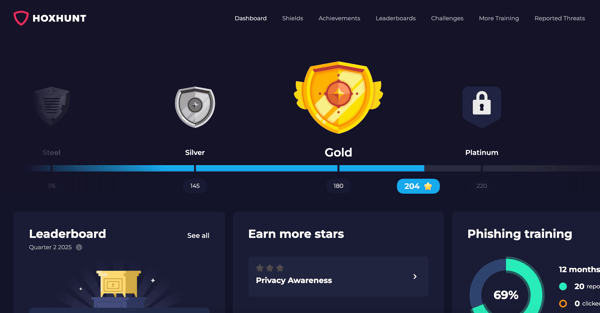
Hoxhunt adopts a gamified approach to security awareness training and is quite popular in the IT, computer software, and telecommunications industries, with 74% of enterprises using it, according to G2 Grid Report data. It has the highest satisfaction score of 97, based on G2 Data, and stood out in my evaluation for its ability to keep users engaged through short, inbox-based simulations that blend into everyday workflows.
I gathered from the reviews that users love Hoxhunt’s gamified approach to security training. The platform transforms phishing detection into a challenge, encouraging employees to spot suspicious emails in exchange for points, feedback, and positive reinforcement. Many reviewers on G2 say this format makes security awareness feel less like mandatory training and more like a daily habit. Progress tracking is also visible to users, helping them stay accountable and invested.
The realism of Hoxhunt’s phishing simulations is highly approved of. According to G2 reviewers, the mock emails are impressively believable and often indistinguishable from actual threats. This level of detail keeps even experienced employees on their toes. Each interaction is followed by instant feedback, helping users learn in real time without derailing their day.
Another standout is Hoxhunt’s inbox-native delivery. Rather than sending users to an external training hub, the platform brings simulations straight to their everyday tools, primarily Outlook and Gmail. I think this subtlety makes training feel like part of the job, not an extra chore. Several reviewers appreciated how easy it was to get started without requiring technical expertise or constant reminders. For teams with limited training time or change management bandwidth, this makes a real difference.
Another recurring point of feedback I noticed was the need for more diverse phishing examples. Several users highlighted that while the emails are well-crafted, they want to see broader attack styles and more advanced tactics reflected in the simulations.
Hoxhunt is a great pick for companies that want to meet users where they are, making security awareness part of the inbox rather than a standalone chore.
What I like about Hoxhunt:
- Reviewers on G2 consistently praised the platform’s gamified design. It motivates users without relying on long lectures or mandatory videos.
- I found that delivering everything through email made the training more natural and less disruptive than traditional learning systems.
What G2 users like about Hoxhunt:
“Hoxhunt email training has an edge over traditional video-based training courses for cybersecurity. It gives you real-time emails that can be identified as a phishing attempt or categorized as a malicious email. Learning through this training platform is impactful because we are learning practically with hands-on experience. Also, the platform is very interactive; it shows a leaderboard for the entire organization from all the departments. The after quizzes are also very important, they sharpen the concept of real-time cyber-attacks and tech security awareness. Overall, I like the Hoxhunt very much because the scenarios taken for training are more similar to the real-time cyberattacks.”
– Hoxhunt review, Prateek V.
What I dislike about Hoxhunt:
- A few reviewers mentioned wanting more variety in the types of phishing simulations. I can see how that would matter for more mature security teams.
What G2 users dislike about Hoxhunt:
“A wider variety of scenarios would make it more engaging. Like collaboration-tool phishing (MS Teams) and evolving threats and more practical day-to-day work related cases.”
– Hoxhunt review, Priya B.
3. SoSafe: Best for human risk scoring
SoSafe offers a structured and localized approach to security awareness training. It is popular in the automotive, manufacturing, and IT industries. G2 Grid Report data also shows that it is primarily used by mid-market and enterprise companies, at 51% and 35%, respectively.
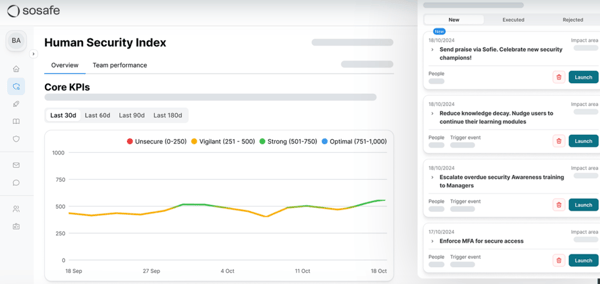
One thing I saw reviewers consistently praise is SoSafe’s microlearning format. The platform breaks training down into short, easy-to-complete modules that users can move through at their own pace. G2 reviewers appreciated that the content doesn’t require long attention spans or lengthy time commitments. Instead, it fits into small gaps in the workday, making it easier to roll out across busy teams. Many also stated that this format helps reduce fatigue and makes security training feel more approachable.
SoSafe’s built-in progress tracking stood out to me as another key strength. Several reviewers liked being able to monitor completed modules, see learning paths, and track how far along users were in the program. This visibility is helpful both for learners and admins. It supports accountability and helps security teams spot who might need follow-up. In several G2 reviews, users said this made it easier to stay engaged over time and gave them a clearer sense of achievement.
I also read a lot of positive feedback for its multilingual support. Users appreciated that the platform supports a broad range of languages and adapts to different regional needs. This made it easier to deploy across global teams or to match the language preferences of non-native English speakers.
However, one theme that came up here, just like it did with KnowBe4 and Hoxhunt, is the risk of repetition. A few G2 reviewers felt that the modules could start to feel familiar if used over long periods of time. While this wasn’t flagged as a major concern, it’s something to keep in mind when running continuous campaigns.
Overall, SoSafe is a solid option for teams that want short, structured training in multiple languages with built-in progress tracking and a clean user experience.
What I like about SoSafe:
- Reviewers mentioned being able to complete the training in short bursts. The micro-learning approach fits easily into the day.
- Multilingual support was highlighted often in reviews, which I think shows the platform’s relevance for international teams.
What G2 users like about SoSafe:
“The security training content library is huge and it includes videos, newsletters and blogs that improve employee security awareness effectively and I like that it supports the creation of phishing scenarios mimicking common tactics used by cybercriminals.”
– SoSafe review, Elena T.
What I dislike about SoSafe:
- Some reviewers felt the training would benefit from more variety as users progressed. It sounds like adding occasional surprises could help maintain long-term interest.
What G2 users dislike about SoSafe:
“The analytics functions are expandable. Especially in user management, the manual effort is high if one’s own EntraID is not maintained, in order to obtain a clean, manageable evaluation.”
– SoSafe review, Lars S.
Related: Check out this deep dive on AI vs. AI in cybersecurity and see how both attackers and defenders are using machine learning.
4. Arctic Wolf: Best for managed security services integration
Arctic Wolf is widely recognized for its managed detection and response (MDR) services, but its Security Awareness Plus training solution deserves a closer look. It’s used in the manufacturing, banking, and construction industries, with 77% of its users coming from mid-market companies, according to the G2 Grid Report.
I came across several reviews on how the platform combines bite-sized training, realistic phishing simulations, and helpful feedback into one meaningful experience. The lessons are short and updated regularly, which makes it easier to keep employees informed without overwhelming them. The training is sent straight to users via email, so there’s no need to log into a separate dashboard or remember extra passwords. That kind of delivery fits naturally into the workday and seems to boost participation.
Customer support received consistent praise, too. I saw plenty of G2 reviews calling out the responsiveness of the team and the overall reliability of their assistance. Whether it was a question during setup or help troubleshooting an issue later on, users generally seemed happy with the experience. That kind of steady support matters, especially when you’re introducing something new across a large team.
Another strength I noticed is how well Arctic Wolf aligns training with real-world threat visibility. Since it’s part of a broader MDR ecosystem, the platform can reflect actual attack patterns and risks observed across its customer base. This connection helps make training feel more relevant and timely, rather than generic or outdated. For organizations already invested in Arctic Wolf’s security services, this added context can make awareness programs more impactful and grounded in real incidents.
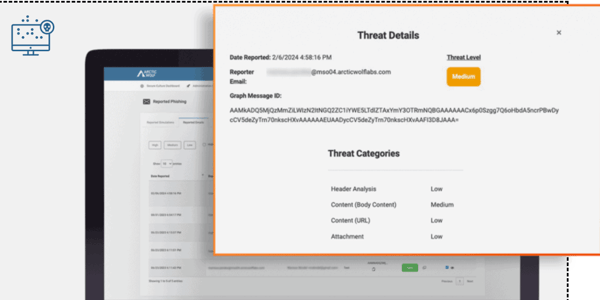
A couple of reviewers pointed out that the platform takes some getting used to, especially during the setup phase. The dashboard isn’t hard to use, but it’s not immediately intuitive either. That said, once everything’s in place, users seemed to find it easy to maintain. If your team has time to get familiar with the system early on, it shouldn’t be a blocker.
If you’re already working with Arctic Wolf for threat detection, their training solution is a smooth extension that is simple to deploy, easy to maintain, and backed by strong support.
What I like about Arctic Wolf:
- The training content lands right in the inbox and doesn’t interrupt the day. I think that kind of delivery helps keep engagement high.
- I appreciated how often reviewers praised helpful support; it makes a big difference when rolling out a new tool and training.
What G2 users like about Arctic Wolf:
“Arctic Wolf has been a force-multiplier for me and my small security team. I don’t have the headcount or coverage that AW provides and we’ve consolidated several tools into them. It’s been really good for us.”
– Arctic Wolf review, Verified User in Information Technology and Services
What I dislike about Arctic Wolf:
- Users mentioned that there is a slight adjustment period for the platform. However, it becomes manageable once you establish a routine.
What G2 users dislike about Arctic Wolf:
“When I need custom things built – it is very difficult as I am not able ot build out custom items to support things that may be specific to my company needs and I do lose that complete control over my logs to create custom parsers if I connect logs from a system that they may not have something built out fully for yet.”
– Arctic Wolf review, Jenine M.
5. MetaCompliance Security Awareness Training: Best for compliance-focused organizations
MetaCompliance helps organizations educate employees on cybersecurity best practices and regulatory compliance. It offers structured training modules, phishing simulations, and policy management tools to support a more security-conscious workforce. According to the G2 Grid Report data, the tool is commonly used in the financial services, government administration, and healthcare industries, with 71% adoption among mid-market businesses.
While reading the reviews, a common theme I noticed was the quality and range of the training content. G2 users frequently described the platform’s materials as easy to follow, well-organized, and relevant to real-life cybersecurity risks. There’s a clear emphasis on awareness-building rather than compliance-only content, and many users noted that the platform makes it easier to engage users with training that feels meaningful.
Another favorable aspect highlighted in the reviews was the platform’s reporting and visibility features. Reviewers appreciated being able to track training completion and monitor user progress. The reporting features appear to be well-suited to both operational users and executive stakeholders, striking a balance between day-to-day metrics and high-level summaries. It’s not just about checking a box; the data seems to help teams understand whether training is actually reaching people.
Support also came up often and positively. I kept circling back to G2 reviewers regularly praising the customer success team, onboarding experience, and technical support’s responsiveness. Several noted having a dedicated contact who helped with rollout or who responded quickly to configuration questions. This kind of support appears to be especially valuable in larger organizations, where training must be adapted to multiple departments or compliance needs. It was clear from multiple reviews that users didn’t feel left on their own once the platform was live.
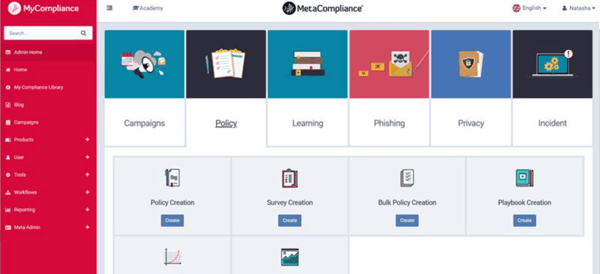
A limitation I came across was the user interface. Although “easy to use” appeared in positive feedback, quite a few users flagged the UI. Specifically, reviewers pointed out that some screens felt dated, and others wished the navigation were simpler.
MetaCompliance is a strong choice for organizations that want engaging security content, detailed reporting, and dedicated customer support, all in one platform built for scale.
What I like about MetaCompliance Security Awareness Training:
- Reviewers described the training as easy to understand and directly relevant. It felt more awareness-focused than just another compliance checklist.
- I saw a lot of praise for the support team, which seems to be a real asset during setup and beyond.
What G2 users like about MetaCompliance Security Awareness Training:
“I like the content and the wide range of topics. I also appreciate the modular structure, which makes it easy to create a great variety of trainings and campaigns.”
– MetaCompliance Security Awareness Training review, Georg T.
What I dislike about MetaCompliance Security Awareness Training:
- Some users noted that the interface can feel a bit overwhelming at first. I can see how a more simplified layout would help, especially for admins.
What G2 users dislike about MetaCompliance Security Awareness Training:
“Overly Complicated Interface: Navigation can feel cumbersome, and some users report the UI as outdated compared to competitors.”
– MetaCompliance Security Awareness Training review, Verified User in Construction.
6. Proofpoint ZenGuide: Best for threat intelligence-driven training
Proofpoint ZenGuide helps organizations educate employees on real-world cyber threats by combining threat intelligence with phishing simulations and role-based learning. It’s widely used across financial services, healthcare, and IT, with 55% of users in the enterprise segment and 40% in mid-market, according to the G2 Grid Report.
I came across multiple comments about how straightforward it was to roll out sessions across large teams, especially with the help of pre-built templates and support from customer success reps.
Phishing simulations were frequently called out as a core strength. Users said there were a wide variety of templates to choose from and appreciated how the system supported evolving phishing tactics. I read several reviews noting that Proofpoint’s templates helped simulate real-world threats and made it easier to drive behavior change across departments.
The content library received strong praise, too. According to G2 reviewers, the platform provides a broad selection of training modules across different topics and roles. I also noticed consistent mentions of support for multiple languages, which helps teams deliver content that’s accessible across regions and departments. For companies with multilingual users, this seems to be a helpful feature.
Scheduling and campaign setup were also features highlighted positively. Several users said they liked being able to plan campaigns in advance using built-in tools and appreciated how the scheduling process reduced their admin workload.
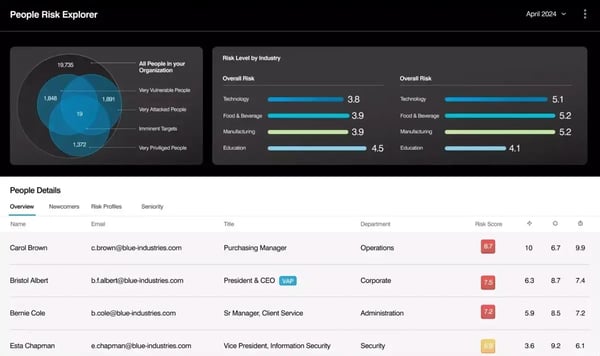
Customization was one area where users wanted more flexibility. A number of G2 reviews had the desire to personalize dashboards, tailor training modules to specific teams, or generate consolidated reports that brought together phishing, training, and user risk data. It sounds like some teams needed more visibility or control than what was available out of the box.
Proofpoint is a solid pick for companies looking for a structured, scalable training platform that’s informed by real-world threat intelligence and built for large, distributed teams.
What I like about Proofpoint ZenGuide:
- The built-in scheduling tools were highlighted in many reviews and seem like a time-saver for busy security teams.
- I appreciated the love for phishing simulations being realistic and current, which makes them more effective for today’s threat landscape.
What G2 users like about Proofpoint ZenGuide:
“The program is very reliable for simulation of phishing and spam emails as part of our security training and I like that the phishing campaigns are both realistic and diverse which effectively helps train employees across departments.”
– Proofpoint ZenGuide review, Amanda C.
What I dislike about Proofpoint ZenGuide:
- Some users said they wanted more options to personalize the training experience or adjust dashboards to reflect their KPIs.
What G2 users dislike about Proofpoint ZenGuide:
“Some training modules feel repetitive over time, and customising content or reporting can be a bit cumbersome.”
– Proofpoint ZenGuide review, Verified User in Retail.
7. Huntress Managed Security Awareness Training: Best for SMB-focused, security-first training
Huntress is best known for its managed security platform, but its security awareness training offering is built with a clear focus: helping small and mid-sized businesses improve human-layer security without adding operational complexity. It combines straightforward training modules, phishing simulations, and actionable insights in a way that feels aligned with real-world security operations rather than standalone compliance exercises.
One of the biggest strengths I noticed is how well Huntress connects training to real-world threats. Instead of positioning awareness as a standalone compliance task, the platform ties user behavior to the kinds of attacks organizations actually face. This makes the training feel more relevant and actionable, especially for teams already thinking about endpoint protection and incident response.
Another highlight is the simplicity of deployment and day-to-day management. From what I’ve seen, Huntress keeps onboarding lightweight, which is ideal for lean IT teams without dedicated training resources. Security teams can launch campaigns quickly without dealing with complicated configurations, making it easier to maintain consistent training without adding operational overhead.
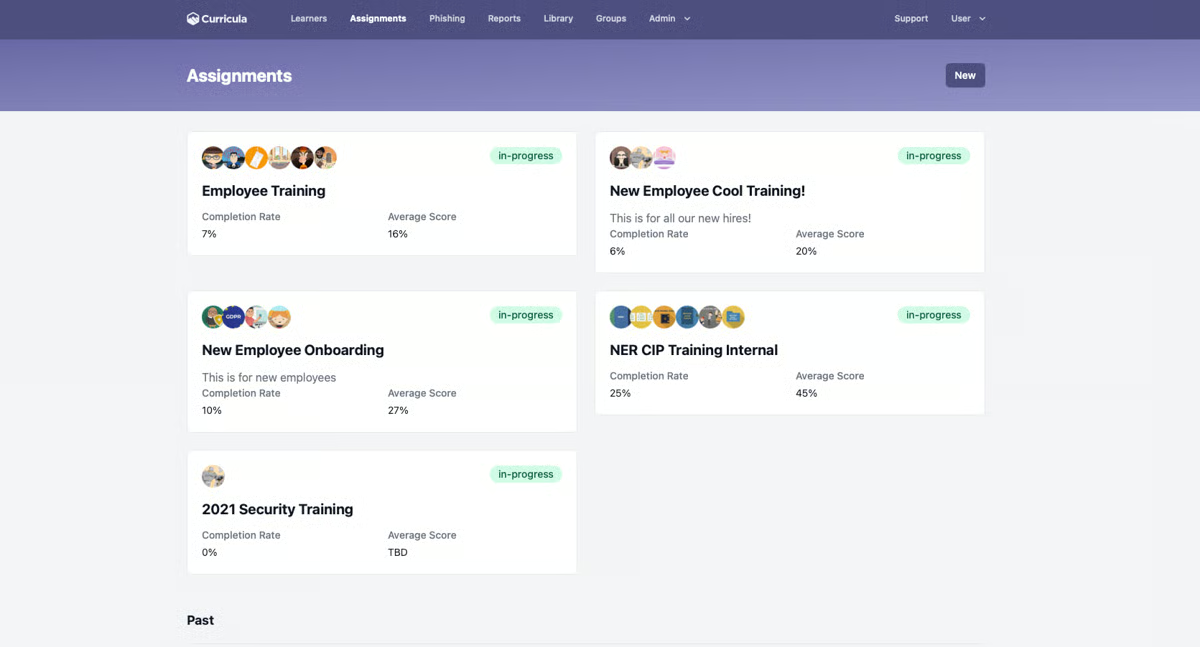
The platform’s content and phishing simulations also stand out for being practical and time-efficient. Huntress focuses on short, focused modules and realistic scenarios that reflect common attack patterns rather than overly complex edge cases. I think this approach helps reinforce habits that employees can actually apply in their daily workflows, without overwhelming them with unnecessary detail.
I also noticed that the reporting and analytics, while clear and easy to use, may not go as deep as some competitors. Teams looking for advanced behavior tracking, granular risk scoring, or highly detailed insights might find the platform a bit high-level in this area.
Overall, Huntress is a strong choice for organizations that value simplicity, relevance, and ease of rollout. It’s particularly well-suited for SMBs that want effective security awareness training without the complexity of larger enterprise tools.
What I like about Huntress Managed Security Awareness Training:
- I found the platform’s focus on real-world, practical threats refreshing. The training feels grounded in scenarios employees are likely to encounter, which makes it more useful than purely theoretical content.
- The ease of deployment stood out as well. It’s clear that Huntress is built with lean teams in mind, making it simple to roll out and manage without needing extensive setup or ongoing admin effort.
What G2 users like about Huntress Managed Security Awareness Training:
“The ‘managed’ part is real. Phishing simulations run on their own, training gets assigned automatically, and reporting is clear enough to show clients their risk without digging around. Content is short and relevant, so employees actually complete it. As an MSP, having SAT integrated with Huntress EDR and ITDR in one dashboard is a genuine time saver. Setup was fast, the team is responsive, and the value for the price is hard to beat.”
– Huntress Managed Security Awareness Training review, Verified User in Computer & Network Security.
What I dislike about Huntress Managed Security Awareness Training:
- There’s limited flexibility when it comes to customization. I can see how teams with specific compliance requirements or branding needs might find the platform somewhat restrictive.
- The reporting is clean and easy to understand, but it may not offer the depth or advanced insights that more mature security programs might seek.
What G2 users dislike about Huntress Managed Security Awareness Training:
“I wish that it was easier to create custom reports, that it was easier to set up dashboards that I could quickly see without having to click through multiple times. Also, it would be great if that were something that I could tie in directly to our SOC overview.”
– Huntress Managed Security Awareness Training review, Coni T.
Frequently asked questions about the best security awareness training software
Got more questions? We have the answers.
1. What are user-friendly security awareness programs for large corporations?
Hoxhunt, SoSafe, and KnowBe4 are among the most user-friendly options for large organizations. According to the G2 Grid Report, Hoxhunt has the highest enterprise adoption (74%) among these tools. Its inbox-based delivery keeps training seamless for employees. SoSafe supports multilingual learning with intuitive navigation, and KnowBe4 offers automation and scalability without overcomplicating the user experience. All three are frequently praised in reviews for reducing friction during rollout and making security training easier to follow across large teams.
2. Which security awareness tool is best for mid-sized businesses?
Based on G2 usage data, Arctic Wolf, MetaCompliance, and Proofpoint are top choices for mid-sized companies. Arctic Wolf leads with 77% mid-market adoption and offers inbox-based training. MetaCompliance supports compliance-focused training at scale, and Proofpoint stands out for its easy campaign scheduling and extensive phishing simulation options.
3. Who are the leading providers of security training services?
KnowBe4, Hoxhunt, SoSafe, and MetaCompliance are consistently recognized as leading providers. These platforms offer a full range of features, including phishing simulations, behavior scoring, compliance tracking, and multilingual content, all backed by high user satisfaction on G2.
4. What are the top security awareness platforms for corporate environments?
The top security awareness platforms for corporate environments include MetaCompliance, Proofpoint, and KnowBe4. MetaCompliance offers policy alignment and structured content tailored to regulatory needs. Proofpoint brings in threat intelligence and large-scale campaign management. KnowBe4 is known for robust simulations and enterprise-grade scalability, making it a reliable choice across large organizations.
5. What’s the top-rated security training app for employees?
According to user feedback on G2, Hoxhunt and SoSafe are the highest-rated security training apps among end users. SoSafe keeps users engaged with short microlearning modules and multilingual content suited to all roles. Hacker Rangers engages users with animated scenarios and multilingual modules designed for all roles. Both tools earn high praise for making training interactive and enjoyable.
6. What are the most effective cybersecurity awareness programs for companies?
Effectiveness often comes down to behavior change. KnowBe4, SoSafe, and Arctic Wolf earned strong reviews for phishing simulation accuracy, adaptive training content, and real-time feedback. These platforms are designed to build lasting awareness, not just check compliance boxes.
7. What’s the best software to train staff on cybersecurity threats?
If you’re training teams on phishing, credential theft, and insider threats, Proofpoint, SoSafe, and Hoxhunt offer highly relevant content. Proofpoint simulates emerging threats using real-world templates. SoSafe provides frequent, short lessons backed by multilingual support. Hoxhunt personalizes training by tracking user behavior and delivering feedback after every phishing test.
8. What is the best security awareness training software for a small business?
SoSafe, Huntress, and Arctic Wolf are solid picks for smaller teams looking to build strong security habits without overwhelming their resources. These platforms offer microlearning modules, practical short-form content, and a lightweight rollout that keeps users interested. Their straightforward rollout processes also make it easier for smaller teams to launch and manage training without heavy admin work.
9. What are the best-reviewed security training solutions for a tech company?
Based on G2 reviews and usage data, Hoxhunt and KnowBe4 are among the top recommended platforms for those in tech. Hoxhunt keeps employees engaged with interactive, inbox-based phishing challenges. KnowBe4 pairs a large training library with a realistic phishing engine and is popular across IT teams. Both platforms stand out for making training feel like part of the workflow rather than a time-consuming task.
10. What’s the best security awareness training software for 51–200 employee teams in the information technology and services industry?
KnowBe4, Arctic Wolf, and SoSafe are strong fits. Per G2 Grid Report data, all three see solid mid-market adoption (Arctic Wolf 77%, KnowBe4 66%, SoSafe 51%), and KnowBe4, Hoxhunt, and SoSafe are all widely used across IT. For an IT team of this size, KnowBe4 brings scalable simulations and a deep content library, Arctic Wolf is ideal if you already use its MDR services, and SoSafe adds microlearning with multilingual support.
11. Which security awareness training software is best for improving team compliance and reducing security risk?
MetaCompliance, KnowBe4, and SoSafe. MetaCompliance maps training to frameworks like ISO, GDPR, and HIPAA and pairs it with policy management. KnowBe4’s user- and group-level risk scoring dashboards help teams track and lower risk over time, and SoSafe’s human risk scoring surfaces who needs follow-up.
12. What’s the highest-rated security awareness training software for IT and services teams seeking rapid deployment?
Hoxhunt, Huntress, and Arctic Wolf. Hoxhunt holds the highest satisfaction score on G2 (97) and deploys straight into Outlook and Gmail with no technical setup. Huntress keeps onboarding lightweight for lean IT teams, and Arctic Wolf delivers training via email without a separate dashboard login.
13. What’s the most trusted security awareness training software for IT managers managing 51–200 employee teams, based on user reviews?
KnowBe4, Hoxhunt, and Arctic Wolf. KnowBe4 is one of the most recognized names in the category with strong mid-market usage (66%), Hoxhunt has the highest G2 satisfaction score (97), and Arctic Wolf leads mid-market adoption at 77% — making all three well-reviewed picks for teams this size.
14. Which security awareness training software is most reliable according to IT managers, based on user reviews and real-world adoption?
KnowBe4, Hoxhunt, and MetaCompliance. Reviewers consistently point to KnowBe4’s dependable phishing engine and regularly refreshed content, Hoxhunt’s high engagement and 97 satisfaction score, and MetaCompliance’s reliable reporting and responsive support — each backed by solid G2 adoption.
15. Which security awareness training software supports awareness training while maintaining team productivity and engagement?
Hoxhunt, SoSafe, and Arctic Wolf. Hoxhunt’s inbox-native, gamified simulations fit into daily workflows without disruption, SoSafe’s microlearning breaks training into short modules that slot into gaps in the day, and Arctic Wolf delivers bite-sized lessons by email so people stay productive.
16. What security awareness training software provides security awareness without extensive training or IT overhead?
Huntress, Hoxhunt, and Arctic Wolf. Huntress is built for lean IT teams with lightweight onboarding, Hoxhunt requires no technical expertise to launch, and Arctic Wolf needs no separate login or dashboard to manage — all keeping admin effort low.
17. Which security awareness training software has low implementation risk and avoids common deployment failures?
Huntress, Hoxhunt, and Proofpoint ZenGuide. Huntress launches quickly without complex configuration, Hoxhunt is easy to start and doesn’t rely on constant reminders, and Proofpoint’s pre-built templates plus customer-success support smooth large-team rollouts. Worth noting: Arctic Wolf reviewers mention a short setup learning curve, so build in extra ramp time there.
18. Which security awareness training software offers the quickest onboarding with minimal vendor lock-in concerns?
Huntress, SoSafe, and Hoxhunt. Huntress keeps setup fast and lightweight, SoSafe’s microlearning rolls out easily across teams, and Hoxhunt runs inside existing email tools without heavy implementation. One caveat: the article doesn’t evaluate contract terms directly, so confirm pricing and lock-in flexibility with each vendor.
19. Which security awareness training software provides the best customer support and training resources for teams?
MetaCompliance, Arctic Wolf, and Huntress. MetaCompliance reviewers repeatedly praise its customer success team and onboarding, Arctic Wolf earns consistent marks for responsive and reliable support, and Huntress users highlight a fast, responsive team during setup.
The strongest firewall? A well-trained team
Finding the best security awareness training software isn’t just about checking off a compliance box; it’s about choosing a solution your team will actually engage with. Whether you prioritize gamification, localization, phishing simulations, or content variety, the tools featured here reflect what real users on G2 are saying works in the field.
At the end of the day, the best fit comes down to your team’s size, technical comfort level, and how you want to deliver training: short videos, inbox modules, or something in between. And with cybersecurity threats growing more sophisticated every day, now’s a good time to go beyond awareness and build lasting behavior change.
Looking to reinforce your human firewall with stronger endpoint protection? Check out the top seven EDR software to secure your devices and stop threats before they spread.
“`html
“`