Google’s Performance Max Overhaul: New Channel Controls Could Revolutionize Your Ad Strategy—Are You Ready?
Have you ever wished you could just whisper in Google’s ear and say, “Hey, I really prefer conversions from YouTube over Display this time around”? Well, advertisers might soon get that chance. Google is testing a fresh Performance Max channel setting—a game-changer breaking away from its usual all-automatic budget juggling act. Imagine having tweakable dials for Search, YouTube, Display, and even Gmail, where you can nudge the algorithm to favor or shy away from certain channels without locking yourself into rigid budget percentages. It’s not just about visibility anymore—this could be the start of marketers genuinely steering where their ad dollars race. But hold tight, because with great power comes the maze of attribution quirks and strategic dilemmas. Could this be the control advertisers have been craving all these years, or just another puzzle to solve? Either way, Google’s stirring the pot, and it’s about time. LEARN MORE.
Google is testing a new Performance Max channel setting that could give advertisers a direct way to tell the algorithm which channels they value more — a notable departure from PMax’s traditionally automated approach to channel allocation.
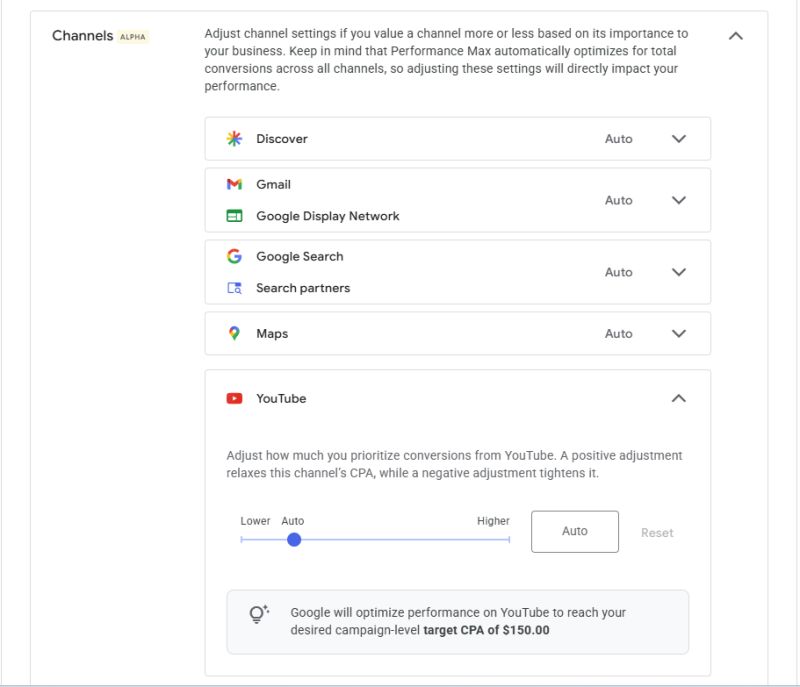
The feature, currently described as being in alpha testing, includes adjustment controls for Search, YouTube, Display, Discover, Gmail and Maps.
What’s new. The experimental “Channels” setting appears to let advertisers make positive or negative adjustments for individual Performance Max channels.

A positive adjustment relaxes the CPA the system is willing to accept for that channel, effectively signaling that the advertiser places greater value on conversions coming from it. A negative adjustment tightens the CPA, encouraging PMax to place less emphasis on that channel.
Importantly, this isn’t the same as assigning a fixed percentage of budget to Search or YouTube. Instead, advertisers appear to be influencing the economics PMax uses when deciding where to pursue conversions.
Why it’s significant. Performance Max has historically given advertisers little direct control over how budgets are distributed between Google’s inventory.
Advertisers could influence the system through assets, audience signals, search themes and conversion value data, but Google’s existing documentation says advertisers can’t directly control how PMax allocates budget by channel.
If broadly released, this would represent a much more direct lever for influencing that mix.
From visibility to control. The test follows Google’s introduction of channel-level Performance Max reporting, which gave advertisers greater visibility into where campaigns were serving and spending.
The new setting could provide the next piece of that puzzle: the ability to take what advertisers learn from channel reporting and use it to influence how PMax behaves.
But attribution complicates things. Channel-level performance isn’t necessarily the same thing as channel-level value. A user could first encounter an advertiser through a YouTube ad and later convert through Search. Looking only at the channel receiving conversion credit could therefore make YouTube appear less valuable than its actual contribution to the customer journey.
Aggressively tightening a channel because its directly attributed CPA looks poor could potentially reduce demand or conversions elsewhere in the campaign.
Why we care. Advertisers have spent years asking for more control over Performance Max, and this test could be one of the most consequential controls Google has introduced. It could help advertisers correct unwanted channel allocation without abandoning PMax altogether.
But it also creates another optimization decision: marketers will need to understand the role each channel plays beyond last-touch performance before telling Google’s algorithm where to pull back.
Bottom line. Google appears to be testing a significant shift in Performance Max: giving advertisers a direct lever to influence which channels its algorithm prioritizes. After giving marketers greater visibility into channel performance, Google may now be starting to give them more control over what happens next.
First spotted. This update was spotted by Search Marketing Advisor Heidi Sturrock, who shared spotting it on LinkdedIn.
Topics on this page
Search Engine Land is owned by Semrush. We remain committed to providing high-quality coverage of marketing topics. Unless otherwise noted, this page’s content was written by either an employee or a paid contractor of Semrush Inc.
About the Author