Google’s June 2026 Spam Update Is Live – Here’s What It Means for Your Website Rankings
Ever wonder if Google’s latest “spam update” is just the search engine’s version of a digital spring cleaning—or more like a stealthy ninja strike against sneaky tactics? Well, on June 24, 2026, Google rolled out their June spam update, wrapping it up by June 26, sweeping across the globe and all languages. This isn’t your garden-variety tweak; it’s a full-on refinement of Google’s spam-busting machinery aimed at cracking down on those tricky cheats who try to game the system with low-value content and cloak-and-dagger moves. The twist? Google’s playing it coy this time around, shedding light on what they aren’t targeting—like link spam and site reputation abuse—but leaving marketers to decode the impact from their ranking shifts post-rollout. If your site slipped during those dates, it might not be your imagination—or your competitor pulling a fast one—it could be the update flexing its muscles. Luckily, with tools like Semrush, you’ve got a fighting chance to pinpoint what’s really going on behind the scenes instead of flying blind in the SEO jungle. Curious to dive deeper into the chaos and conquer this update like a pro? LEARN MORE.
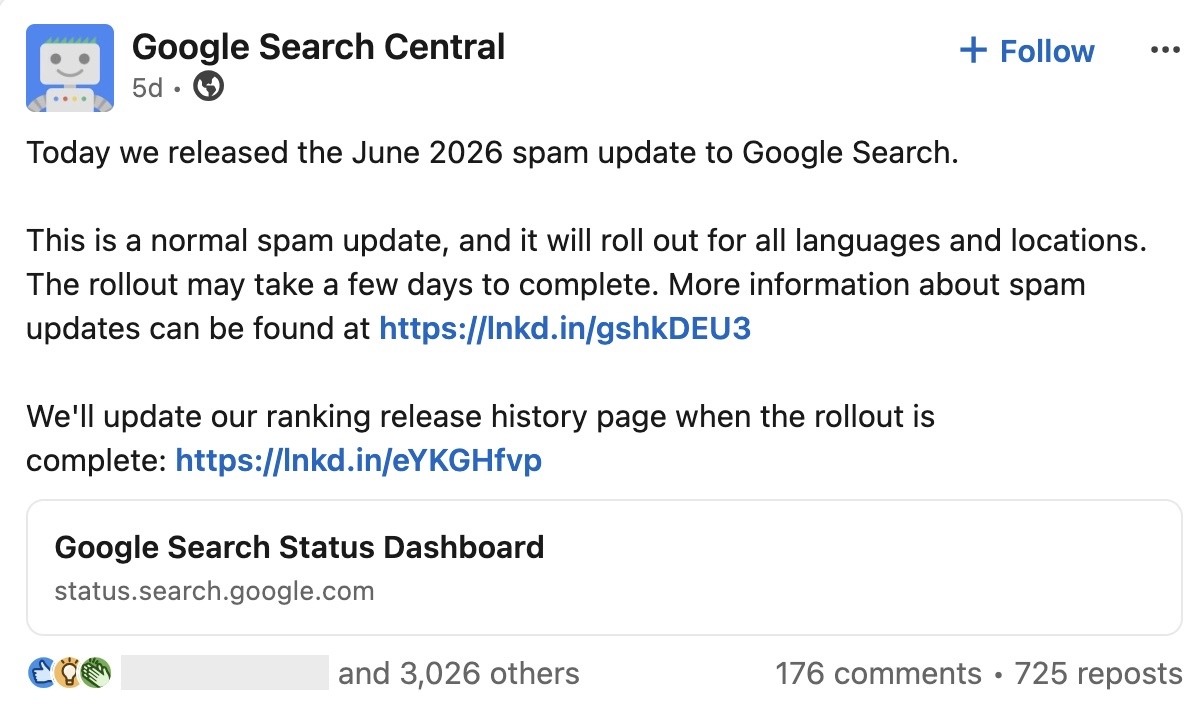
Google released the June 2026 spam update on June 24, 2026. The rollout completed on June 26. The update applies globally and to all languages.

What spam updates do
Spam updates reflect improvements to the automated systems Google uses to detect violations of its spam policies. According to Google’s spam policies documentation, these systems target tactics used to deceive users or manipulate search rankings, not content that simply underperforms.
Google’s current policies cover a broad range of practices, including:
- Scaled content abuse, which means generating large volumes of pages that provide little value to users
- Site reputation abuse, or publishing third-party content on an established host site primarily to exploit that site’s existing ranking signals
- Link spam
- Cloaking
- Sneaky redirects
- Keyword stuffing
Google rarely says what a spam update targets, but it did rule a couple of things out this time. The June 2026 update doesn’t go after link spam or the site reputation abuse policy, according to Google’s comments to Search Engine Roundtable.
Google hasn’t said what it does focus on, so the clearest signal is how your rankings move in the days after the rollout.
Why this matters for marketers
This update matters because it’s one more thing that could explain a change in your rankings. If your visibility dropped during the June 24 to 26 rollout, the spam update could be the cause, or it could be an earlier algorithm change, a competitor pulling ahead, or a shift in how AI search surfaces your pages.
Without tracking tied to specific dates, it’s hard to tell which factor is in play.
How to assess the impact with Semrush
To tell whether a visibility change is tied to the spam update, line up your ranking shifts with the rollout dates and compare against competitors.
Semrush One combines the SEO Toolkit and AI Visibility Toolkit in one platform, so you can do both without switching tools. Start with Position Tracking: set up a campaign for your target keywords and watch the daily position graph to pinpoint the exact day your rankings moved. If the drop lands inside the June 24 to 26 window, the spam update could be a likely cause; if it started earlier, something else is driving it.

Next, open Organic Research and enter a competitor’s domain to see its organic traffic and position trends over the same dates. If rivals climbed while you slipped, drill into the keywords and pages they gained to tell whether the shift hit your whole niche or just your site.

For teams managing large sites, Semrush Enterprise AI Optimization (AIO) runs the same checks across both Google and AI platforms like ChatGPT, Perplexity, and Gemini, so you can see whether a visibility change is limited to traditional search or showing up in AI answers too.