Google Unveils Mysterious New Agentic Browsing Category in Lighthouse—What This Means for the Future of Web Development
Ever wonder if AI agents could navigate your website as smoothly as your best human user? Well, Google Lighthouse just threw us a fascinating curveball with its new experimental Agentic Browsing category—a tool that actually audits how well these AI agents can roam, comprehend, and take action on your site. But hold up—this isn’t your everyday audit. You’ll need to dive into Chrome Canary, Google’s cutting-edge playground, to give it a spin. It’s like giving your website a pop quiz, with tests covering WebMCP integration, the parts of your site that matter most for AI interaction, and even stability checks that look for that curious little llms.txt file. Intrigued? You should be, because this new feature hints at a future where your site’s AI-readiness might just make or break your digital presence—and marketers, this is a signal you can’t keep snoozing on. Curious how your site stacks up in the agentic era? LEARN MORE.
Google Lighthouse now includes an Agentic Browsing category that audits how well AI agents are able to navigate, understand, and act on a site.
Google’s documentation notes that the Agentic Browsing category is experimental. Practically speaking, that means you need to run Lighthouse in Chrome Canary, Google’s experimental Chrome channel that’s released daily.
The Agentic Browsing category runs three sets of checks:
- WebMCP: Validates your WebMCP integration — a proposed web standard that lets a site provide directions for AI agents to act upon
- Agent-centric accessibility: Reviews the part of your accessibility tree that matters most for machine interaction, including names and labels, tree integrity, and visibility
- Stability and discoverability: Measures Cumulative Layout Shift (CLS) and checks for the presence of an llms.txt file
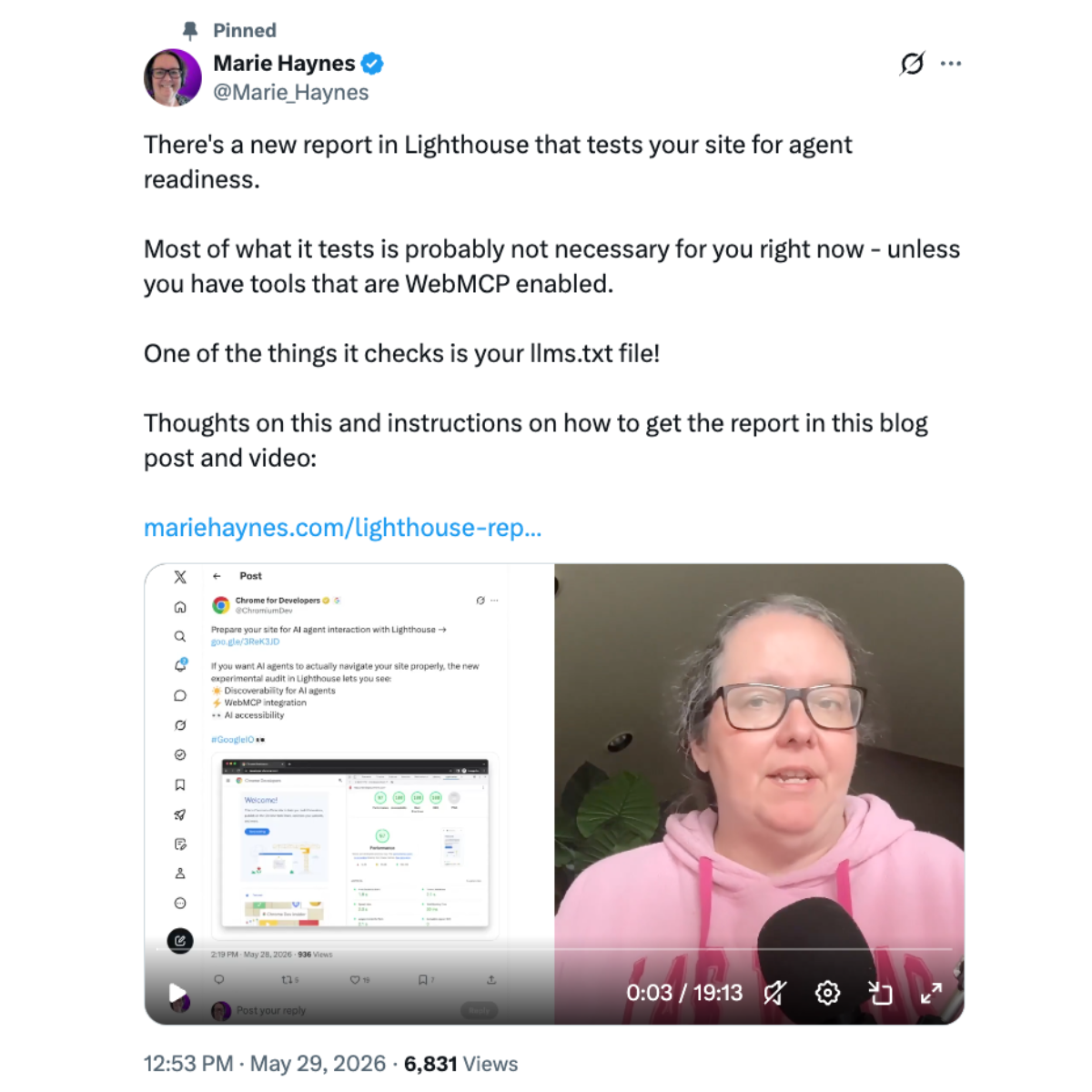
Marie Haynes, Owner of Marie Haynes Consulting, shared an X post about the announcement that pointed out how interesting it is that one of the checks centers on an llms.txt file:

Per Google’s documentation, the standards for the agentic web are still emerging. Instead of the familiar 0–100 score, the Agentic Browsing category shows a ratio of how many readiness checks your site passes.
What the Agentic Browsing category signals for marketers
Agentic readiness has been easy to put off until now, but the recent change to Lighthouse signals that isn’t feasible for much longer.
Agentic protocols and tools are arriving fast. Just recently, Google has been building toward an agentic web with:
A Google-backed audit for agentic readiness provides search marketers with a reputable way to justify their work to stakeholders.
Google has also said llms.txt isn’t required for generative AI search. Its inclusion here suggests the file matters more when your site has agent-specific elements, which is exactly what the Agentic Browsing report evaluates.
How to measure visibility beyond Google’s surfaces
For an agent to act on a website, it must first be visible to AI platforms, including ChatGPT and Perplexity.
Semrush One combines both the AI Visibility Toolkit and the SEO Toolkit to let you track your presence across numerous AI platforms and search engines in one place.
Use the AI Visibility Toolkit to monitor citation frequency and visibility trends across AI tools. And to see which of your URLs get cited, the grounding queries that trigger those citations, and citation counts by platform.

Then confirm you aren’t accidentally blocking AI agents using Site Audit. Unintentionally blocking AI crawlers limits your AI visibility.

For larger and more complex organizations, Semrush Enterprise AIO reveals in-depth insights about your share of voice, visibility, and AI referral traffic across platforms.