G2’s 2027 Vendor Survey Shows AI Project Reporting Saves Hours
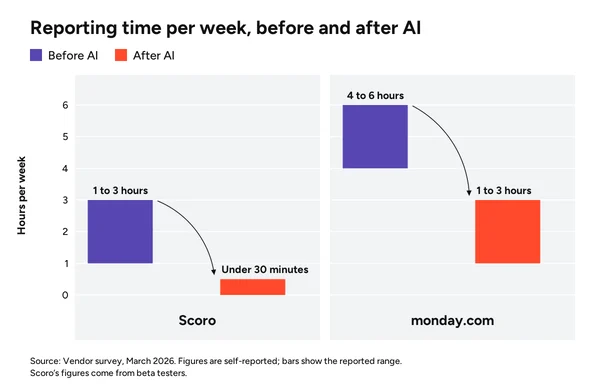
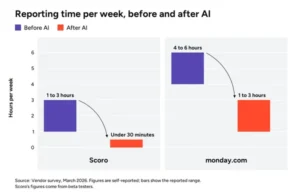
Does AI truly reduce the time spent on project reporting? According to two of the three vendors surveyed by G2, the answer is yes: Scoro reports a reduction from 1 to 3 hours weekly to under 30 minutes among beta testers, while monday.com notes a decrease from 4 to 6 hours down to 1 to 3 hours. A key insight from all three vendors is that the quality of data feeding the AI is what limits results.
Project managers frequently dedicate part of their week gathering data from various disconnected tools and drafting summaries. AI-driven project reporting seeks to eliminate this manual assembly by automating data collection, creating summaries, and flagging risks before they cause delays.
While much coverage focuses on AI’s promises, less is available on proven capabilities, adoption rates, and obstacles preventing further progress.
To investigate, G2 surveyed leaders from Scoro, monday.com, and Backlog by Nulab in 2026. They shared insights on time savings, adoption levels, and field constraints. This report summarizes their findings, highlighting strengths and ongoing challenges.
Key Takeaways: AI-Powered Project Reporting Overview
- Time savings are tangible but vary by starting point: Scoro reports time spent on reporting dropping from 1–3 hours to under 30 minutes weekly; monday.com sees a fall from 4–6 hours to 1–3 hours.
- Risk detection stands as the most consistently validated AI feature: AI spots project risks earlier than manual methods in 50% to 74% of cases, as reported by all three vendors.
- Usage of AI-generated reporting has surged: Adoption increased by over 50% across all platforms compared to the previous year.
- Qualitative context remains a challenge for AI: Two out of three vendors highlight missing critical
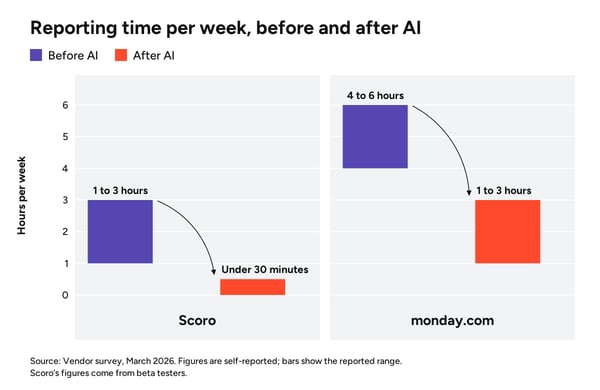
Does AI really save hours on project reporting? Two of the three vendors G2 surveyed report figures that say yes: Scoro, from 1 to 3 hours a week to under 30 minutes (beta testers), and monday.com, from 4 to 6 hours to 1 to 3. The more useful finding is what all three say holds results back: the data around the AI.
Project managers often spend part of their week pulling data from disconnected tools and writing summaries. AI project reporting aims to remove that assembly work with automated data pulls, generated summaries, and risk flags before they become delays.
Coverage of AI project status reporting mostly focuses on what the technology promises. Far less explains which capabilities have proof behind them, how deep adoption runs, and what stops organizations from going further.
To find out, G2 surveyed leaders at Scoro, monday.com, and Backlog by Nulab in 2026. I asked each what they observe with their customers: time savings, adoption, and the limits they hit in the field. This report covers what the three platforms see, where results are strongest, and where constraints remain.
TL;DR: AI-powered project reporting at a glance
- Time savings are real, but starting points differ: Scoro reports reporting time fell from 1 to 3 hours to under 30 minutes per week. monday.com reports a drop from 4 to 6 hours to 1 to 3 hours per week.
- Risk detection is the most consistently validated AI capability: All three vendors report AI identifies project risks earlier than manual reporting 50% to 74% of the time.
- Usage has surged across all three platforms over the past year: All three vendors report AI-powered reporting usage increased by more than 50% compared to 12 months ago.
- Qualitative context is what AI still cannot capture reliably: 2 of 3 vendors flag missing critical details or overgeneralized summaries as the primary user concern, and validating AI output remains the last manual step for 2 of 3 platforms regardless of how much they trust the output.
- The data foundation, not the AI itself, is the binding constraint: All three vendors name data access as the core ceiling. Each identifies a distinct barrier: unrecorded context (Scoro), tool fragmentation and missing methodology (monday.com), and single-tool scope plus privacy barriers (Backlog).
- Project managers are expected to spend less time on administration: monday.com projects strategic planning rising from under 20% to over 70% of PM time. Backlog projects administrative work falling to 5% to 10% of the role. Scoro describes AI as giving project managers “a promotion.”
Who are the 3 project management platforms shaping AI-powered reporting in 2026?
This report includes insights from:
- Scoro (4.5/5 on G2): A professional services automation platform built for agencies and consultancies, currently introducing AI-powered reporting capabilities to beta users, with a focus on surfacing project health and margin insights from consolidated operational data.
- monday.com (4.7/5 on G2): A multi-product work platform used across every major industry, with 1-click AI reporting embedded as a core product feature and a user base that spans team members, product managers, and external clients.
- Backlog by Nulab (4.6/5 on G2): A project management and collaboration tool by Nulab, built primarily for technology and SaaS teams, and distinguished by a privacy-first data philosophy that shapes both how its AI reporting works and what it can access.
Each vendor brings a distinct customer profile, product philosophy, and perspective on AI in automated project status. All three are actively building and deploying AI-powered reporting features across their customer bases.
Methodology: How I gathered these insights
This report is based on a 28-question survey, collected in March 2026 from leaders at the three platforms above. Each vendor received the same questions, so answers are comparable across vendors. Many answers are reported as ranges. All figures are self-reported by the vendors, and Scoro’s responses come from its beta stage. The survey focused on the following areas:
- Current AI adoption rates and reporting automation depth across platforms.
- Which stages of the project reporting process AI is actively handling.
- Time savings and stakeholder communication outcomes observed in the field.
- Trust levels, accuracy concerns, and where manual effort remains.
- Limitations constraining deeper AI reporting adoption today.
- Expectations for how project managers will redistribute their time as AI automates reporting.
The survey responses give an experience-backed view of where AI project reporting stands in 2026 and where it is headed. Category averages from the G2 Grid Report for Project Management, Fall 2026, are added in separate, labeled sections as buyer context.
What do G2 reviewers say about project management software?
G2 reviewers give project management software an average Net Promoter Score of 58 and rate how well it meets their requirements at 89% (G2 reviewer-reported, Fall 2026). The table shows the full set of category averages.
G2 satisfaction measure Category average Likelihood to Recommend 87% Product Going in the Right Direction 88% Meets Requirements 89% Ease of Use 88% Ease of Setup 87% Ease of Admin 88% Quality of Support 89% Ease of Doing Business With 91% Net Promoter Score (NPS) 58 Source: G2 Grid Report for Project Management, Fall 2026. Based on G2 reviewer-reported data. Net Promoter Score ranges from -100 to +100.
These category averages are added as buyer context. They sit alongside the vendor-reported findings in the rest of this report.
AI reporting saves time. How much depends on where your team stands today.
Scoro reports weekly reporting time falling from 1 to 3 hours to under 30 minutes. monday.com reports a drop from 4 to 6 hours to 1 to 3 hours. Backlog did not share time data. Both sets of figures are vendor-reported, and Scoro’s come from beta testers.
“Saves time” can mean very different things. A cut from 4 hours to 20 minutes and a cut from 30 minutes to 20 minutes are both savings, but they carry different weight in a business case. The table shows what each vendor reports observing in its customers before and after AI-powered reporting.
Scoro monday.com Backlog Observed in customers before AI 1–3 hrs/week 4–6 hrs/week Data not shared (privacy policy) Observed in customers after AI Under 30 min/week (75% reduction, ~4x faster) 1–3 hrs/week (60% reduction, ~2.5x faster) — Annual Hours Recovered (per PM) ~78 hrs ~156 hrs — Annual Hours Recovered (5-person team) ~390 hrs ~780 hrs — *Percentage reductions, “x faster” multiples, and annual hours recovered are my calculations from the midpoint of each reported range, over 52 weeks. Midpoints used: Scoro 2 hours before and 0.5 hours after; monday.com 5 hours before and 2 hours after. Scoro’s figures come from beta testers.

One detail stands out: monday.com’s post-AI range of 1 to 3 hours per week matches Scoro’s pre-AI range. In my reading, this likely reflects a difference in reporting environment. Scoro is a consolidated PSA platform built for agencies and consultancies, where project, time, and financial data already sit in one place. monday.com serves a broader customer base across industries, including small businesses, with more varied data structures and external-facing reporting requirements.
According to Scoro’s survey response, status updates now take significantly less time to put together, and more time goes to discussion. Scoro reports that stakeholder meetings become shorter, sharper, and focused on “what do we do next.”
For context, G2 reviewers rate project monitoring features, which cover KPIs, resource allocation, and activity dashboards, at 85% to 88% satisfaction on average (G2 reviewer-reported, Fall 2026).
G2 project monitoring feature Category average Baselining / KPIs 85% Resource Allocation 86% Activity Dashboard 88% Source: G2 Grid Report for Project Management, Fall 2026. Based on G2 reviewer-reported data.
What this means for buyers:
- Measure your team’s current weekly reporting hours before comparing tools. Vendors report different starting points: 1 to 3 hours (Scoro) and 4 to 6 hours (monday.com).
- A higher starting point leaves more hours to recover. At the midpoint, monday.com’s reported range falls by about 3 hours a week and Scoro’s by about 1.5 hours (my calculation).
Risk detection is where AI reporting earns its strategic value
All three vendors report that AI identifies project risks earlier than manual reporting in 50% to 74% of cases. Each chose “Frequently (50–74%)”, and none chose a higher frequency band that the survey offered. All three also list risk identification among the aspects users trust.
Time savings are measurable for two vendors. Earlier risk detection is a result all three report the same way, across different customer bases and product approaches.
1. A structural advantage, not just a faster version of manual review
A project manager running multiple concurrent projects cannot hold the full resource utilization picture across all of them at once. AI running across all projects can surface systemic patterns that individual project views miss. In my view, that cross-project vantage point is a different kind of capability, not a faster version of manual review.
Scoro and Backlog also named the insight types AI catches that manual reporting typically misses. Their answers overlap on four of five. monday.com said insight types vary significantly by customer tier and industry.
Insight type Scoro Backlog Resource overutilization patterns ✓ ✓ Bottlenecks in workflows ✓ ✓ Trends in task completion rates ✓ ✓ Cross-project performance patterns ✓ ✓ Early indicators of project delays ✓ — *Based on vendor survey responses. Backlog’s response is based on user feedback data. — = not selected.
2. Where AI shifts from a reporting tool to a decision support layer
In my view, task completion trends and cross-project performance patterns can act as lagging indicators. Manual reporting often notices such signals only after a problem has formed. When AI surfaces them early, they can act as leading indicators, so PM judgment is applied to a forming problem instead of a crisis.
3. The risks each platform prioritizes reflect who its customers are
Scoro selected early indicators of project delays, and Backlog did not. Scoro serves consulting and professional services firms, where, in my view, project delays can affect billing, client relationships, and margin. monday.com said insight types vary by customer tier and industry, which may reflect its broad deployment across industries.
For context, G2 reviewers rate the features closest to these risk types (resource capacity, scheduling, dependencies, issue tracking, and critical path) at 84% to 88% satisfaction on average (G2 reviewer-reported, Fall 2026).
G2 feature group Feature Category average Resource Management Capacity 86% Resource Management Scheduling 88% Tasks Dependencies 86% Projects Issue Tracking 86% Projects Critical Path 84% Source: G2 Grid Report for Project Management, Fall 2026. Based on G2 reviewer-reported data.
What this means for buyers:
- Decide which risks cost your business money (billing, delivery dates, capacity) and check those insight types first. The vendors surveyed name different ones.
- All three vendors report earlier detection in 50% to 74% of cases, so earlier detection is a reasonable first use case to test.
What every AI reporting platform covers, and where they part ways
Backlog automates 7 reporting tasks, Scoro 6, and monday.com 4. Beyond that shared core, scope diverges by product philosophy, customer type, and what each platform treats as the boundary of reporting.
AI-generated reports serve project managers, executives, team members, and in some cases external clients. The stakeholders a platform is built for shape the format, depth, and framing of its AI output.
1. There is a shared reporting core. Beyond it, the platforms diverge sharply
I mapped two survey questions across the platforms: which reporting tasks each automates, and which stages of reporting benefit most from AI. All three vendors selected these stages:
- Report generation and formatting
- Identifying project risks and delays
- Creating stakeholder-ready summaries
Scoro and monday.com also selected data collection from multiple tools. Backlog did not. Backlog’s stage selections are based on user feedback data. The coverage table lists automated tasks only. monday.com selected risk identification as a benefiting stage but not as an automated task, so its cell in that row shows “—”.
Scoro and Backlog concentrate their automation on the project delivery reporting cycle: status, health, risk, and cross-project visibility. monday.com’s 4 tasks split between traditional project reporting (sprint and meeting summaries) and broader business intelligence (competitor research, customer discovery and interview summaries).
Reporting task Scoro monday.com Backlog Sprint and milestone progress summaries ✓ ✓ ✓ Automated meeting summaries — ✓ ✓ Automatic project status summaries ✓ — ✓ AI-generated executive reports ✓ — ✓ AI identification of project risks ✓ — ✓ Task completion trend analysis ✓ — ✓ Cross-project performance summaries ✓ — ✓ Competitor research summaries — ✓ — Customer discovery and interview summaries — ✓ — *Based on vendor survey responses. — = not selected.
2. Who the reports reach is as differentiating as what they contain
Scoro and Backlog report that AI-generated reports are consumed primarily by internal stakeholders: project managers, executive leadership, department heads, and team members. The reporting chain runs upward and laterally within the organization.
monday.com’s picture is different. Its primary report consumers include external clients and partners alongside team members and product managers. It is the only vendor in this survey to list external clients and partners among its primary consumers. In my reading, its presence in client-services and agency workflows may explain this, since external reporting there is often a core deliverable.
The stakeholder lists reveal a further difference. Scoro’s includes program and portfolio managers. monday.com’s includes product managers. In my reading, Scoro’s list points to project delivery intelligence and monday.com’s to market and product intelligence, consistent with the competitor research and customer discovery summaries it automates.
3. Report formats differ by platform
Executive summaries are the only format all three platforms generate. The format differences appear to reflect the audience differences above.
Format Scoro monday.com Backlog Executive summaries ✓ ✓ ✓ Weekly project status reports ✓ — ✓ Project health dashboards ✓ — ✓ Client-facing progress reports — ✓ ✓ Sprint review summaries — — ✓ *Based on vendor survey responses. — = not selected.
Backlog generates client-facing progress reports and lists communicating updates to stakeholders as an activity that still requires the most manual effort. In my reading, a project manager still handles the sending. Backlog also says AI helps project managers find the best methods of presentation for their stakeholders, making communication more frequent and clear.
4. Which industries are leading adoption, and what that tells a buyer
Each platform’s strongest reported demand segment maps onto its customer base:
- Scoro: Consulting and professional services, where, in my view, project delays can affect billing, client relationships, and margin.
- Backlog: Technology and SaaS. In my view, sprint cadences and release cycles create recurring reporting pressure.
- monday.com: Broad use across industries. Its survey response says AI reporting is “front and center in the product (1-click reporting) so all industries use it regularly.”
The combined stakeholder and industry data surfaces one gap worth naming. Across all three platforms, 7 distinct stakeholder types are served, and no single platform covers more than 5. A buyer with multi-stakeholder requirements spanning executives, portfolio managers, team members, and external clients should map that gap before committing to one platform.
For buyer context, G2 reviews show who reviews project management software. Among the 16,027 approved reviews submitted in 2026, Computer Software (8.0%), Marketing and Advertising (7.5%), and Information Technology and Services (7.4%) are the three largest industry groups. (G2 reviewer-reported, reviews submitted January 1 to November 25, 2026).
Reviewer industry Share of reviews Computer Software 8.0% Marketing and Advertising 7.5% Information Technology and Services 7.4% Financial Services 2.3% Construction 2.2% Accounting 2.0% Non-Profit Organization Management 1.8% Hospital & Health Care 1.8% Education Management 1.6% Other industries (each 1.5% or less) 34.0% Industry not specified 31.5% Source: G2 reviews of Project Management software submitted January 1 to November 25, 2026 (approved reviews, n = 16,027). Based on G2 reviewer-reported data. Industry is selected by the reviewer. Shares are rounded.
By company size, 51% of G2 reviewers of project management software are from small businesses, 32% from mid-market companies, and 17% from enterprises (G2 reviewer-reported, Fall 2026).
Company size Share of G2 reviewers Small business (50 or fewer employees) 51% Mid-market (51–1,000 employees) 32% Enterprise (more than 1,000 employees) 17% Source: G2 Grid Report for Project Management, Fall 2026. Based on G2 reviewer-reported data.
What this means for buyers:
- List the stakeholder types your reporting chain serves (executives, portfolio managers, team members, external clients) and check which vendor’s list covers them.
- Buyers in consulting or technology may value a platform whose customer base matches their own. monday.com reports regular use across all industries.
- These G2 figures show who reviews project management software. They do not show who uses AI reporting.
Adoption of AI-powered reporting across the board
All three vendors report that usage of AI-powered reporting features grew by more than 50% compared to 12 months ago. How many teams use it and how much it automates differ by vendor. Scoro reports more than 75% of teams among its beta testers, monday.com reports 51% to 75% of teams, and Backlog did not share data.
Usage growth and automation depth are different measures. Trying an AI reporting feature once is not the same as automating 80% of reporting tasks, but both can count as adoption. These vendors agree on usage growth and diverge on depth.
1. AI reporting usage growth is unanimous across the vendors
The growth figure is the same for all three vendors. The share of teams actively using AI-generated reporting differs:
Platform Proportion of teams using AI reporting Note Scoro More than 75% Beta testers only, not full user base monday.com 51% to 75% Drawn from broader active user population Backlog Data not shared Privacy policy *Based on vendor survey responses.
monday.com’s figure is drawn from its broader active user population. Scoro’s is measured among current beta testers, who are early users of the feature. Backlog did not share data, citing security and privacy reasons.
2. Depth of automation tells a more complicated story
The survey asked two related questions: what share of status reports are AI-assisted, and what share of reporting tasks the platform automates. Backlog did not share data for either.
Platform Share of status reports that are AI-assisted Share of reporting tasks automated Scoro 26% to 50% More than 80% monday.com 11% to 25% 21% to 40% Backlog Data not shared Data not shared *Based on vendor survey responses. Scoro is in active beta, so its automation figure may describe platform capability and may differ from usage across its full customer base.
Scoro reports a 26% to 50% AI-assisted share, besides more than 80% of reporting tasks automated. In my reading, its beta stage may explain part of that gap. The difference between Scoro and monday.com on automation (more than 80% versus 21% to 40%) likely reflects platform architecture more than AI capability. Scoro is built around consolidated data covering projects, time, finance, and resource planning, so automating the reporting layer is a shorter step. monday.com serves a broader customer base with more varied data structures and reporting workflows, which may limit how far automation reaches within a single deployment.
3. What is actually driving the uptake?
All three vendors cite reducing administrative workload as a primary driver of adoption.
Driver Scoro monday.com Backlog Reducing administrative workload ✓ ✓ ✓ Faster stakeholder communication ✓ — ✓ Improved visibility into project performance ✓ ✓ — Real-time reporting expectations — ✓ ✓ *Based on vendor survey responses. — = not selected.
Beyond that shared driver, the other factors likely reflect each platform’s customer base, in my view. Faster stakeholder communication is cited by Scoro and Backlog, real-time reporting expectations by monday.com and Backlog, and improved visibility into project performance by Scoro and monday.com.
For context, G2 reviewers report an average user adoption of 70% across project management products (G2 reviewer-reported, Fall 2026). This is a different measure from the vendor-reported share of teams using AI reporting shown above.
Source: G2 Grid Report for Project Management, Fall 2026. Based on G2 reviewer-reported data.
What this means for buyers:
- Ask vendors two questions: how many teams use the AI reporting feature, and how much of the reporting work it automates. The vendors here report different answers to each.
- Scoro’s adoption and automation figures describe beta testers, not its full customer base.
Where does user trust in AI reporting break down, and why?
Even with Scoro’s platform, which is enabling more than 80% of reporting tasks to be automated, the before-and-after data does not reach zero. The residual is the review, validation, and send step that persists regardless of how much is automated upstream. Understanding why that step remains, and what it reveals about where trust actually sits, is the more useful question for anyone planning a deployment.
1. What AI reporting has earned trust on
Before examining where trust breaks down, it is worth establishing what AI reporting has actually earned from users. The answer is more specific than the general narrative suggests.
Trusted aspect Scoro monday.com Backlog Project health indicators ✓ ✓ ✓ Risk identification ✓ ✓ ✓ Timeline analysis ✓ ✓ ✓ Data aggregation and metrics ✓ ✓ Workload analysis ✓ ✓ *Scoro and monday.com responses reflect platform-level observations. Backlog’s responses are based on user feedback data.
Across platforms, AI reporting is trusted for project health indicators, risk identification, and timeline analysis.
Where AI is working with structured and quantifiable inputs, users trust the output. The trust is high enough to have a measurable consequence on Scoro’s platform. Scoro reports more than 80% of AI-generated project reports are shared with stakeholders without major revisions. For Scoro’s users, AI output has reached a level of trust where most reports go out with only minor edits.
2. Where the trust breaks down
Across all three platforms, trust in AI reporting breaks down at the same point. AI handles structured, quantifiable data well. Trust drops where the output requires qualitative judgment or unrecorded context.
Primary user concern Scoro monday.com Backlog Missing critical qualitative details ✓ ✓ Overgeneralized summaries ✓ Data privacy concerns ✓ *Scoro and monday.com responses reflect platform-level observation. Backlog’s responses are based on user feedback data. Backlog is also the only platform to name data privacy as an active user concern rather than a policy constraint.
Across platforms, AI handles the data layer reliably. Human effort remains concentrated on interpretation and communication. Scoro and Backlog users flag missing qualitative context as their primary concern. For illustration, qualitative context can include relationship tension in a client account, a team member quietly underwater, or a deadline that looks achievable on paper.
monday.com users flag overgeneralized summaries across their diverse customer environments. The manual effort data confirms the same gap. Scoro and monday.com users identify validating AI-generated summaries as their highest manual effort task. Backlog users continue doing stakeholder communication and cross-tool data integration by hand. The human review step has not been eliminated on any platform in this survey.
3. Why trust has a ceiling and no platform has eliminated the human review step
In my reading, the ceiling on AI reporting sits in the data and tooling around the model. When asked about the biggest limitation, each vendor pointed to the data and tooling around the AI. Scoro named unrecorded project context. Backlog named a privacy-driven limit on data access. monday.com named tool overload and a missing methodology.
Scoro frames the limitation as a capture problem on the customer side. In most organizations, project context that was never recorded cannot be analyzed, regardless of how capable the AI layer is.
“The biggest limitation is the data AI has to work with. AI can only analyze what’s been captured, and in most organizations a huge amount of project context lives in people’s heads, and hallway conversations that never make it into the system. No matter how smart the model is, it can’t report on what it can’t see.”
Karin Kanamäe
Paid Marketing Manager, ScoroBacklog frames the limitation as a platform-level constraint. By design, Backlog’s AI can only work with data stored within the tool itself. Pulling from external systems would require broader data access, which conflicts with their privacy-first architecture.
“AI (in our case) can only generate reports based on the data stored within the tool. Accessing information across multiple tools would require broader data access, which can raise security and privacy concerns.”
monday.com describes the limitation as tool overload and a missing methodology on the customer side.
“Too many tools available, which creates ‘AI chaos’: users don’t have a battle tested methodology to get the most out of AI.”
Sarah Blank
Marketing & Strategic Partnerships Manager, monday.comAn organization with fragmented tools and unrecorded project context will hit the ceiling faster and lower than one with a consolidated data foundation, regardless of which platform they choose. The tool you choose matters less than the foundation you build before deploying it.
4. Where to start
I asked the vendors what implementation practices have proven most effective. Scoro was the only vendor to answer.
Scoro’s advice is to start with data before starting with AI. According to Scoro, organizations that first consolidate their tools and establish consistent data practices see far better results. Once the data is in order, Scoro recommends starting small with one or two high-impact use cases, such as automated project health summaries or margin forecasting. Scoro adds that teams should build trust in the outputs before expanding. In my view, deploying AI reporting before fixing the data foundation is likely to produce weaker outcomes.
The next capability leap: what all three platforms are building toward
On how AI-powered reporting will evolve over the next 12 to 24 months, the three platforms land in three different places:
- Scoro: AI reporting becomes a standard feature across most project management tools. The focus shifts toward deeper data integration, moving from hard operational data toward softer foundational inputs.
- monday.com: AI moves from producing insights to acting on them directly. The ceiling is not what AI can analyze but whether it can execute without waiting for a human to act on the finding.
- Backlog: Gradual growth with incremental improvements, building on existing capabilities rather than a step change.
In my view, each vision reflects the constraints and customer base of the platform holding it.
The survey also asked what new insights AI reporting could generate in the future. Backlog sees room for more proactive summaries and workload analysis, such as predicting outcomes and highlighting team members who are available based on workload and expertise.
monday.com expects the future to center on the ability to act autonomously on insights. Scoro expects AI to connect external signals, such as economic shifts or industry trends, to a project portfolio, so that reporting evolves from dashboards toward a strategic advisor.
How vendors expect the project manager role to change
The survey asked each vendor how project managers will redistribute their time as AI automates more reporting and administrative work. The three answers differ in detail and share one direction: less administration.
Scoro answered in qualitative terms. In its words, “In a way, AI is giving project managers a promotion.” Scoro expects AI to handle much of the data pulling, report compiling, and manual risk assessment. Project managers then focus on strategic steering and stakeholder relationships.
Scoro also expects project managers to manage more projects at the same time, since operational overhead per project drops significantly. A new responsibility will emerge: coordinating and overseeing AI agents, and checking that the agents work with the right data on the right tasks.
monday.com gave the most specific figures. It projects strategic planning rising from under 20% of project manager time today to over 70%. It expects communication, risk management, and coordination to be largely automated.
Backlog shared a full breakdown of expected time allocation:
- Stakeholder communication: 30% to 35%
- Strategic planning: 20% to 25%
- Risk management: 15% to 20%
- Team coordination: 15% to 20%
- Administrative work: 5% to 10%
Backlog adds that administrative work decreases the most, which gives teams more time for strategic planning and efficient workflows.
The three answers agree that administrative work shrinks. They differ on where the freed time goes. monday.com sees strategic planning taking over most of the role. Backlog keeps stakeholder communication as the largest share. Scoro points toward strategic steering, stakeholder relationships, and oversight of AI agents. All figures in this section are vendor expectations.
AI project reporting: what to do next
The three vendors describe two results most consistently: earlier risk detection and less administrative work. Each also names the limit as the data and tooling around the AI, not the model itself. In my view, the practical question for your team is not which platform to pick first. It is whether the context behind your project decisions is recorded anywhere a tool can read it.
What this means for you: Pick one live project this week. Note the hours spent on its status reporting and where the context behind your risk calls lives. That gives you a baseline and shows whether an AI layer would have anything to work with.
To go deeper on the tools behind AI-powered project management, explore the best AI project management tools rated by real G2 users.









Post Comment