Chatbot Setup in 2026: Insights from Over 18,900 G2 Reviews
Summary: Insights on Chatbot Setup
- G2’s analysis of over 18,900 verified chatbot reviews reveals that mentions of setup difficulties accounted for 5% of dislikes through 2024, then more than doubled to 11% during 2025-2026.
- Reviews highlighting setup issues still average 4.45 stars, slightly lower than the 4.59 stars for reviews without setup complaints. Pricing complaints have a bigger impact, with an average rating of 4.34 stars compared to 4.60 stars for those without pricing concerns.
- In G2’s Fall 2026 Grid, products rated higher for Ease of Setup generally have fewer setup complaints, though the correlation is modest, based on 25 products, and not statistically significant (rho = -0.39, p = 0.052).
Verified chatbot reviews average 4.58 stars out of 5 overall, with 92% being positive. However, reports of setup difficulties rose sharply, more than doubling from 5% to 11% of dislikes between 2023-2024 and 2025-2026.
Steps for Setting Up a Chatbot
Chatbot setup typically involves six key steps, covering the process stages frequently mentioned by reviewers such as setup, configuration, implementation, onboarding, and learning:
- Select a specific workflow: Begin with a focused use case before expanding capabilities.
- Integrate actual data: Use the team’s own queries, documents, and processes rather than vendor sample data.
- Configure a single flow in a sandbox environment: Allow the team to build and test in a controlled setting before launch.
- Design escalation processes: Define when the bot transfers interactions to humans and through which channels (live chat, help desk, contact center).
- Verify onboarding support: Confirm what vendor assistance is included with the selected pricing tier.
- Plan for ongoing maintenance: Assign responsibility for flow upkeep and estimate the required time commitment.
The following sections use G2 review data to identify common setup issues and testing recommendations.
G2’s AnalysisTL;DR: Key findings about Chatbot Setup
- According to G2’s analysis of 18,900+ verified Chatbots reviews, setup mentions held at 5% of dislikes through 2024, then more than doubled to 11% in 2025-2026.
- Reviews with setup mentions still average 4.45 stars, 0.14 below the 4.59 for reviews without setup mentions. Pricing complaints cost more: those reviews average 4.34 stars, 0.26 below the 4.60 for reviews without pricing mentions.
- In G2’s fall 2026 Grid, higher Ease of Setup scores go with fewer of these complaints, but the link is modest, rests on 25 products, and is not statistically significant (rho -0.39, p 0.052).
TL;DR: Key findings about Chatbot Setup
- According to G2’s analysis of 18,900+ verified Chatbots reviews, setup mentions held at 5% of dislikes through 2024, then more than doubled to 11% in 2025-2026.
- Reviews with setup mentions still average 4.45 stars, 0.14 below the 4.59 for reviews without setup mentions. Pricing complaints cost more: those reviews average 4.34 stars, 0.26 below the 4.60 for reviews without pricing mentions.
- In G2’s fall 2026 Grid, higher Ease of Setup scores go with fewer of these complaints, but the link is modest, rests on 25 products, and is not statistically significant (rho -0.39, p 0.052).
Verified reviews of chatbots in this analysis average 4.58 out of 5 overall, and 92% of them are positive. Yet complaints about chatbot setup in reviewer dislikes more than doubled, from 5% to 11% in 2025-2026.
Setup matters for customer experience because it decides what customers actually meet: which questions the bot can answer, when it hands off to a person and whether it reflects the company’s own policies and data. This report traces where the rise in setup complaints comes from, why ratings barely register it and what to test before signing. First, a quick guide to how chatbot setup works.
How do you set up a chatbot?
Setting up a chatbot comes down to six steps. They cover the stages reviewers write about: setup, configuration, implementation, onboarding and the learning curve.
- Pick one workflow. Start with a narrow use case before widening access.
- Connect real data. Load the team’s own queries, documents and processes, not vendor-picked examples.
- Configure one flow in a sandbox. Give the team a bounded window to build and test it before launch.
- Design the handoff to people. Decide when the bot escalates and who picks up, whether through live chat, a help desk or a contact center.
- Confirm onboarding support. Check what vendor help is included for the pricing tier.
- Plan upkeep. Decide who maintains the flows and how much of a person’s time that takes.
The sections below use G2 review data to show where setup goes wrong and what to test first.
Methodology: How G2 analyzed chatbot setup in 18,900+ reviews
G2 Review Data
- Reviews analyzed: 18,900+ verified G2 reviews across 430+ Chatbots products.
- Period: June 18, 2014 to October 19, 2026 (frozen snapshot, so every count is exact).
- Category: Chatbots
- Method: A review counts as a setup mention when its dislike text matches G2’s setup keywords (setup, configuration, implementation, onboarding, learning curve). Pricing mentions work the same way with pricing keywords. Rates are the share of dislikes, not satisfaction scores. A positive review is 4 stars or higher out of 5.
- Product-level analysis: Products with 150 or more reviews. Paylocity’s reviews cover HR and payroll products, so it sits out the product-level analysis and stays in category-wide figures.
- Validation: A sample of 210 setup mentions found 79% describe real setup friction (95% CI 73% to 84%). Two AI raters, Claude Sonnet and Claude Opus, supplied the labels and agreed on 94% of them. No human labeled the sample, and recall was not measured.
- Grid match: Fall 2026 Grid products are matched to reviews on G2 product ID. Paylocity is excluded here, as in the product-level analysis, because it is an HR and payroll product: many of its setup mentions describe employee onboarding, not chatbot setup. 25 products qualify.
Vendor Research
- Vendors contributed: Assembled and Apollo.
- Method: Written survey responses, quoted verbatim. Vendor quotes are expert opinion, not G2 data.
- Time period: October 2026
- Vendor selection: Vendors that responded to G2’s survey on customer-facing AI agents
This report combines G2’s proprietary review data with structured input from two vendors that responded to G2’s survey on customer-facing AI agents. Vendor insights are clearly attributed throughout and represent platform-level observations.
Are chatbot setup problems getting worse?
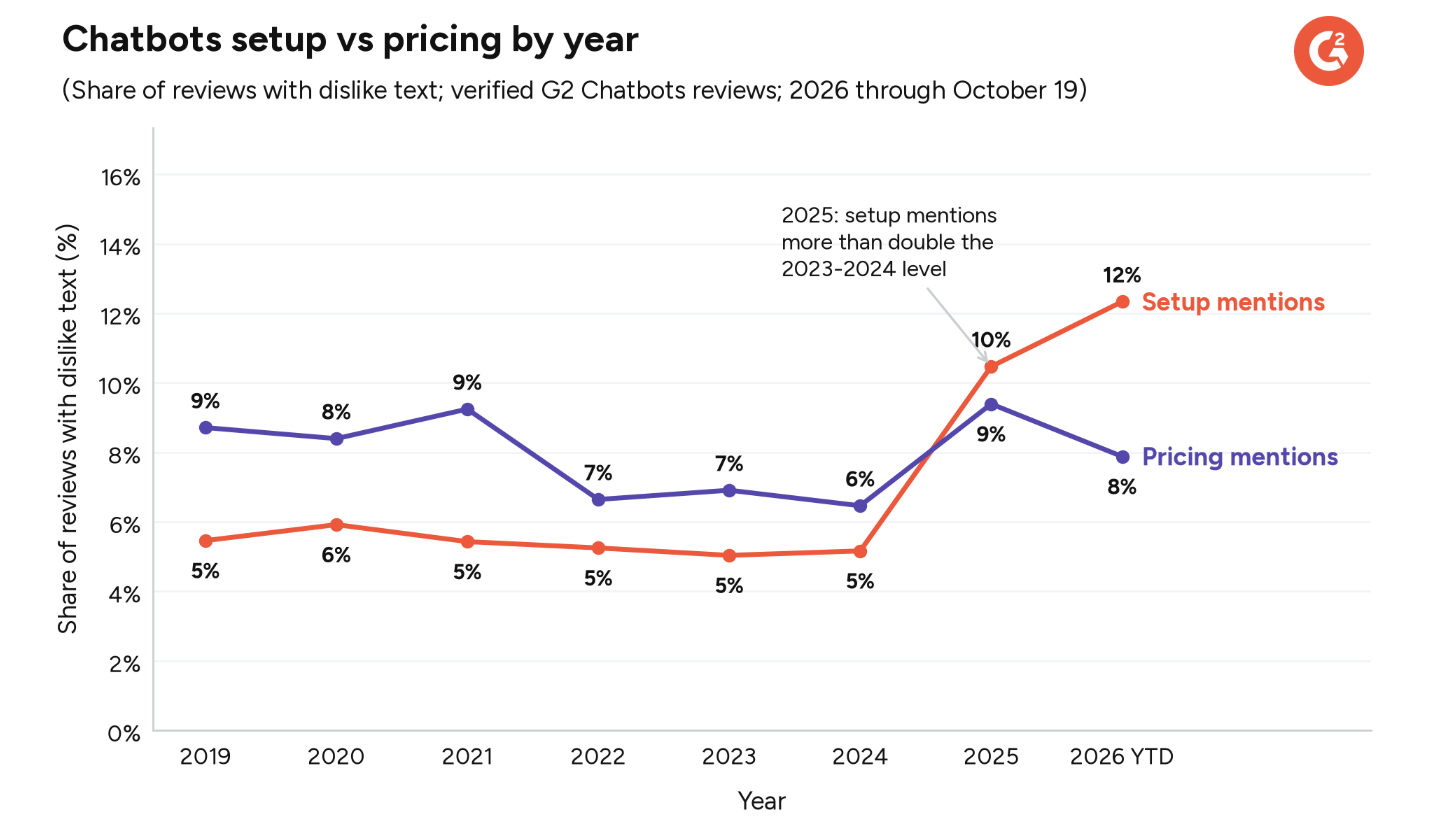
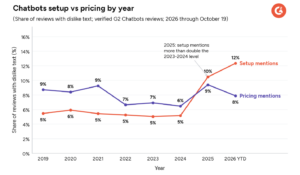
Yes, and the jump is recent. In verified G2 reviews, setup mentions held at 5% of dislikes before 2023 and through 2023-2024, then climbed to 11% in 2025-2026 and to 12% for 2026 reviews through October 19.
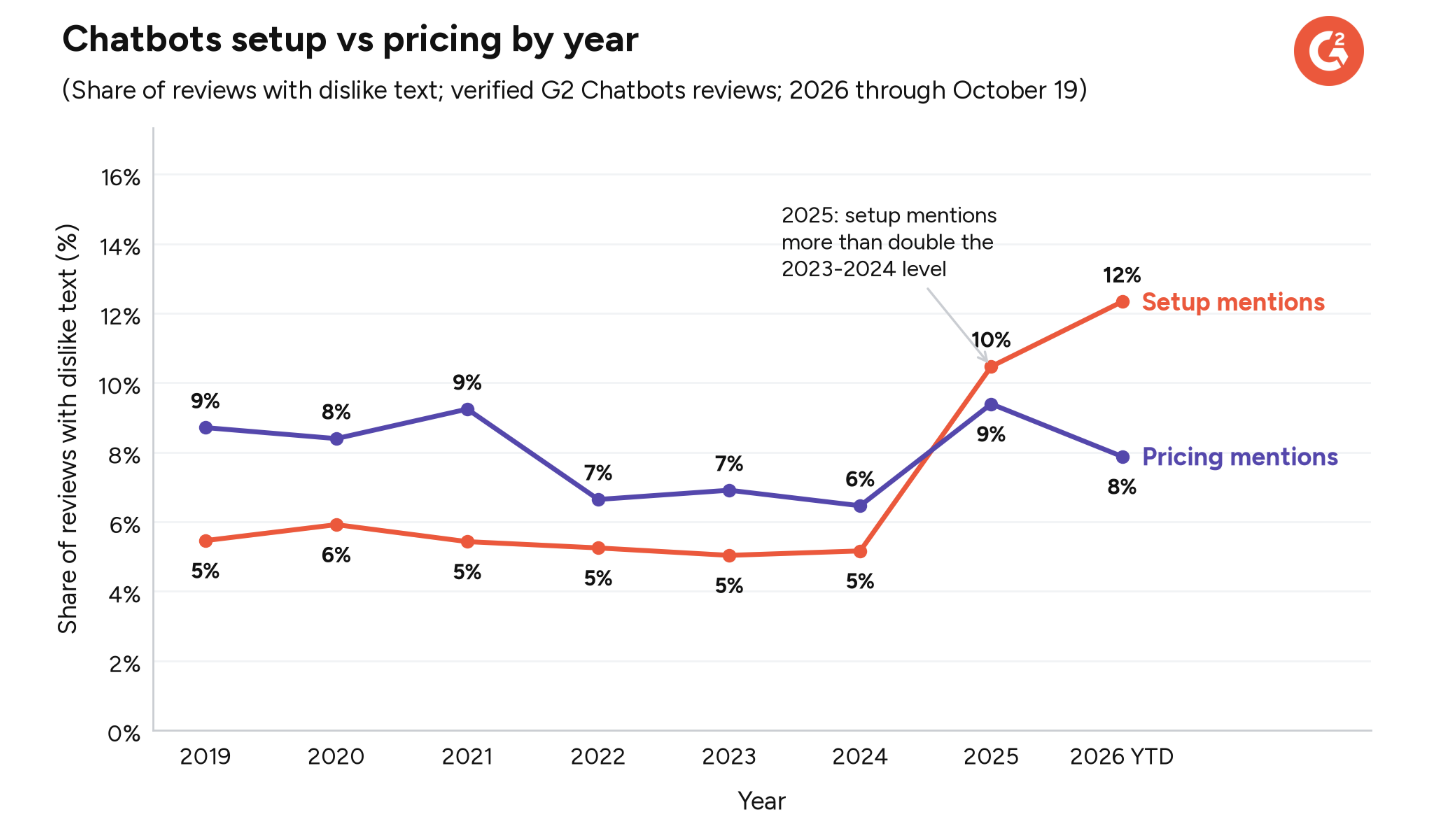
Setup mentions more than doubled, from 5% before 2023 to 11% in 2025-2026
Source: G2 review snapshot, October 19, 2026
Notice how flat the line is before the jump. Pricing was long the louder complaint, and across all years it still leads, at 8% of dislikes (1,440+ reviews) against 6% for setup (1,210+ reviews). In 2025-2026, the order flipped. Pricing reached 9%, while setup reached 11%.
G2 checked the jump two ways. It is not a flood of new reviewers, since monthly volume was lower in 2025-2026. Product mix explains only part of it: reweighting 2025-2026 reviews to the 2023-2024 mix lowers the rate from 11% to 9%, which still leaves a rise.
The next question is where the rise comes from.
What is behind the rise in chatbot setup complaints?
G2’s reviews show where the rise sits more than why: five products account for 46% of the setup mentions above each product’s own 2023-2024 level, and they include both newcomers and long-running platforms.
Two are newcomers. Jotform AI Agents has no 2023-2024 reviews, and HighLevel has only three, a small base to measure from. The other three are established platforms: Zendesk for Customer Service, Qualified, and Fin.
This shift spans beyond recent market entries. Assembled product manager Becca Xu highlights how customer support teams adjust their workflows:
“AI agents can now be trusted to autonomously resolve well-scoped intents end-to-end, and the frontier has moved from answering to acting: refunds, account changes, verification. What hasn’t caught up is operations. Most support orgs still plan, staff and measure as if humans handle every ticket.
We are already seeing teams at the forefront that manage AI agents the way they manage people, by forecasting their volume, QA their work, and design handoffs as carefully as the automation. This will become ubiquitous and necessary in the near future.”Becca Xu
Product Manager, Assembled
Her account fits the timing of the jump in 2025-2026, though G2’s review data cannot confirm the cause.
Do setup problems hurt chatbot ratings?
Barely. Here is the surprise. Verified G2 reviews that complain about setup still average 4.45 stars, against 4.59 for reviews without setup mentions. That is a gap of 0.14.
Pricing complaints cost more. Reviews that mention pricing average 4.34 stars, against 4.60 for reviews without pricing mentions, a gap of 0.26. The order holds within 18 products with enough reviews on both sides: the gap is 0.12 stars for setup and 0.28 for pricing.
Why would a hard launch cost so few stars? Ratings describe the chatbot once it runs, and these complaints describe the road to get it running, so reviewers are rating the product they ended up with, not the difficulty of getting there. Call it the setup tax: the effort to get a chatbot running, which star ratings never record.
A smaller labeled sample points the same way, with gaps of 0.08 for setup and 0.30 for pricing. It is too small to show for certain that setup lowers ratings at all, or that pricing complaints cost more, so read the 0.14 and 0.26 gaps as rough guides. Either way, a healthy average can hide a hard start.
Next, the Grid.
Which chatbots have the lowest setup complaint rates?
Among products with 150 or more reviews, Appy Pie has the lowest setup mention rate at 0%, followed by Simplified at 1% and Wati, SendPulse and Verloop.io at 2%, according to G2’s review data. A low rate does not prove easy setup, so check the Grid’s Ease of Setup score too.
The Grid is a useful starting map. The fall 2026 Grid for Chatbots names 33 Leaders and 60 High Performers. High Performers rate well with customers but have a smaller market presence, so Grid placement reflects reach as well as satisfaction. Ease of Setup is another useful signal: among the Leaders it runs from 82 to 100.
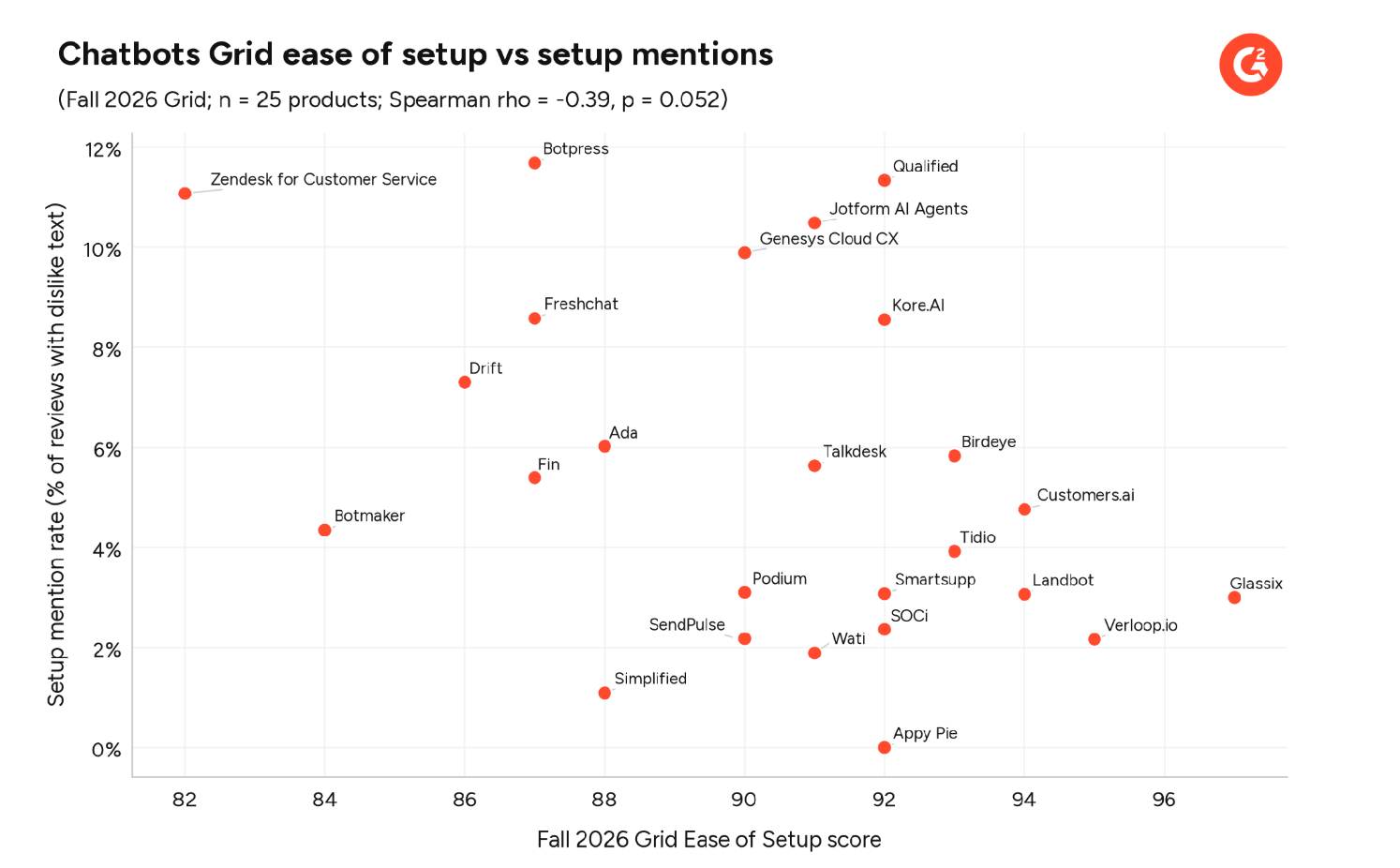
Higher Ease of Setup scores go with lower setup mention rates (rho -0.39, p 0.052, n 25)
Source: G2 Grid fall 2026, G2 review snapshot
Loosely. Across 25 products with 150 or more reviews, the dots drift down as Ease of Setup rises, meaning fewer complaints of this kind in verified G2 reviews. The relationship is modest. Spearman rho, the statistic behind it, runs from -1 to 1 and shows how consistently two rankings move together: -1 is a perfect opposite and 0 is no link, so the -0.39 here is a moderate downward link.
The p value of 0.052 says a pattern this strong would turn up by chance about one time in twenty even if the two were unrelated. That is just above the usual cutoff, so the result is not statistically significant, and with only 25 products it is a hint rather than proof.
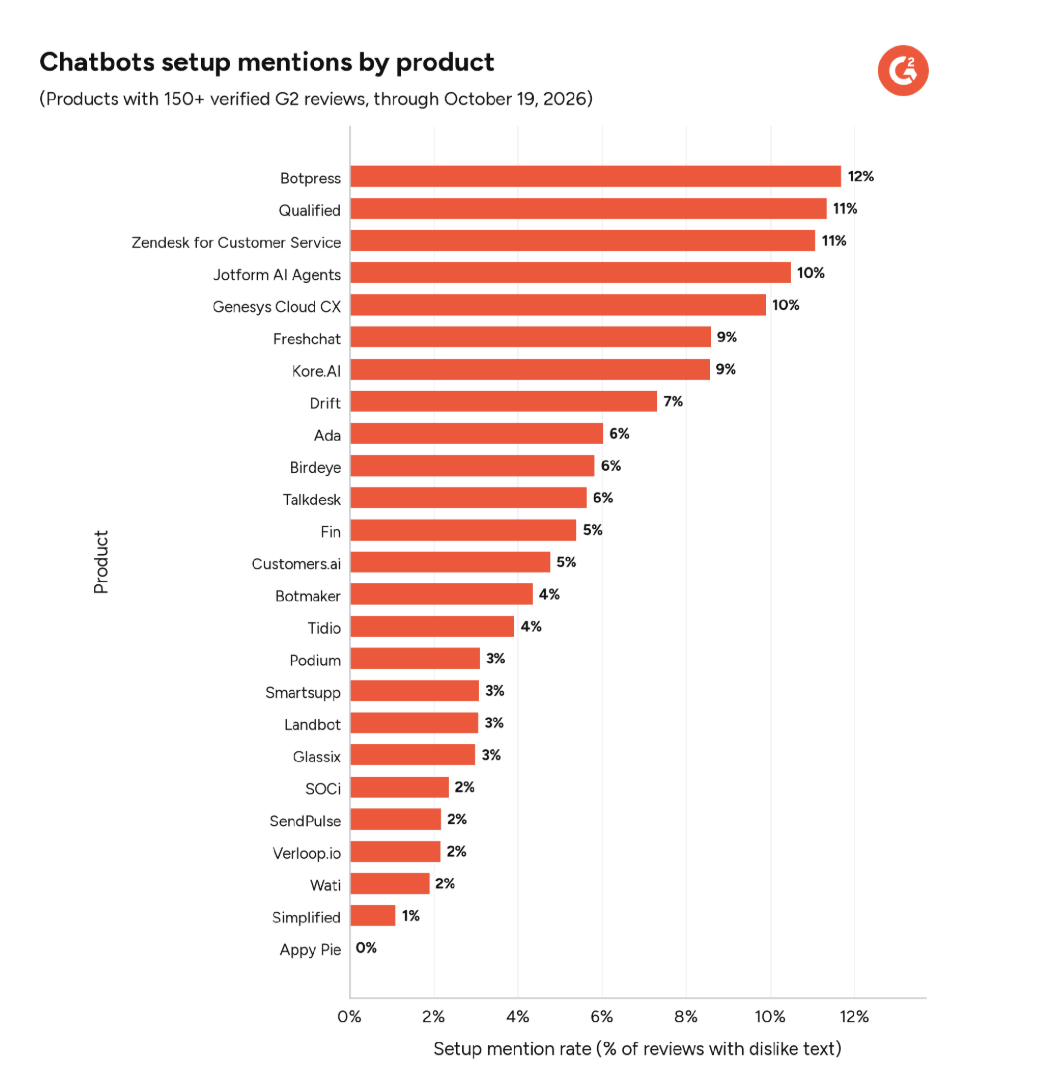
Rates range from 0% to 12%
Source: G2 review snapshot, October 19, 2026
Now look at the other end. Botpress reaches 12%, Zendesk for Customer Service and Qualified 11%, and Jotform AI Agents 10%. Rates range from 0% to 12%, so the choice of product matters.
Company size barely matters: the rate is 6% among Small-Business reviewers and 7% among Mid-Market reviewers.
Build the shortlist from the official Grid, then pressure-test it with review text.
Every name on that shortlist still needs a trial.
What should buyers test before choosing a chatbot?
It is important to test how easy a chatbot is to set up. Star ratings will not reveal setup difficulty. Hands-on testing is the only way to know what it takes to get a chatbot running.
G2’s October analysis of enterprise AI agent reviews reinforces this, with setup and complexity emerging as the most common complaints.
Three tests separate a chatbot that will work from one that will not:
- Configure one real flow in a sandbox before buying. Give the team a bounded window, its own data and a real use case. Configuration that requires technical knowledge is a frequent setup complaint.
- Ask what ongoing administration costs in time, not just money. Find out who maintains the flows and how much of a person that takes.
- Use the vendor’s onboarding team, and confirm it is included for the tier. Reviewers credit hands-on onboarding and support for turning a hard setup into a manageable one.
- Run the trial on real work. Vendor-picked examples skip the hardest part: connecting the bot to the team’s own queries, documents and processes.
Tyler Phillips, director of product at Apollo, on where an agent’s advantage comes from:
“Everyone is arguing about model quality, but models are becoming a commodity. What can’t be copied is context. That means knowing what actually worked across millions of sequences and replies, like a teams’ wins and losses, plus every edit a rep makes to a draft.
An agent built on that is useful on day one from cross-customer patterns and gets better every week from the team’s own data.”Tyler Phillips
Director of Product, Apollo
For a buyer, that makes the trial data as important as the vendor, so load the team’s own case history before judging any bot.
Start with one workflow. A narrow pilot that logs what the agent did at each step shows where the rollout breaks before access widens. Assembled’s Becca Xu on what holds rollouts back:
“Trust, and the main reason it’s missing is knowledge and visibility. Teams can’t see what the agent did or why, so they keep it small. What unblocks it is giving the right tools to the support team themselves.
Start from your real case history to pick the right use case categories, roll out in stages, and give ops leaders the same QA and monitoring for AI that they’ve always had for humans.”Becca Xu
Product Manager, Assembled
Ask each vendor to demonstrate that monitoring during the trial, because it is part of the setup work the ratings miss.
Use the Grid to shortlist, not to judge setup: placement reflects market presence and satisfaction, and Ease of Setup scores did not correlate significantly with reviewers’ setup complaints.
Stars show how a chatbot runs, and only a trial shows what it takes to get it there.
Frequently asked questions (FAQs) about Chatbots
Q1. Are chatbot setup complaints increasing?
Yes. According to G2’s analysis of verified Chatbots reviews, setup mentions rose from 5% of dislikes before 2023 to 11% in 2025-2026.
Q2. Do setup complaints mean a chatbot is bad?
No. Reviews that complain about setup average 4.45 stars against 4.59 for reviews without setup mentions. Test the effort in a trial.
Q3. Is pricing a bigger complaint than setup?
Over the full period, yes: 8% of dislikes against 6%, with a rating gap of 0.26 against 0.14. In 2025-2026 the order flips, 11% against 9%.
Q4. Which chatbot products draw the fewest of these complaints?
Among products with 150 or more reviews: Appy Pie at 0%, Simplified at 1%, and Wati, Verloop.io and SendPulse at 2%. A low rate does not prove easy setup.
Q5. Which chatbots are best for small businesses?
G2’s data does not rank products by segment. The rate is 6% among Small-Business reviewers and 7% among Mid-Market reviewers.
Q6. Does the G2 Grid show which chatbots are easiest to set up?
Not directly. Leaders score 82 to 100 on Ease of Setup, and the link to the complaint rate is not statistically significant (rho -0.39, p 0.052, n 25).
Q7. What is the setup tax in chatbot review?
The setup tax is the effort required to get a chatbot running that star ratings never record. G2’s analysis shows reviews with setup mentions still average 4.45 stars. Buyers rate the chatbot they ended up with, not the difficulty of getting there.
The bottom line for chatbot buyers
G2’s verified reviews average 4.58 out of 5 overall, yet setup mentions in dislikes grew from 5% before 2023 to 11% in 2025-2026. Stars show how a chatbot performs once it runs, and the review text shows what it took to get there. Before signing, test setup on the team’s own data and confirm what onboarding support is included.
Explore the top-rated Chatbots software on G2









Post Comment