Bitcoin Titans Saylor and Back Unite to Challenge Controversial BIP-110 Ordinals Proposal—What’s at Stake?

So here’s a twist for the Bitcoin saga you might not have seen coming — Michael Saylor and Adam Back, two heavyweight champions of the crypto realm, are firmly planting their flags against BIP-110. This proposal, aiming to curb those NFT-like Ordinals “spamming” the network with non-monetary data, sounds like a tidy fix on paper, right? But hold on — these veterans warn that this so-called “spam fix” might just be tipping the scales, risking the integrity of ordinary Bitcoin transactions themselves. Imagine trying to clean up your digital room only to accidentally toss some of your favorite stuff into the trash! While the Ordinals hype is cooling off, the debate over the network’s future rages on — a reminder that in Bitcoin’s world, even the smallest tweaks can ripple into massive waves. Makes you wonder: when does protection become overreach? Dive into the full story to catch all the drama unfolding on this blockchain battlefield. LEARN MORE.
Strategy executive chairman Michael Saylor and Blockstream CEO Adam Back have doubled down on their opposition to BIP-110, a proposed temporary fork to limit non-monetary transactions on the Bitcoin network.
Bitcoin Improvement Proposal-110 was introduced in December 2025 to stop nonfungible token-like Ordinals inscriptions and other arbitrary data from “spamming” the network and to preserve Bitcoin’s main use as a peer-to-peer cash system.
While critical of Ordinals activity, Saylor and Back fear a fork could do more harm than good to the network’s credibility. “There are 110 things more dangerous to Bitcoin than spam,” Saylor said in a post to X on Saturday, adding that BIP-110 could invalidate ordinary transactions on the network.
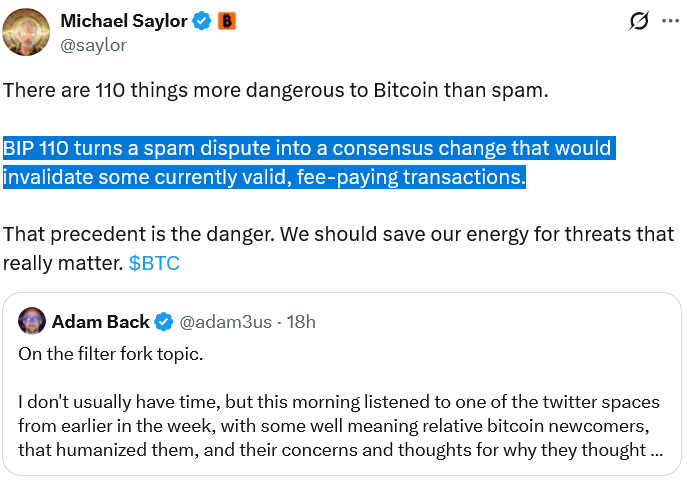
Source: Michael Saylor
BIP-110 is one of the more notable protocol-level disputes in the Bitcoin development community since the Blocksize Wars between 2015 and 2017, when ecosystem participants debated whether it was worth risking a chain split to raise the block size limit for scalability.
BIP-110 was introduced by pseudonymous Bitcoin developer “Dathon Ohm” with the support of Ocean protocol founder Luke Dashjr.
BIP-110 is a long shot from activating
BIP-110 won’t be activated unless 55% of Bitcoin nodes validating blocks are in support of the proposal across a Bitcoin block “period.”
In the last period, period number 475 between block 955,584 and 957,599, only 1% of blocks were BIP-110-supportive.
The dispute comes at a time when Ordinals activity is at near all-time lows, with fewer than 10,000 Ordinals inscribed into the Bitcoin blockchain on a daily basis over the last month, down massively from the more than 400,000 seen during its peak in August 2023.
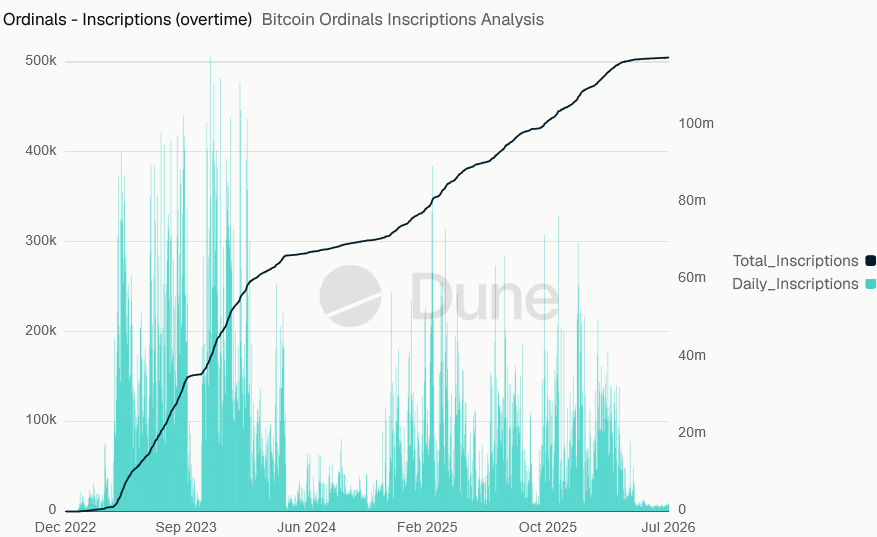
Change in daily Ordinals inscriptions since December 2022. Source: Dune Analytics
Meanwhile, Back offered a deeper critique of BIP-110, describing it as a “quest to police other people.”
Related: Bitcoin doesn’t need Ethereum-style yield, says Strategy’s Michael Saylor
He said Bitcoin’s decentralization should mean “you can’t impose your views on others,” calling it incompatible with Bitcoin’s cypherpunk ethos of permissionless, censorship-resistant money.
Dashjr and other BIP-110 proponents have called Ordinals-driven bloat a “serious threat” to the network, prompting the need for an imminent fix.
They have also argued BIP-110 wouldn’t cause a chain split, as many fear, while adding that the BIP-110 fork imposes a temporary one-year limit and thus wouldn’t invalidate fee-paying transactions over the long term.
Features: From Bitcoin critics to blockchain believers: The 5 biggest crypto backflips