Is Google AI in Chrome the SEO Killer—or the Ultimate Truth Revealer?

Ever felt like Google just flipped the whole script on how we explore the web? On April 16, 2026, Robby Stein and Mike Torres dropped a bombshell that’s way more than a simple product tweak—welcome to AI Mode in Chrome. Imagine diving into your search results with everything side-by-side, no more tab-hopping madness, just a smooth, guided journey powered by AI. Sounds nifty, right? But here’s the kicker: this isn’t just about convenience. It’s a wake-up call for anyone in SEO—Google’s shifting control from the old rank-and-wish model to a trust-driven experience that challenges the very meaning of clicks and content value. If your material is generic fluff, AI Mode’s going to spotlight it for all to see. Conversely, those offering originality, deep expertise, and real value? They might just thrive in this new landscape. Ready to rethink your SEO game in light of this AI-powered evolution? It’s about time. LEARN MORE

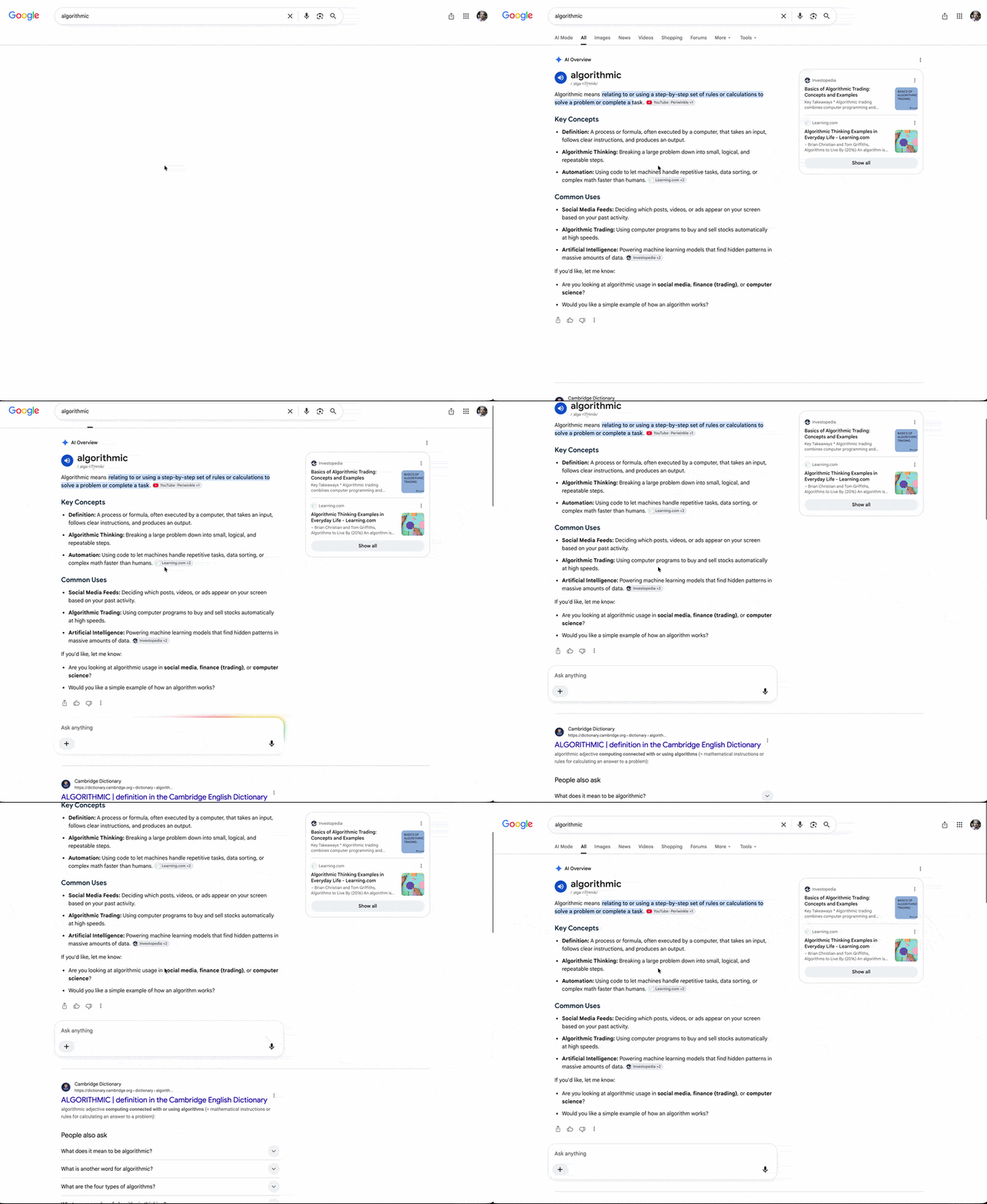
On April 16, 2026, Robby Stein, Google Search’s VP of Product, and Mike Torres, Google Chrome’s VP of Product, announced a new way to explore the web with AI Mode in Chrome. In their announcement, the two VPs wrote that the update makes it easier to “access and engage with content and dive deeper into what you find, all without losing your place or needing to switch tabs.”
Although that sounds like a product update, it’s really a warning shot. Search is moving from a list of links to a guided experience, and that should make every SEO professional pay attention.
Why? Because if Google is now helping searchers compare, refine, and continue their journey without leaving the AI layer, then the old “rank and hope” model is no longer enough. Search is becoming a trust test. And a plethora of SEO content isn’t passing it.
The Real Shift Is Control
For years, SEOs have measured success in visibility, rankings, and click-through rate. Those still matter. But AI Mode changes the sequence. A user can now start with a Google-generated answer, stay in the AI interface, open publisher pages side by side, and keep asking follow-up questions without restarting the journey. That means the click is no longer the beginning of discovery. In many cases, it’s the moment of verification.
The scale of this shift is hard to overstate. Recent research published by Index Exchange found that 69% of publishers experienced year-over-year ad opportunity declines throughout 2025, with an average drop of 14%.
Meanwhile, Ahrefs documented in February 2026 that AI Overviews now correlate with a 58% reduction in click-through rates for top-ranking pages – nearly double the 34.5% decline measured just a year earlier. Against that backdrop, the side-by-side view is not a concession to publishers. It is a structural change in what a “click” even means.
That has real consequences for reporting, budget allocation, and internal buy-in. Last-click attribution will look less and less like reality. That’s a problem for anyone still treating SEO as a traffic-only discipline.
AI Mode Is A Stress Test
Google’s latest move isn’t bad news for SEO. It’s a stress test. If your content is thin, generic, or interchangeable, then AI Mode makes that weakness easier to see. If your content is original, useful, and clearly structured, then AI Mode gives it more chances to surface at the right moment.
Rand Fishkin made this case bluntly in his post on April 20, 2026, “5 Strategic Features that Predict Survival in the Zero-Click Era,” citing an analysis by Cyrus Shepard of 400 websites that did not collapse during what Fishkin called “the great traffic apocalypse of 2024-2026.”
What are the five features shared by survivors? They offered a unique product or service, enabled task completion, held proprietary assets, maintained tight topical focus, and built a strong brand.
Critically, Fishkin argues that “no amount of tactical excellence can save you” if your business model is one that Google and AI can disintermediate. SEO tactics alone are not the answer. The answer is whether your site offers something AI cannot summarize away.
That distinction matters here. AI Mode is not replacing SEO. It’s exposing weak SEO and rewarding strong SEO. SEO built on formulaic targeting and low-value content will struggle. SEO built on genuine expertise, clear structure, and editorial judgment will be better positioned.
The Open Web Is Still Here – For Now
It would be easy to turn this into another dramatic story about Google swallowing the web. But the side-by-side design suggests something more nuanced: Google still needs the open web. It still wants users to explore publisher pages. The announcement confirmed that early testers found that “having both Search and the web side-by-side helped them stay focused on their tasks while exploring useful webpages.”
The sites most likely to benefit are the ones that offer something AI cannot flatten into a summary: original reporting, proprietary data, firsthand experience, strong analysis, and a point of view that adds value. Fishkin’s data backs this up: Letterboxd survived Google’s decimation of movie review sites because it offers something unique – its own user-generated data to graph movie popularity over time. That is something ChatGPT cannot replicate. AI Mode compresses the margin for mediocrity.
What SEOs Should Do Now
The core lesson here is this: The search journey is becoming less linear, more mediated, and more dependent on whether your content earns its place inside the process.
SEOs should focus on content that is clear enough to answer quickly, structured enough to be parsed, specific enough to be worth citing, original enough to stand apart, and credible enough to deserve trust.
They should also revisit how success is measured. If AI Mode affects discovery earlier in the journey, then SEO value may show up in places traditional reporting has ignored – assisted conversions, branded demand, and cross-channel influence.
Google AI Mode isn’t killing SEO. It’s exposing weak SEO, rewarding strong SEO, and forcing everyone else to rethink what visibility really means. That makes it one of the most important search stories of 2026 so far.
More Resources:
Featured Image: Kateryna Onyshchuk/Shutterstock