The Hidden Battle Between HTML and XML Sitemaps: Which One Will Skyrocket Your Ecommerce Success?
Ever wonder how the humble sitemap — that oft-overlooked list of links tucked away in website footers or hidden on standalone pages — evolved into a cornerstone of search engine success? Back in the early days of the web, developers simply dropped these handy roadmaps to guide visitors through key site sections like categories, policies, and more. Then came 2005, when Google, forever the game-changer, rolled out XML sitemaps crafted from a somewhat ancient data format called Extensible Markup Language. This wasn’t just a tweak; it revolutionized how search engines crawl and index every nook and cranny of a site. Fast forward, and we’ve got two siblings in the sitemap family: HTML and XML. Confusing? You bet. But here’s the kicker — both are still valuable assets for ecommerce owners who want to boost their site’s visibility and crawlability. Intrigued? Let’s unravel the mystery behind these digital blueprints and why leaning on both might just be the secret sauce your site needs. LEARN MORE.
From the web’s earliest days, developers included a summary of links to a site’s key sections, such as categories, company pages, policies and procedures, and more. The summaries could appear in footers or on standalone pages. Developers called the summaries “sitemaps.”
In 2005, Google introduced a new version of sitemaps based on Extensible Markup Language, a 1990s text-based format for storing data, that site owners could submit to Google (via what became Search Console). The aim was to help search engines crawl and index all pages on a site.
In time, the industry referred to the versions as “HTML sitemaps” and “XML sitemaps.”
Many owners confuse the two, though both remain helpful.
Here’s a quick guide for ecommerce owners.
The difference
XML sitemaps help with discoverability. Search engines can find pages quickly in the sitemap without landing on the site itself. Whether the search-engine bots access and index the newly discovered pages depends on crawl budget, site authority, content relevance, depth and originality, internal linking, and external backlinks, among other signals.
Conversely, HTML sitemaps provide no backdoor to a site. Crawlers must land on a site to access an HTML sitemap, likely via internal links.
Search engine optimizers disagree on the impact of HTML sitemaps. In my experience, such sitemaps likely help indexing by revealing the internal links to every page. When placed in the footer, HTML sitemaps spread internal link equity to the listed pages. They minimize the number of pages in Search Console’s “Crawled, currently not indexed” status.
Use both
Both sitemaps — HTML and XML — help search engines discover, crawl, and index more pages, especially on larger sites.
But neither replaces a website hierarchy that naturally prioritizes important pages. Only a fast, well-structured, and well-interlinked website ensures solid organic search visibility.
I sometimes advise temporary HTML sitemaps when restructuring a site and awaiting its final interlinks. But it’s never a permanent substitute.
In last month’s “Search off the Record” podcast episode, Google’s John Mueller, long skeptical of HTML sitemaps, noted they “would help crawling because from this place we can find all the links.”
Construction
XML sitemaps are dynamic — continually updated with new pages, products, and updates — and include every URL you want indexed.
HTML sitemaps are usually static and include the most important pages.
In the same episode, Mueller discussed the differences:
If you have an ecommerce site, you wouldn’t list all of your products in an HTML sitemap file. You would list the categories so people can go to the right place, then pick out the product individually.
XML sitemaps are typically built into the content management system or ecommerce platform and update automatically. Check the documentation of your CMS or platform for the XML sitemap’s URL(s). Then submit it to Search Console and Bing Webmaster Tools.
Web crawlers such as Screaming Frog can evaluate your XML sitemaps for broken links, noindexed URLs, and other glitches.
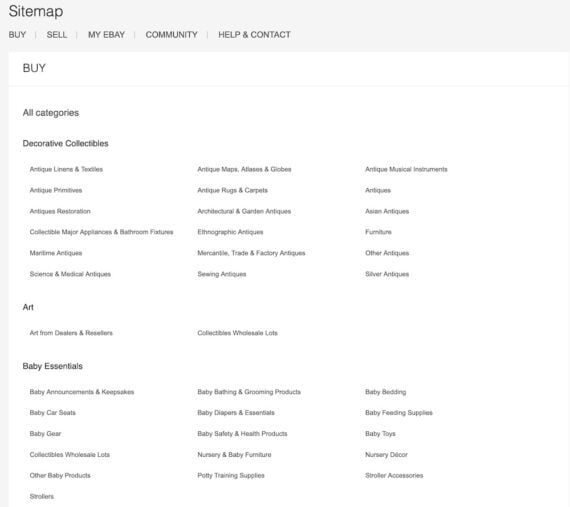
HTML sitemaps help crawlers and humans find important pages. Developers build HTML sitemaps based on a site owner’s page priorities. An example is eBay’s HTML sitemap, which links to main categories and subcategories. The audience is humans looking for categories, help pages, and community discussions.
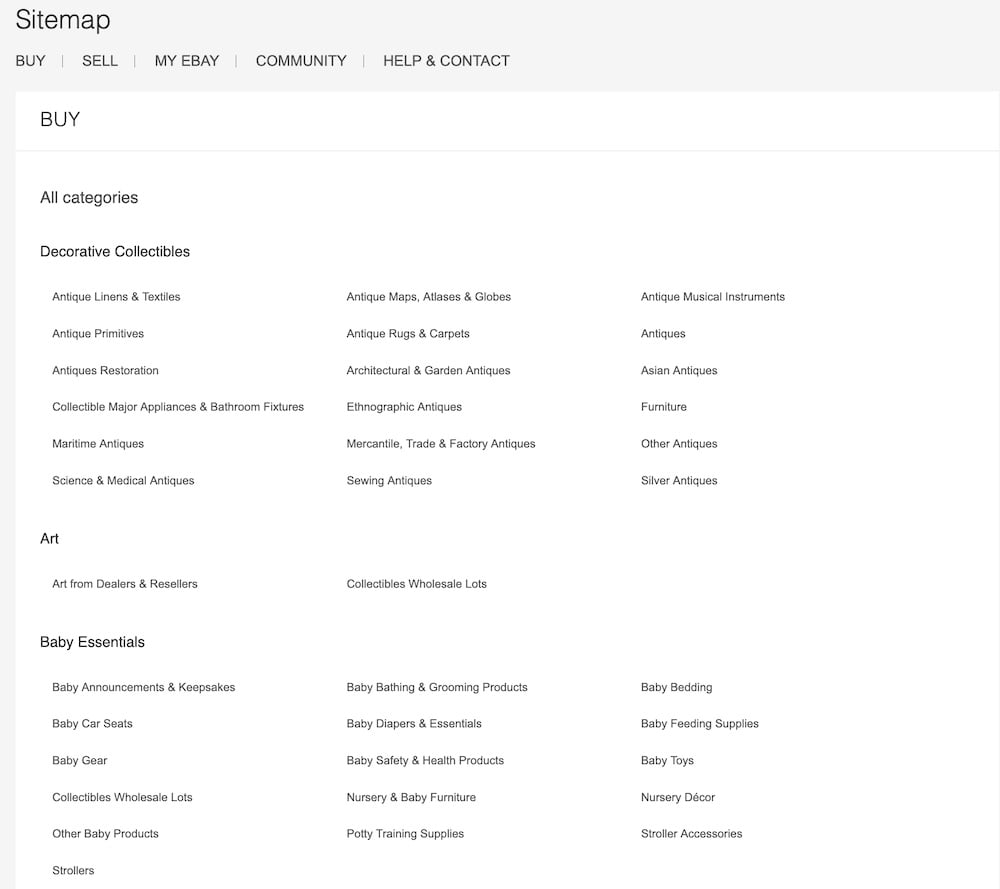
eBay’s HTML sitemap displays the main categories and subcategories with links. Click image to enlarge.












Post Comment