How Bitcoin Survived Binance Hack Shockwaves—Strive CEO Reveals Unexpected Resilience

So, the $6.3 billion Binance hack happened — the biggest crypto heist on record — and yet Bitcoin barely flinched. Can you believe it? I mean, when you hear about a breach of that size, you’d expect the king of crypto to take a nosedive. But according to Matt Cole, CEO of Strive, it’s more like a bank robbery than a system failure. Bitcoin dipped just 4%, holding up way better than many anticipated, which has me wondering: Is Bitcoin truly the fortress everyone claims it to be, or are we just lucky this time around? Cole’s confident that this won’t shake Bitcoin’s long-term investment thesis, and frankly, I find that reassuring. The market might be in the slow ‘early spring’ phase of recovery, but the fundamentals seem intact despite the chaos. It’s a wild dance between security vulnerabilities in exchanges and the unwavering robustness of the Bitcoin network itself. Curious to dive deeper? LEARN MORE.
Bitcoin has held up better than expected following the $6.3 billion Binance hack, according to Strive CEO Matt Cole, who said the breach does not undermine the cryptocurrency’s long-term investment thesis.
Speaking on Cointelegraph’s Chain Reaction on Friday, Cole said the breach had not changed his long-term investment case for Bitcoin. He compared the attack on Binance’s wallets to a bank robbery rather than a failure of Bitcoin’s network.
Bitcoin traded near $77,400 at 4:00 pm on Saturday, about 4% below its price shortly before the attack began Thursday, according to CoinGecko data.
Strive, a publicly traded company that holds Bitcoin on its balance sheet, reported owning 43,000 BTC as of Oct. 23.
“I do have conviction that over any reasonable time frame, this does not change the investment thesis on Bitcoin,” Cole said.
Cole said Bitcoin’s decline was less severe than he expected given the scale of the breach and broader market weakness, although he acknowledged that it was too early to determine whether the cryptocurrency had reached a price bottom.
Cole described the market as being in an “early spring” recovery phase that could last another six to nine months, with prices gradually rising rather than surging to new highs.
Paul Chapman, financial crime director at Wirex, also distinguished the attack on Binance from a compromise of Bitcoin’s network. “It’s important to be clear that Bitcoin itself hasn’t been hacked — this was an attack on one company’s systems, not the network,” he told Cointelegraph.
Related: Strive closes $630M SATS IPO, leaves Bitcoin allocation unspecified
Bitcoin reaction compared with Bybit
According to Glassnode, Thursday’s Binance breach was the largest cryptocurrency hack on record, with around $6.3 billion affected, exceeding the combined losses from the next nine largest hacks. The previous record was the $1.5 billion Bybit exploit in February 2025.
Glassnode said three of the 10 largest crypto hacks have occurred since the beginning of 2025, all involving exchanges.
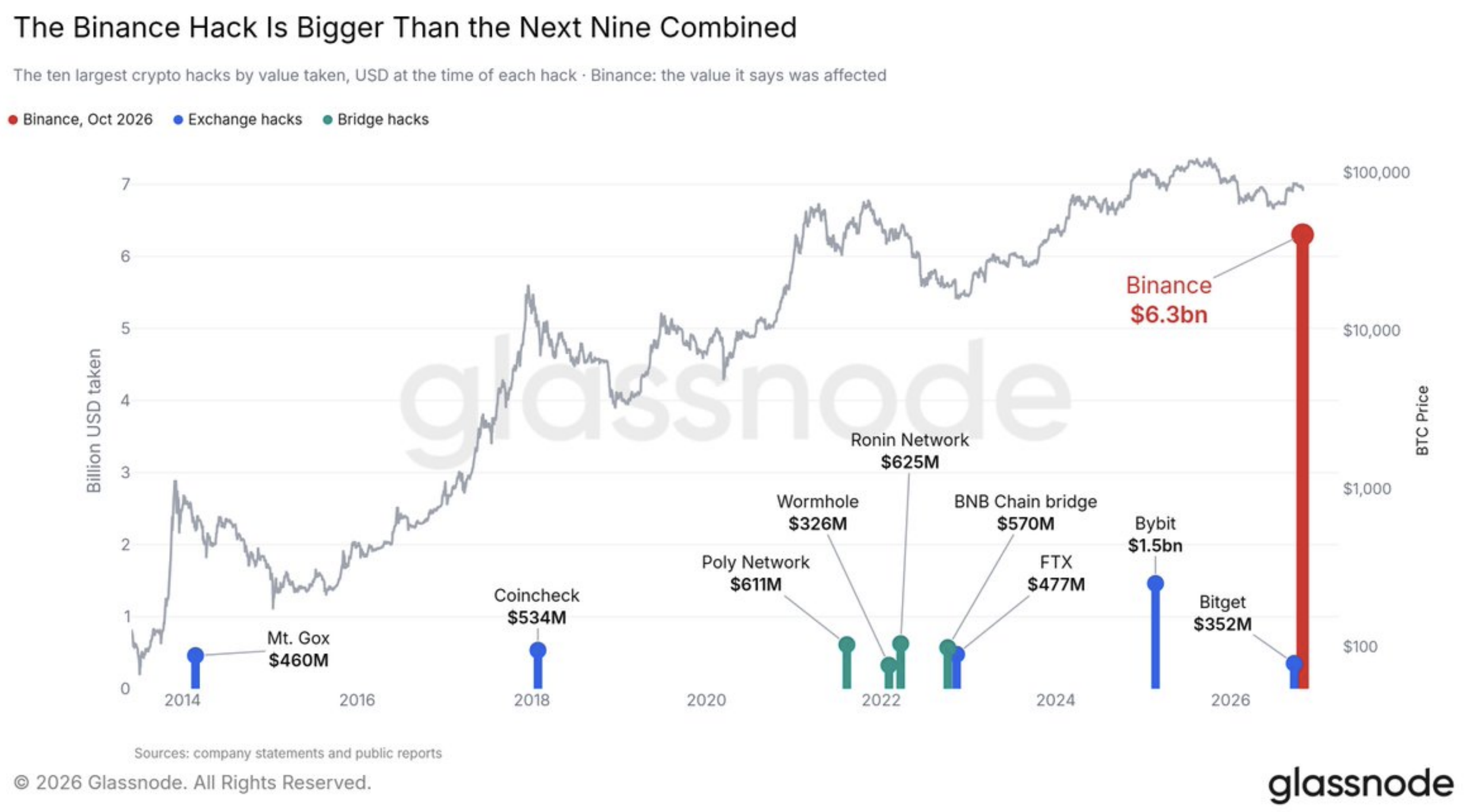
Binance hack exceeds the next nine largest crypto exploits combined. Source: Glassnode
By comparison, following the Bybit hack in 2025, Bitcoin fell roughly 5% from nearly $100,000 to around $95,000 amid the breach and broader market volatility, according to a Bitfinex market report.
Anchorage Digital data cited by CNBC put Bitcoin’s average decline in the first 24 hours after previous crypto exchange exploits at 8.3%.
Binance hack exposes exchange security vulnerabilities
Blockaid CEO Ido Ben-Natan said the attackers appeared to have compromised Binance’s transaction signing process. Binance said Friday that it had found no evidence of leaked wallet private keys, though its investigation remained ongoing.
Blockaid’s analysis identified an Ethereum transaction containing 50 signed authorizations covering different transaction counts. A matching authorization allowed attacker-controlled code to operate through the wallet. Ben-Natan argued that checks before signing could have blocked the malicious authorization.
Magazine: Tampered Ledger reported in Singapore a month before news broke: Asia Express














Post Comment