Google’s Secret Redirects: Are Search Rankings Being Manipulated Behind the Scenes?
Ever wonder if Google’s turning the tables on those pesky bots and AI agents snooping around its search results? It’s like watching a high-stakes game of hide-and-seek where Google’s switched from open roads to winding alleys—introducing the new google.com/goto redirects instead of letting bots and rank trackers have a straight shot at full URLs. This crafty move isn’t just about messing with machines; it’s shaking up how rank trackers report, how Search Console numbers appear, and even how generative AI platforms credit their sources. If you thought last year’s ban on the &num=100 parameter was the endgame, think again—Google’s upping the ante, making it tougher for bots to scrape without a hitch. So, what does this mean for marketers, SEO pros, and anyone relying on accurate data? Time to buckle up and rethink how we play the SEO game in Google’s evolving jungle. LEARN MORE.
Google has long struggled with bot-initiated search sessions. Bots from rank tracking tools exacerbate the problem, as do agents from generative AI platforms that search Google for answers to users’ prompts.
Last year, Google attempted to curtail the activity by canceling the &num=100 URL parameter that allowed 100 listings per organic search result, forcing bots to crawl more pages and use more resources.
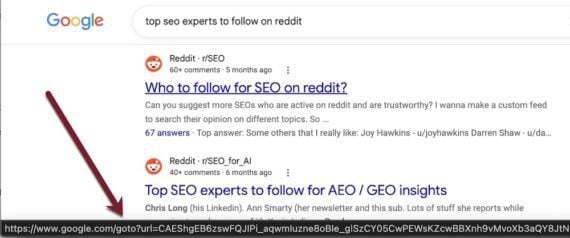
A new update from Google adds more hurdles. Rather than showing the full, direct URL, Google now shows google.com/goto redirects. The search giant has tested these redirects since July and plans to deploy them to most logged-out users within a month.
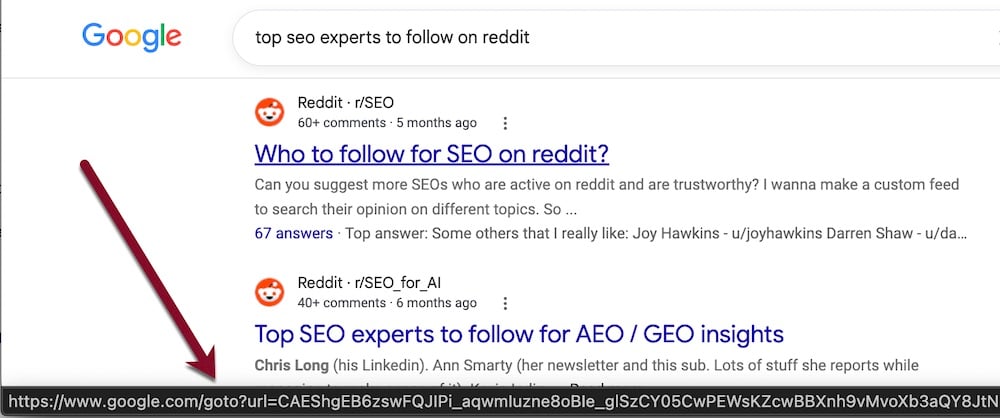
Google now shows google.com/goto redirects instead of the full, direct URL. Click image to enlarge.
Here are the likely effects on human (and machine) searchers.
Inaccurate rank trackers
The new redirects require clicks to obtain the destination URLs.
Reports from ranking tools could show inaccurate results, although Ahrefs and Moz claim to have detected Google’s testing and solved the problem.
Semrush, in my experience, seems to have adjusted, too. In early August, Semrush reported google.com/goto links as ranking, but few now appear. Semrush has evidently found a workaround.
Other trackers slow to adjust may report dramatic ranking drops for a time.
Search Console reports
Search Console “Performance” reports appear unaffected thus far. But the tactics of AI and tracking bots could skew the data.
I’m keeping an eye on two possible effects:
- Fewer impressions for the same clicks owing to AI agents abandoning Google because of difficulties retrieving the URLs.
- More clicks if bots and AI agents must land on destination URLs instead of merely citing them.
Regardless, don’t panic if Search Console’s numbers go temporarily sideways.
GenAI platforms continue to search Google but now cite the /goto URL. This will likely change, though third-party citation reports could show declines in the interim.
Uncertainty surrounding search-engine data
Will Google continue to restrict access to search results?
In December 2025, Google sued SerpAPI, a prominent scraper used by ChatGPT to retrieve search results, in U.S. District Court, alleging violation of the 1998 Digital Millennium Copyright Act. The court tossed the lawsuit last month, although Google has since filed an amended version.
Nonetheless, Google seems focused on blocking bot access. Expect less data and fuzzier reports going forward.












Post Comment