Are AI Watermarks Silencing Truth? The Hidden Threat to Free Expression

So, the European Union just dropped a new regulation aimed at making AI-generated content identifiable—and honestly, it’s stirring the pot in ways marketers might not have anticipated. Imagine a world where every piece of AI-written text gets “watermarked,” kind of like a secret stamp that screams, “Hey, a bot wrote this!” Sounds neat for transparency, right? But here’s the kicker: this could morph into a surveillance-style setup where governments or platforms start sorting and even censoring content—not based on how good it is, but on whether it’s AI-produced. As someone who’s seen the digital marketing trenches, this feels like a double-edged sword. Sure, it promises clarity, yet it might just hand big players the tools to control what we see and share—perhaps even throttling the very AI advantages small teams depend on to compete. Curious how this text-based watermarking actually works and why it could change the game? Buckle up; it’s a wild ride. LEARN MORE
A new European Union regulation meant to make AI content identifiable might have surveillance-like consequences for marketers.
Regulation (EU) 2024/1689 of the European Parliament (informally the “E.U. AI Act“) promises transparency, but by requiring “synthetic” content to be machine-detectable, it also creates infrastructure that could let governments or platforms segregate and censor text based on how it was produced rather than its quality.
In response to the rule, Anthropic announced that all future versions of its Claude models will add identifiable, text-based “watermarks.”
Other AI companies are likely to follow.

A system of detecting AI-generated content could lead to its censorship.
Identification
The E.U. wants to know when something is AI-generated.
Some folks would swear an em dash (—) or a colon (:) is a sure sign of AI-generated text, but both of these punctuation marks have been around and in use for much longer than ChatGPT, Claude, or similar.
A database of AI’s writing affinities and proclivities would soon be outdated. AI writing is becoming more human-like every day by design.
Thus guessing what an AI wrote is sketchy at best. But that won’t satisfy the E.U.
Anthropic will rely on a Google-developed, text-based watermarking approach called SynthID-Text.
The approach embeds a hidden watermark while the AI model is generating text. The watermark is detectable without returning to the LLM, referencing a database, or using much computational power.
The Next Token
In the AI context, a token is bite-sized data such as parts of words, whole words, numbers, or punctuation marks.
When prompted to produce a blog post, a product description, or an email marketing message, the generative AI model starts with a token, then guesses the next one.
To explain, Google Gemini used a sentence that begins with “my favorite tropical fruit is.” Gemini would then apply statistical probability to choose the next token, and it won’t always choose the same one.
- Mango – 50% probability
- Lychee 30%
- Papaya 15%
- Durian 5%
Those reasonable alternatives give SynthID the opportunity to run a tournament.
Tournaments
SynthID selects competitors akin to a sports tournament.
- The LLM picks the competitors. Based on the text written so far, the model calculates the next tokens that make sense and their likelihood. In Google’s fruit example, mango, lychee, papaya, and durian are all possible choices.
- SynthID makes the rules. The watermarking algorithm combines the most recent text with a secret key to create a number called a seed. That seed determines how the model scores the competitive tokens.
- The candidates enter the tournament. SynthID samples several tokens from the LLM’s normal choices and pairs them off.
- Seed scores decide each round. The seed helps assign scores to the competing tokens. The higher-scoring token advances, while ties are settled randomly.
- The winner becomes the next token. Then the model moves forward one token and the whole process begins again with new context and a new seed.
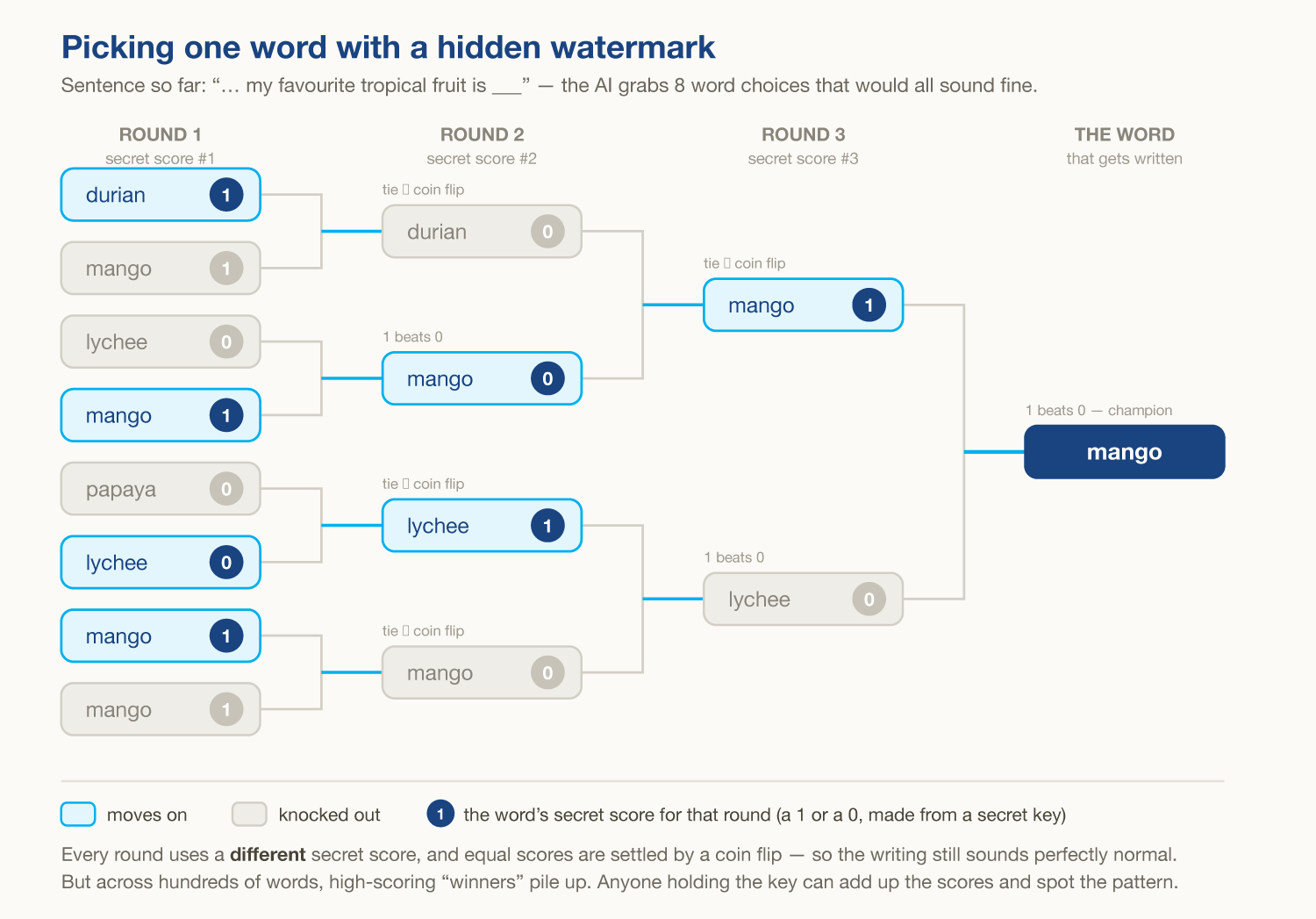
SynthID conducts a tournament for each new token created, building a statistical watermark with each winning token. Click image to enlarge.
Hence there are no consistent watermarked words. “Mango” might win in one sentence and lose in another.
What’s more, one tournament proves nothing. But after hundreds of these contests, watermarked text contains more seed-influenced tokens than ordinary chance should produce.
That statistical pattern is the watermark.
Detection
A “detector” algorithm with the secret key can split a passage into its underlying tokens, reconstruct the tournament scores, and determine whether the various token choices correlate strongly enough with the watermark to cross a detection threshold.
Longer passages provide more evidence. One or two winning tokens could happen by chance. Hundreds provide much stronger evidence that SynthID influenced the choices.
Conversely, factual passages or lots of user feedback during the composition process produce relatively less evidence because the model has fewer acceptable choices.
Nonetheless, any passage of text scoring above the detection threshold would be considered AI-generated or, at least, AI-aided.
Marketing Concern
The ability to identify AI-generated text with relative ease and confidence means search engines, social networks, LLMs, or email clients could isolate the text and eventually filter or suppress it.
For ecommerce marketers, AI content segregation or censorship could undermine a key generative AI advantage, helping small teams create and repurpose content inexpensively.
Watermarking could be a proxy for quality.
Search engines could discount AI-aided pages, LLMs could avoid them as sources, social platforms could reduce their distribution — Pinterest is already doing this — and email clients could route them to spam or a “likely AI” folder.
Moreover, the system is imperfect. Detection is statistical. False positives are likely if the detection threshold is too low.









Post Comment