How Demand Gen Teams Identify and Close Competitive Gaps Before Losing Deals
Your pipeline is down, and you might be focusing on the wrong issue.
Many teams assume a decline in pipeline is due to low demand and respond by increasing campaigns, spending, and lead generation.
However, in 2026, software buyers spend the majority of their time evaluating options. Consequently, a drop in pipeline often signals a competitive issue rather than a shortage of demand. Deals are lost because software buyers select competitors during evaluation phases that are invisible to you.
Buyers conduct “which software is better” or “X vs. Y” comparisons using AI chatbots before visiting your website, with G2 playing a central role in these AI-generated answers. Out of approximately 1,900 head-to-head software comparison queries tracked, G2 is the most frequently cited source in AI responses, surpassing analysts and vendors (Source: G2 internal data via Profound, July 2026).
If you are unsure whether your company appears in AI search results, start by reading the Demand Gen Playbook for Getting Found in AI Search. This resource helps you identify who you are losing to and how to engage the accounts currently comparing your solutions.
Key Takeaways:
- A dip in pipeline is caused either by demand shortage or competitive pressure—each requires different remedies. Simply increasing leads won’t resolve competitive losses.
- Software category trends and review activity on G2 serve as early indicators, often changing weeks before your pipeline does.
- Comparison data reveals the exact competitors buyers consider and directly influences AI recommendations. Appearing prominently in comparisons improves your chance of being recommended.
- Buyer intent data transforms competitive positioning into a list of live, named accounts evaluating your competitors and ready for outreach.
Detecting and Addressing Competitive Shifts Before Pipeline Impact
Begin by determining if the issue is low demand or increased competition. Demand problems mean fewer buyers are active; competitive problems mean buyers are choosing rival products. Investing in lead volume won’t help with competitive losses and only increases costs.
Focus on leading indicators such as category activity and review velocity to catch shifts early. Winning teams leverage these signals to engage prospects before competitors do.
How to interpret key signals:
| What You See | Likely Diagnosis | Recommended Action |
|—————————————————-|——————-|—————————–|
| Traffic and impressions down across the board | Demand problem | Rebuild top-of-funnel demand |
| Traffic steady, slipping win rates, deals lost post-comparison | Competitive problem | Improve positioning and validation, not
Your pipeline is down, and you’re about to fix the wrong problem.
Most teams treat a pipeline dip as a demand problem. They add campaigns, spend, and leads.
But in 2026, software buyers spend the most time in the evaluation phase. So, if you’re experiencing a pipeline dip, it’s often a competitive problem rather than a demand scarcity problem. You’re losing a deal because your software buyer is choosing a competitor in an evaluation you never see.
Buyers now run the “which software is better” or “X vs. Y” comparisons through AI chatbots before they ever reach your site, and G2 sits at the center of that answer. Across the roughly 1,900 head-to-head software comparison prompts we track, G2 is the single most-cited source in AI answers, ahead of the analysts and the vendors themselves (Source: G2 internal data via Profound, July 2026).
If you don’t yet know whether you show up in AI answers at all, read the Demand Gen Playbook for Getting Found in AI Search first. This piece shows you who you’re losing to, where, and how to reach the accounts comparing you right now.
TL;DR
- A pipeline dip is either a demand problem or a competitive problem, and the two need opposite fixes. More leads won’t fix a competitive one.
- Software category activity and review velocity on G2 move weeks before your pipeline does. Watch them as early warnings.
- Comparison data shows the exact matchups buyers run, and that same data feeds the AI answer. Show up in the comparison, and you show up in the recommendation.
- Buyer intent turns competitive positioning into a target list: the named accounts evaluating your competitors, in real time, ready for outreach.
How do you spot and tackle competitive shifts before they hit pipeline?
The first step is identifying if you have a demand scarcity or a competitor threat. Diagnose this first because the two look identical and have opposite solutions. A demand problem means fewer buyers are in-market. A competitive problem means buyers are in-market but landing on someone else’s shortlist. Spend on lead volume to fix a competitive leak, and you pay more to lose at the same rate.
Watch leading indicators, not lagging ones. Category activity and review velocity lead, and you can see them weeks earlier. Deal winning teams proactively identify and capture interested prospects before a competitor claims the ground.
Read the signals this way:
What you see | Likely diagnosis | What to do |
Traffic and impressions down across the board | Demand problem | Rebuild top-of-funnel demand |
Traffic steady, win rates slipping, deals dying after a comparison stage | Competitive problem | Fix positioning and proof, not volume |
Two numbers show why this matters now. Buyers who used AI to source recommendations bought from their first shortlist in three of their last five purchases 80% of the time, versus 65% for buyers who didn’t use AI. And 31% of buyers open their AI research by naming competitors directly.
The software industry competitive shift, by the numbers
- 80% vs. 65% — how often AI-guided buyers stick to their initial shortlist vs. everyone else
- 31% of software buyers start AI research with competitor-based prompts
- 33% of buyers start with category-comparison queries (“best CRM for enterprise”)
Sources: G2 2026 Buyer Behavior Report (1,038 B2B buyers, June 2026); The Answer Economy: G2’s 2026 AI Search Insight Report (1,076 buyers, March 2026)
Once you’re off that first list, the door mostly closes. So don’t generate more. Diagnose correctly, then find where the ground is moving.
How do you see where competitors gain ground before it hits pipeline?
Watch leading indicators, not lagging ones. Pipeline lags: By the time it moves, the shift has already happened. Category activity and review velocity lead, and you can see them weeks earlier.
Read the software category, not just your G2 profile
Most teams watch their own G2 profile and stop. The competitive signal lives one level up, in the category. Watch three things about your rivals: their review volume, how recent those reviews are, and their movement on the G2 Grid (G2’s category ranking chart that scores products on satisfaction and market presence).
When a competitor’s numbers accelerate, a positioning shift is forming, and it shows up before you lose a single deal.
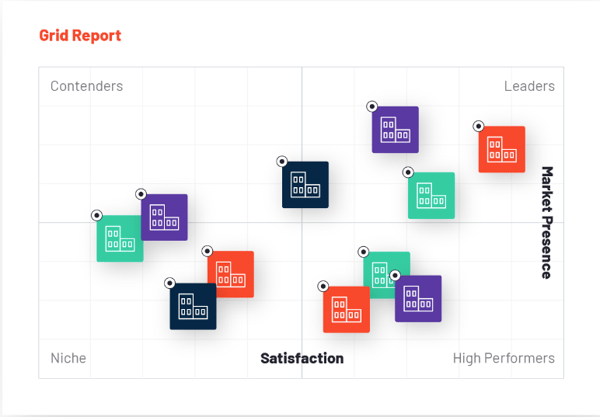 Source: G2
Tip: G2 Competitive Insights tracks this movement for you. Treat category momentum like a pipeline metric: review it weekly, give it an owner, tie it to an action.
New categories are new competitive fronts
Watch the map redraw itself. G2 added 22 new AI software categories to its taxonomy in the first half of 2026, including AI Marketing Agents, Revenue AI Platforms, Agentic AI Browser, AI Search Visibility Optimization Tools, and Enterprise AI Chatbots (Source: G2 product catalog data via G2 MCP).
Each new category is an open competitive front. No leader has locked in yet, and AI hasn’t decided who the default is. Enter early, and you can become the peer-validated default before your competitors notice the category exists. Treat new-category entry as a land grab, not a wait-and-see.
What does software comparison data reveal about how buyers evaluate you?
It names the exact matchups buyers weigh, and they’re usually not the ones you assume. You think you compete with A and B. Your buyers are running you against C.
Your comparison set is your real competitive set
See which competitors your prospects also evaluate, and which comparison pages hold their attention, and you see your real market position instead of your intended one. G2’s CMO explainer video of the G2 MCP returns exactly this: a live visualization of the competitors buyers compare you against most. That view often rewrites a positioning strategy. The rival you build battle cards against may not be the one buyers actually stack you up with. Fix the comparison you’re really in, and you stop losing deals you didn’t know you were fighting.
Source: G2 YouTube
Tip: Connect the G2 MCP in your ChatGPT or Claude account and identify competitive opportunities that plug into your GTM workflows.
The AI answer runs on the same comparison data
Buyers don’t just run comparisons on review pages. They run them through AI, and that answer feeds on the same data. G2 leads those answers as the #1 cited source across the comparison prompts we track (Source: G2 internal data via Profound, July 2026). When you’re absent there, the risk isn’t neutrality. It’s misrepresentation: Buyers arrive with AI-sourced comparisons that are category-level, dated, or simply wrong about you, and your sales team wastes cycles correcting them.
Alex Halliday, CEO of AirOps, put it directly in the G2 2026 Buyer Behavior Report:
“The first version of a buyer’s shortlist is increasingly being assembled by AI before that buyer ever lands on your site or talks to Sales. If the model can’t understand why you belong in the shortlist, the buyer may never get the chance to either.”
Alex Halliday
CEO of AirOps
So make your value legible to AI. Here’s how to translate three common comparison signals into action:
Comparison signal | What it tells you | Your move |
A competitor you don’t target keeps showing up in your comparisons | Your real competitive set isn’t your assumed one | Rebuild messaging and battlecards around the actual matchup |
Buyers linger on one specific comparison page | Head-to-head comparison decides the deal | Strengthen proof (reviews, badges, ROI) on that exact axis |
A rival’s category review velocity is climbing | A positioning shift is forming upstream | Close the review gap before it reaches pipeline |
How do G2 badges and report placements work as competitive assets?
Software sellers can use badges and report placements as third-party proof, but they need to be precise about what’s actually driving the lift. AI doesn’t parse a badge icon — it cites the review foundation and profile investment that earned the badge in the first place. The badge is the compressed, human-readable version of that same proof; the underlying data is what shows up in the AI answer.
Reviews are the foundation. The data shows why:
Signal | Figure | Why it matters |
Review sites’ influence on buyer shortlists | 38% (vs. 37% for AI chatbots) | Reviews are the single biggest shortlist influence |
Review-platform citations in AI answers, discovery → evaluation | Rise 1.8x, from 7% to 13% | Proof matters more as buyers near a decision |
AI-answer appearances for profiles with strong review foundations | ~5x more | A deep review base compounds your visibility |
Sources: G2 2026 Buyer Behavior Report; Kevin Indig via G2 2026 Buyer Behavior Report; G2
On top of that foundation, the profile tier that badges come from adds its own multiplier:
Signal | Figure | Why it matters |
Share of AI citations captured by paid G2 profiles | Paid profiles are 9% of listings, capture 60% of all AI citations | Profile investment compounds visibility |
Paid vs. free citation multiplier, controlled for review volume | 2–7x at every review-volume tier | The advantage holds even when review counts are equal — it’s not just “more reviews” |
Correlation between reviews and AI citations | r = 0.41 (paid), r = 0.26 (free) | Reviews remain the dominant variable — paid status compounds it, doesn’t replace it |
Source: Kevin Indig, “Why Paid G2 Profiles Earn 2x the AI Citations as Free Ones,” sell.g2.com, April 2026.
Earn a badge by building the G2 Market Profile that this data rewards — deep, current, specific reviews on a complete profile — and you’ve built an asset that works in the two places the deal is decided: the buyer’s shortlist and the AI answer feeding it.
Holly Chen, VP of Growth Marketing at Samsara, said it plainly in the report:
“Treat answer engines as a channel you market to deliberately. If you’re absent, the AI or your competitors will fill the gap without you.”
Holly Chen
VP of Growth Marketing at Samsara
How do you find the accounts evaluating your competitors right now?
Use buyer intent data that identifies the accounts researching you and your rivals in real time before any form fill. The accounts reading your competitor’s profile and lingering on your comparison page aren’t hypothetical demand. They’re in-market, mid-evaluation, and reachable today.
To give you a glimpse of how we drink our own champagne, we asked Nabiha Balala, G2’s Sr. Demand Gen Manager, to share how G2’s demand generation team uses buyer intent data to gain a competitive edge.
“Buyer intent is one of the clearest ways to understand what buyers are actually doing — not what we hope they’re doing. We use those insights to prioritize accounts already in-market and align our messaging to the questions they’re trying to answer.”
Nabiha Balala
Sr. Demand Gen Manager at G2
Feed that signal of your target accounts actively viewing and comparing you with competitors into your CRM, and close the gap between “AI recommended a competitor” and “our team started a conversation.” You also don’t need to live in a dashboard to act on it.
Follow these steps that Alex London, CMO of G2, outlines in the G2 MCP demo.
The whole workflow runs in plain language through the G2 MCP, inside the AI tools you already use:
- Turn on the G2 MCP in your AI tool. No dashboard login, no CSV export.
- Ask for the accounts that viewed competitor profiles. Include which competitor and which category.
- Ask for a visual of the competitors you’re compared against most.
- Act on the signal. Competitor research is your highest-urgency trigger, so route it to sales the same day.
To turn those signals into pipeline and higher deal sizes, read How GTM Teams Turn Buyer Signals Into High-ACV Deals. For demand gen, the takeaway is simple: Competitor research is the clearest “in-market now” signal you’ll get, and you can pull it by asking a question.
The G2 Take: What wins AI citations, review volume, review recency, or review quality?
You need both, measured against your category rivals rather than a universal number. Three factors decide whether your review foundation wins the comparison, and each does a different job.
Volume sets the floor: Categories with 10% more reviews earn roughly 2% more AI citations, a small edge that compounds as the category matures (Source: Kevin Indig, SEO and AEO expert, October 2025).
Recency is the multiplier: Current reviews tell AI your product is live, used, and trusted today. Three-year-old praise barely registers.
Specificity is what gets quoted: “It replaced our old attribution tool in six weeks” gives AI something to cite. “Great tool, highly recommend” gives it nothing.
The competitive read:
You don’t have to out-review the whole market. Out-review the one competitor you keep losing to, with fresher and more specific proof on the axis buyers care about. That’s the job G2 Review Generation is built to do.
Being found, trusted, and chosen are no longer a coincidence
More leads won’t fix a competitive problem. The demand gen teams winning in 2026 don’t generate more demand. They make sure that when a buyer asks AI which one is better, the answer already includes their name.
“My advice is to focus less on collecting more signals, and more on building repeatable actions around the signals that matter.”
Nabiha Balala
Sr. Demand Gen Manager at Founder of G2
Being found in AI search and being trusted are two different things that impact your business.
Find out what your software buyers are asking AI LLMs and build your brand presence that clearly caters to it — all while staying true to your business’s moat.
Frequently asked questions
How do you know if you’re losing deals to a competitor rather than to no-decision? Break your win rate down by the competitor named in each deal, and watch two G2 signals: how often a rival appears in your comparison data, and how many of your lost deals viewed that rival’s profile before going dark. A rising loss rate against one named competitor points to a positioning gap, not a budget freeze.
What’s the fastest way to find companies evaluating your competitors? Ask the G2 MCP in plain language, inside the AI tool you already use: “Show engaged accounts that viewed competitor profiles, with the competitor and category, and visualize the competitors I’m compared to most.” You get a live, sourced view without logging into a dashboard or exporting a file.
Which new AI software categories should you watch in 2026? Start with the ones adjacent to your buyers: AI Marketing Agents, Revenue AI Platforms, Agentic AI Browser, AI Search Visibility Optimization Tools, and Enterprise AI Chatbots are among the 22 that G2 added in the first half of 2026. Claim your position in a relevant new category early, while AI hasn’t yet decided on a default.
How many reviews do you actually need to win in AI search? There’s no fixed number. What matters is your review volume, recency, and specificity relative to the competitor you’re compared against, not an absolute benchmark. A product with 200 recent, specific reviews can out-cite a rival with 500 stale, generic ones.
Can a smaller or newer brand compete on AI search visibility without a big budget? Yes. AI weights peer proof over ad spend, so a focused review program plus an early position in a new category can outperform a bigger competitor’s dated foundation. The advantage goes to the brand with the most specific, current customer voice in the exact comparison buyers are running.
Edited by Supanna Das
DATA AND METHODOLOGY
This article draws on the following sources:
- G2 AI comparison-prompt visibility — G2’s citation and visibility tracking across ~1,900 head-to-head software-comparison prompts via Profound, July 1–30, 2026, across ChatGPT, Google AI Mode, Google AI Overviews, Google Gemini, Perplexity, Microsoft Copilot, Grok, and Meta AI. G2 ranked #1 at 15% visibility.
- New AI software categories — G2 product catalog data via the G2 MCP; 22 AI categories added to G2’s taxonomy between January and mid-2026.
- G2 2026 Buyer Behavior Report — 1,038 B2B buyers plus 55 GTM leader interviews, June 2026, global.
- G2 2026 AI Search Insight Report — 1,076 B2B buyers, March 2026, global.
- Kevin Indig correlation analysis — 30,000 AI citations across 500 G2 categories via Profound, October 2025, Learn.G2.
- G2 CMO demo of the G2 MCP — buyer-intent and competitive-signal workflow