Trump’s Bold Crypto Move: Why Bitcoin and Coinbase Are Now at the Center of His Portfolio Strategy

Donald Trump’s latest financial disclosure just dropped, and guess what? Amid thousands of transactions, only a trio of crypto-related stocks—MARA Holdings, Coinbase, and Strategy—made the cut between January and March 2026. Now, isn’t it curious how these picks aren’t some obscure tokens but heavyweight players in the Bitcoin arena? While most eyes might zero in on the crypto angle, there’s more than meets the eye here—with parallel bets on AI and infrastructure showing up in the same portfolio. It makes you wonder: Is this a calculated pivot towards tomorrow’s tech giants… or just another wildcard move in an already unpredictable financial deck? Either way, the nuances behind these selections, especially under third-party management, poke holes in surface interpretations. Couple that with the Trump family’s hefty bets on Nvidia, Microsoft, Oracle, and Boeing, and you’ve got a fascinating crossroads of tech, politics, and crypto intrigue. Ready to dive deeper into what this all means? LEARN MORE.
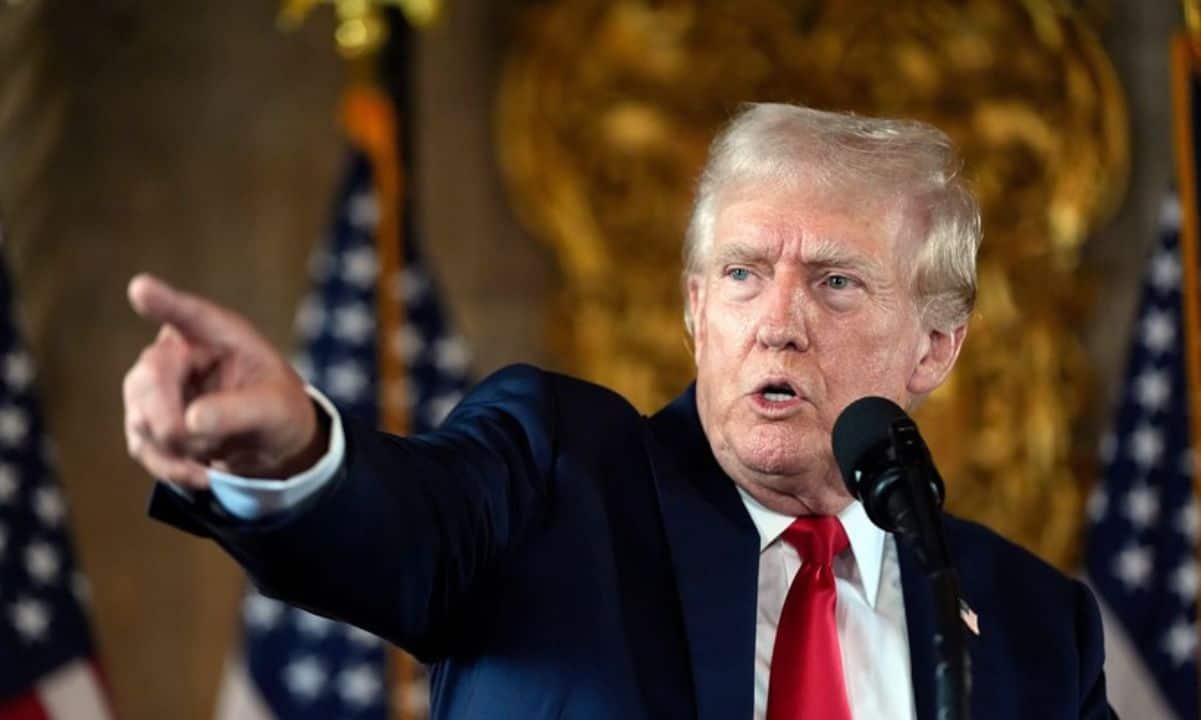
Broader tech allocations in the same filing show a parallel bet on AI and infrastructure alongside crypto-linked assets.
A federal financial disclosure filed by Donald Trump on May 14 shows his portfolio purchased shares of MARA Holdings, Coinbase, and Strategy between January and March 2026.
Out of more than 3,600 transactions listed across 113 pages, those three were the only crypto-related names in the entire filing.
What the Filing Actually Shows
The document in question is an OGE Form 278-T, the type of periodic transaction report that senior government officials are required to file, with the MARA purchase appearing at line 1106, dated March 30, 2026, in the $15,001 to $50,000 range.
Normally, the form does not disclose exact dollar amounts for individual transactions, only brackets. Furthermore, the filing noted that the holdings are managed by a third-party financial institution, not by Trump directly, which matters when reading anything into the selections.
That caveat aside, the composition of the crypto slices is worth paying attention to. MARA Holdings is the largest publicly traded Bitcoin miner in the United States by market cap. Coinbase is the dominant US crypto exchange and one of the few crypto companies with a long trading history as a public company. Strategy holds more Bitcoin on its balance sheet than any other publicly traded firm.
These are not obscure picks, but rather, they are three of the most recognizable institutional proxies for Bitcoin exposure available on US exchanges.
The Trump family also bought shares in Nvidia, whose CEO Jensen Huang was part of the entourage that accompanied the president on his first visit to China since 2017. Records also show they put money in Microsoft, Oracle, and Boeing, spending between $1 million and $5 million on those stocks.
You may also like:
Trump-Linked Crypto Ventures Under Scrutiny
The US president’s financial ties to the crypto industry have been under scrutiny for some time now, with one of them, American Bitcoin, a mining company backed by his family members, reporting an $82 million net loss in Q1 2026 despite mining a record 817 BTC during that period.
CEO Mike Ho framed it as an accounting issue rather than an operational one.
Meanwhile, World Liberty Financial has had a rougher run. Its native WLFI token hit an all-time low late last month after a 16% single-day drop, with the asset trading around $0.05 at the time, well below its peak near $0.33.
The project has faced additional pressure from a lawsuit by Tron founder Justin Sun and a Wall Street Journal report linking one of its partners to individuals sanctioned by the US Treasury in connection with alleged fraud operations in Southeast Asia.
Further, yesterday, Massachusetts Senator Elizabeth Warren asked the SEC to investigate World Liberty, accusing it of misleading investors and/or violating securities laws when it recently borrowed $75 million using WLFI as collateral.