Unlock the Future: 29 Pinterest Stats Marketers Can’t Afford to Ignore in 2026
Ever wonder if Pinterest is just a digital scrapbook or a secret weapon for savvy marketers? Spoiler alert: it’s way more than mood boards and pretty pictures. With a staggering 619 million monthly active users—40% of whom are from US households earning over $150K—Pinterest stands as a powerhouse for brands eager to tap into affluent, high-intent shoppers. What really sets it apart? About 96% of its searches are unbranded, meaning people aren’t hunting for a specific company—they’re on the lookout for new ideas and products, giving marketers a golden ticket to grab attention before competitors even have a chance. And here’s the kicker: brands using Pinterest Shopping ads enjoy 15% higher ROAS and 2.6 times more conversions, with 85% of weekly users buying something they spotted on the platform. Not bad for a site many still write off as just a place for inspiration, right? If you’re looking to boost your ecommerce game or build that next big brand presence, understanding Pinterest in 2026 isn’t optional—it’s essential. LEARN MORE.
Summary
- Pinterest reaches 619 million monthly active users worldwide, including 40% of US households earning over $150K, making it a powerful platform for brands targeting affluent, high-intent shoppers.
- Around 96% of Pinterest searches are unbranded, and the top reason users visit is to discover new products, giving marketers a strong chance to win attention before consumers choose a competitor.
- Brands running Shopping ads on Pinterest see 15% higher ROAS and 2.6x higher conversion rates, and 85% of weekly Pinners have made a purchase based on a brand Pin, proving the platform’s ability to turn discovery into ecommerce sales.
Unlike most social platforms, Pinterest works as a high-intent visual discovery engine. Over half a billion users search for ideas, products, styles and recipes on the platform each month, and they’re primed to take action on what they find.
Pinterest isn’t just a mood board—it’s a revenue engine. Its ability to drive unbranded searches and convert them into direct ecommerce sales leaves passive-scrolling feeds in the dust.
The social media statistics below cover Pinterest’s audience, ad performance, content trends and ecommerce influence so you know exactly where the platform stands in 2026.
2026 Pinterest stats every marketer should know
Need a quick snapshot? These three Pinterest stats tell you everything you need to know about the platform’s reach, performance and impact in 2026.
| Statistic | Insight & Context |
|---|---|
| Pinterest has 619 million monthly active users (MAUs) | Pinterest offers massive global reach. It’s large enough to support brand awareness, search visibility and ecommerce success for both niche communities and at scale. |
| Pinterest’s average engagement rate hovers around 0.2% to 0.5% | Engagement on Pinterest looks different from other platforms and varies by format, with Idea Pins driving the highest interaction. |
| Brands using Shopping ads on Pinterest see 15% higher ROAS and 2.6x higher conversion rates | Done well, Pinterest ads can move people further down the funnel and improve return from paid social. |
Pinterest user statistics
User counts are the starting point for any Pinterest strategy. These numbers show how big the platform really is, where its audience lives and how active users are week to week.
1. Pinterest has 619 million monthly active users
Pinterest reported 619 million global monthly active users in Q4 2025. That’s a record high, reinforcing that the platform has been continuously expanding its footprint since Q4 2021.
For marketers, Pinterest’s user base is large enough to matter, and its audience behavior is different from any other social network. People come to Pinterest with a purpose, which makes those half a billion users worth paying attention to.
2. Almost 97 million users are located in the US
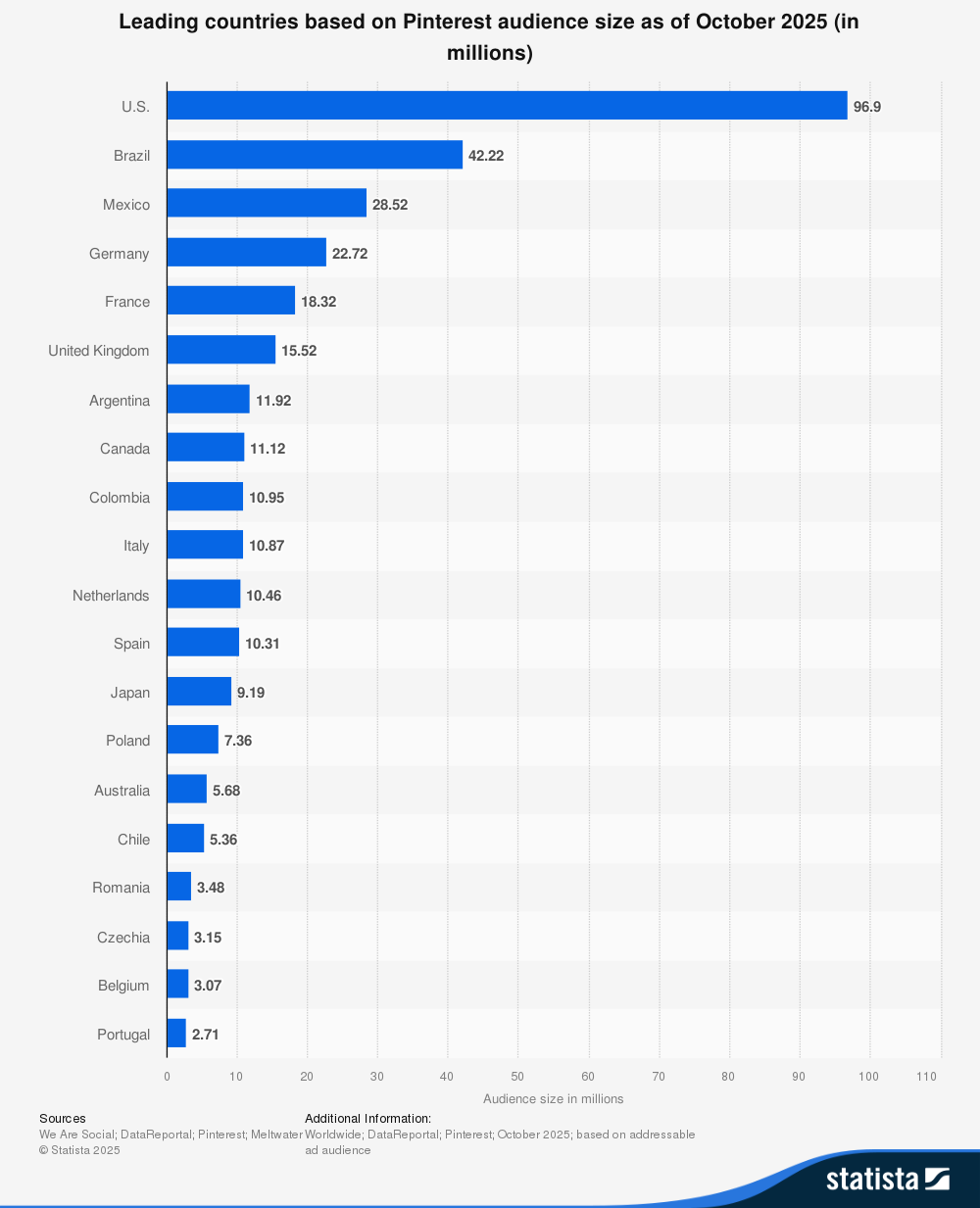
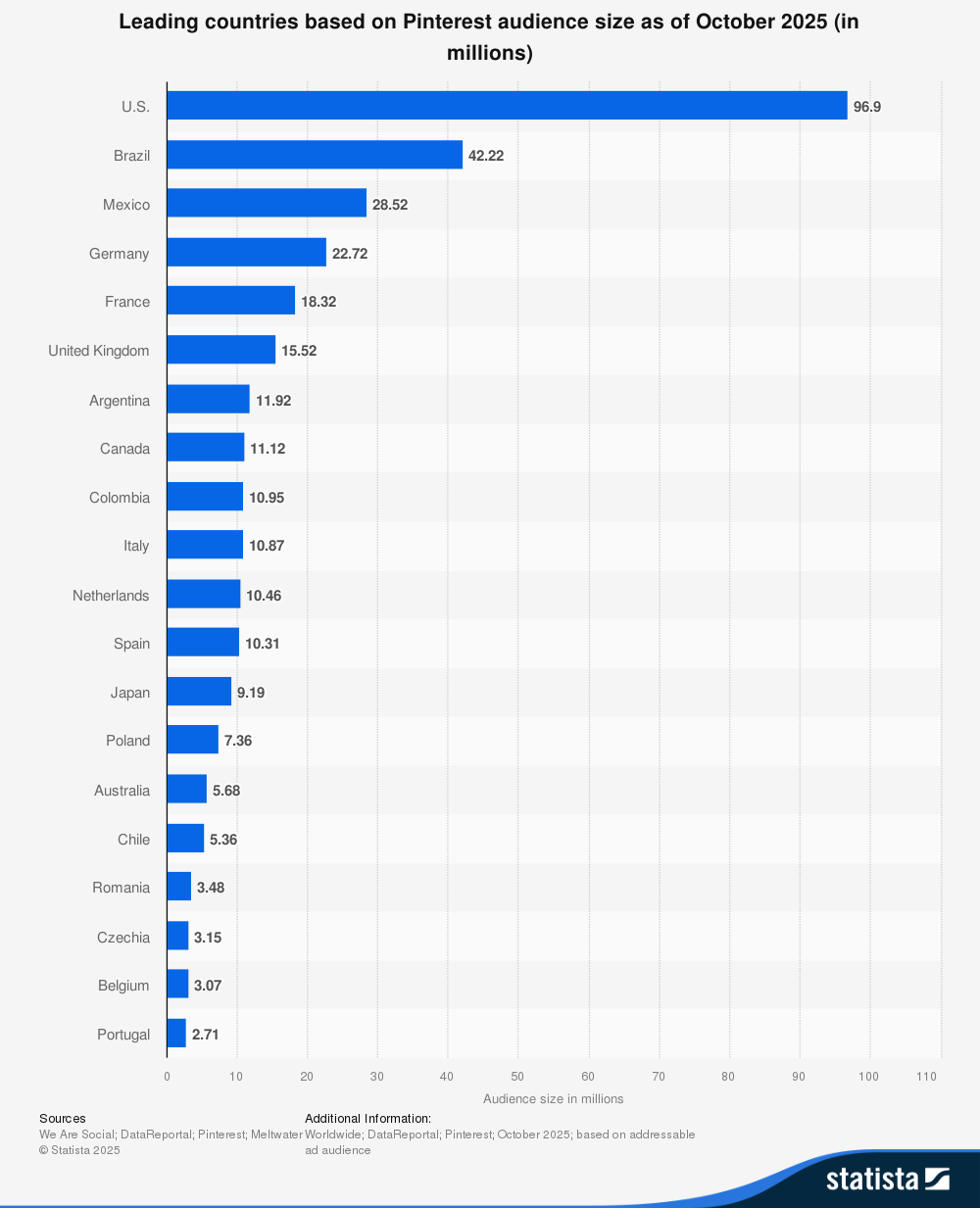
As of October 2025, Pinterest’s biggest audience was in the United States, with about 96.9 million users. If your brand sells in the US, Pinterest could be one of your most valuable channels for reaching American consumers, depending on your category.
3. Users save more than 1.5 billion Pins per week
Saves are one of the highest-intent signals on social media, and Pinterest’s internal data shows users save over 1.5 billion Pins each week.
When someone saves a Pin, they’re often planning a purchase, a project or a future decision. For brands, that means your content has a chance to influence buyers long after it’s first posted.
4. Nearly one-third of social media users worldwide are on Pinterest
According to Sprout Social’s Q2 2025 Pulse Survey, around 31% of all social media users globally have a presence on Pinterest, making it the ninth most popular platform overall.
Pinterest may not dominate conversation the way Instagram or TikTok do, but its value lies in its niche audience. Regardless of where they’re located, most Pinners come ready to plan and buy, which translates into a higher conversion potential than most other networks.
5. Pinterest usage is strong in the US, Australia and the UK
Sprout’s Q2 2025 Pulse Survey shows Pinterest reaches 33% of US consumers, 32% of Australian consumers and 30% of UK consumers.
These numbers make a strong case for English-speaking, high-spending markets. If you’re running campaigns in any of these regions, Pinterest belongs in your channel mix.
Pinterest audience and demographics statistics
Knowing who uses Pinterest helps you create content that resonates. These demographic stats reveal Pinterest’s gender split, age range, generational mix and household income so you know you’re reaching the right audience.
6. Around 70% of Pinterest users are women
Pinterest skews female more than almost any other major platform. Women make up roughly 70% of Pinterest’s user base, while men account for 22.8% (and 7.2% are unspecified).
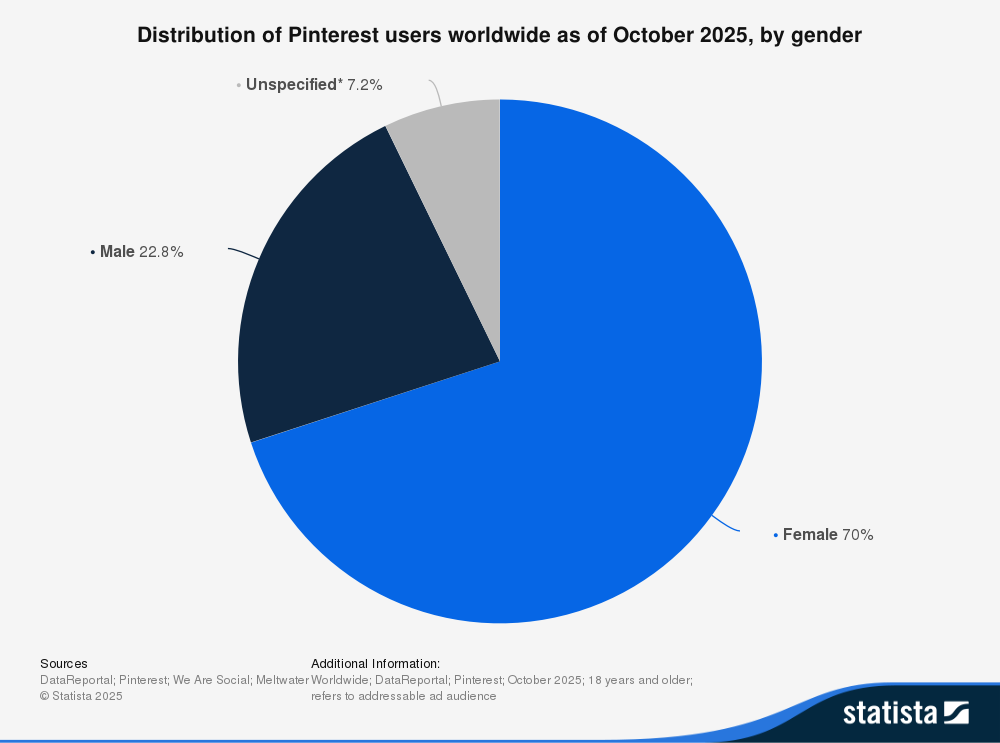
For marketers, that doesn’t mean Pinterest is only for women-focused brands. But it does mean the platform is particularly strong for categories that historically resonate with female shoppers.
7. Pinterest’s biggest audience segment is women aged 25–34
Statista data shows women aged 25 to 34 make up Pinterest’s largest audience segment worldwide. In the US specifically, the platform reaches more younger audiences, including 46% of people between 18–24 years old.
8. Gen Z is the most likely demographic to use Pinterest
Sprout’s Q2 2025 data shows Gen Z leads Pinterest adoption with 39% of the generation on the platform, followed by Millennials at 32%, Baby Boomers at 28% and Gen X at 26%.
Pinterest is often mistaken for an older user platform. The fact is that younger users have made it part of their daily discovery habits, especially for shopping and inspiration.
Internal data from Pinterest supports our findings: Gen Z is the platform’s fastest-growing audience segment. And they mainly use Pinterest to find information about products or brands.
9. Around 9% of consumers plan to spend more time on Pinterest in 2026
According to Sprout’s survey data, 9% of consumers plan to use Pinterest more in 2026. That number rises to 13% among Gen Z and 11% among Millennials.
Younger generations are leaning in further with Pinterest use. For brands, that’s a cue to invest before the platform gets more crowded.
10. Pinterest reaches 40% of US households earning over $150K annually
Pinterest says it reaches 40% of US households earning more than $150,000 a year. That high-income reach is one of Pinterest’s most underrated assets.
Premium brands, financial services, travel companies and luxury retailers all have reason to take Pinterest seriously as a channel for reaching affluent buyers.
Pinterest usage statistics and behavior
How people use Pinterest matters as much as how many use it. These stats break down what users want from brands, how often they engage and how they spend their time on the platform.
11. Roughly 70% of Pinterest users interact with brand content weekly
According to Sprout’s 2026 Content Strategy Report, around 70% of Pinterest users interact with brand content at least once a week, rising to 78% among Gen Z. Pinterest is also one of the places consumers are least bothered by brand presence, second only to YouTube.
On most platforms, brands have to earn attention without disrupting the experience. On Pinterest, your content is the experience, which means thoughtful brand publishing adds value to users’ sessions.
12. Pinterest users are most likely to engage with static images and Shoppable Pins
When interacting with brands on Pinterest, consumers are most likely to engage with static images (38%) and Shoppable Pins (34%), Sprout’s data shows.
While video keeps gaining ground on most platforms, Pinterest users still respond strongly to well-designed still imagery and product Pins built for shopping.
13. Most Pinterest users want to see entertaining content from brands
Pinterest users prioritize entertaining content (23%) above all else when it comes to what brands should post. That’s followed by educational product information (21%), influencer partnerships and customer service (both at 13%).
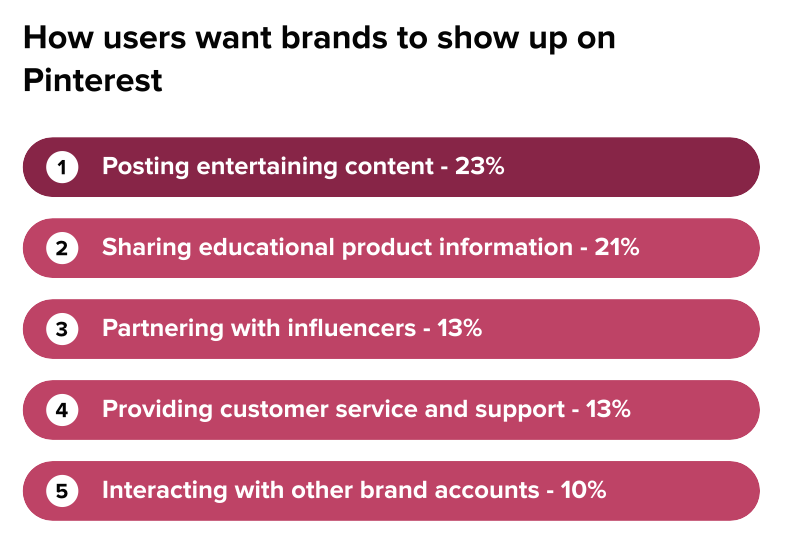
Entertainment edges out education by a small margin, but the strongest brand strategies on Pinterest blend the two. Edutainment content on social media teaches users something useful about your product in an enjoyable, visual, even humorous way.
14. The average Pinterest user spends 10 minutes on the platform daily
DataReportal shows Pinterest users spend an average of 10 minutes per day on the platform. That’s way shorter than what users spend on Instagram or TikTok, but Pinterest sessions are different.
Users come here with shopping intent, which brands trying to influence purchases can capitalize on. It also means your content needs to be strong enough to grab attention and drive clicks at a glance.
Pinterest advertising and revenue statistics
According to Pinterest itself, combining your organic Pinterest marketing strategy with paid content is the best way to succeed on the platform. These advertising and revenue stats show how Pinterest performs for brands paying to play and where its growth is headed.
15. Brands using Shopping ads see 15% higher ROAS and 2.6x higher conversion rates
According to Pinterest, brands that add Shopping ads into their mix enjoy 15% higher return on ad spend (ROAS) and 2.6x higher conversion rates compared to brands that don’t.
People come to the platform ready to plan purchases, and Shopping ads put your products directly in front of users actively searching for what you sell.
16. Pinterest’s average revenue per user is $2.16
As of Q4 2025, Pinterest’s average revenue per user (ARPU) sits at $2.16. For advertisers, the lower ARPU translates into a less crowded bidding environment than other, more saturated channels. There’s room to capture value before costs catch up to other platforms.
17. Pinterest ads cost between $0.00 – $2.00 per conversion
According to WebFX, Pinterest advertising remains relatively cost-effective. Brands typically spend between $0.00 and $2.00 per conversion, while 26% of advertisers spend just $0.00 to $0.10 per click.
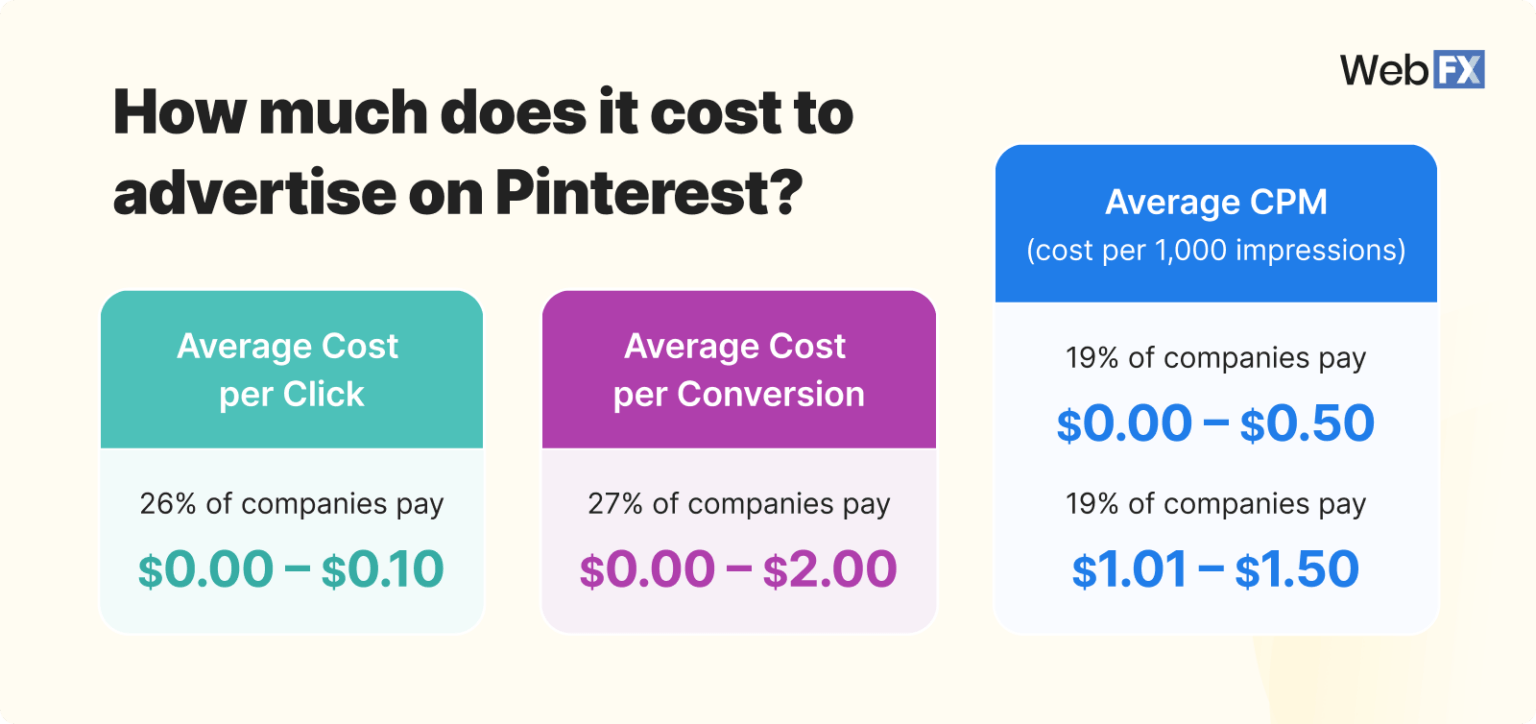
That makes Pinterest one of the most accessible paid channels for performance marketers, especially smaller brands testing into ecommerce. Strong creative paired with low CPCs is a recipe many brands are using to scale efficiently.
18. Pinterest generated around $4.2 billion in revenue in 2025, up 16% year-over-year
Pinterest reported approximately $4.2 billion in revenue in 2025, a 16% increase from the prior year. Steady growth shows that more advertisers are putting budget behind Pinterest, and the platform is delivering. For marketers, Pinterest might be a channel worth investing in before competition pushes costs higher.
19. Pinterest users say ads feel more relevant on the platform
According to Pinterest, users report that ads feel more relevant on Pinterest than on other social platforms. That perception mostly comes to intent.
People search Pinterest for ideas and products, so ads that match those searches enhance the experience instead of disrupting it. For brands, targeted Pinterest ads can drive results without the creative fatigue common to other platforms.
Pinterest content and engagement stats
Content performance on Pinterest follows its own rules. These stats reveal how often brands post, what kind of engagement they earn and where Pinterest’s web traffic comes from.
20. Pinterest averages over 1.3 billion monthly visits
According to Semrush, Pinterest receives over 1.3 billion monthly visits from all over the world. Remember, Pins frequently rank in Google search results, which extends your Pinterest content’s reach well beyond the platform itself.
21. Around 96% of all Pinterest searches are unbranded
Pinterest’s data shows 96% of all searches on the platform are unbranded, which means users aren’t searching for a specific company by name.
This is one of Pinterest’s most powerful insights for marketers. Pinners come open-minded, looking for ideas before they commit to a brand. That creates a massive opportunity to capture attention from people who haven’t yet decided who to buy from.
22. Pinterest’s average engagement rate hovers around 0.2% to 0.5%
According to WebFX, Pinterest’s average engagement rate sits between 0.2% and 0.5%, depending on your content mix. Here’s a quick breakdown of the data:
- Standard Pins engagement rate: 0.15% to 0.25%
- Idea Pins engagement rate: 0.5% to 1%
To improve your Pinterest engagement rate, diversify your content. Idea Pins outperform every other format on engagement, so brands relying only on Standard Pins are missing out on interactions.
23. Brands post around 10 times each week on Pinterest
According to Statista, brands published an average of 10 posts per week on Pinterest in 2025, up nearly 43% compared to 2024. Posting less than 10 times a week? You’re likely losing ground to competitors.
If you’re posting more, make sure your quality holds up. Pinterest rewards consistency, but only when the content earns its place. Find out more about the best times to post on social media, including Pinterest.
Pinterest search and ecommerce statistics
Pinterest’s biggest strength is discovery and social commerce, not conversation like most other networks. That makes it especially useful for ecommerce and retail brands. Here’s what the stats show about social search and shopping trends on Pinterest.
24. The #1 reason people use Pinterest is to find new products and brands
According to Pinterest’s internal data, the top reason users come to the platform is to discover new products and brands. Users aren’t just open to seeing your products. They’re actively looking for them. Few other platforms offer that kind of built-in shopping intent.
25. Around 16% consumers use Pinterest as their primary discovery network
Sprout’s data shows 1 in 6 consumers turn to Pinterest as their main social platform for discovering new products. Don’t let the size fool you. Pinterest users are the most purchase-ready audience on social media, making this segment incredibly lucrative for the brands that show up.
26. Older generations prefer Pinterest as a product discovery channel
According to Sprout’s research, Baby Boomers are the most likely generation to use Pinterest as their primary network for discovering products at 26%, followed by Gen X at 20%, Gen Z at 12% and Millennials at 10%.
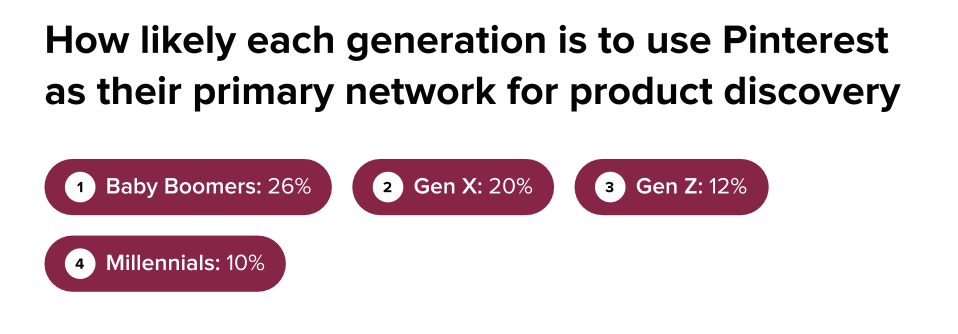
While Gen Z is the fastest-growing audience, older shoppers use the platform with the most clear-cut buying intent. Brands selling to Boomers and Gen X would benefit from treating Pinterest as a top-tier discovery channel.
27. Only 8% of social media users contact brands through Pinterest during the holidays
During the holiday season, just 8% of social media users say Pinterest is the network they’re most likely to use to get in touch with a brand, Sprout’s Q4 2025 Pulse Survey data shows.
Pinterest is mainly a discovery and planning channel. Save your social media customer service resources for platforms like Instagram and Facebook, and focus your Pinterest strategy on inspiring purchases instead.
28. Around 80% of weekly Pinners find inspiration on the platform
According to Pinterest, 80% of weekly Pinners feel inspired by the platform’s shopping experience. This may involve finding purchase inspiration or discovering new products and brands.
Pinterest for businesses is built to inspire buying decisions. Showcase your products through striking Pins and informative guides to turn browsers into buyers.
29. About 85% of US Pinterest users have made a purchase from Pins
US Pinterest users are avidly shopping on the platform. A whopping 85% of weekly Pinners have made a purchase based on a pin they saw from a brand.
This is great news for brands wanting to drive purchases through Pinterest. Creating boards that feature your products can inspire people to buy from you.
Inspire and sell with these Pinterest stats
Pinterest brings together a rare combination of high-income users, unbranded search and visual discovery that makes it a top-tier channel for ecommerce and brand awareness.
To stay competitive on Pinterest, you need more than great Pins. You need analytics that show you what’s working, scheduling that keeps you consistent and reporting that ties your strategy to revenue. Sprout Social enables you to do all of that from one platform.
Successfully navigating social gives your brand the upper hand. Don’t let the opportunity social provides go to waste. Try Sprout Social free for 30 days to measure your Pinterest performance, track your ROI and schedule Pins all in one place.
Pinterest statistics FAQs
Is Pinterest good for marketing?
Yes, Pinterest is a good platform for marketing because users come there with shopping intent. The top reason people visit Pinterest is to find new products and brands, 96% of searches are unbranded and 80% of weekly Pinners say the platform inspires their purchases. Pinterest gives brands an effective way to capture buyers and turn interest into action.
What is the largest demographic on Pinterest?
Pinterest’s largest demographic is women aged 25 to 34. The platform skews female overall, with around 70% of users identifying as women. This explains why categories like fashion, beauty, home, food and lifestyle consistently thrive on Pinterest.
How many people use Pinterest in 2026?
Pinterest has 619 million monthly active users in 2026, according to the company’s latest reported figures. That makes it one of the largest social platforms in the world and a major reach channel for marketers looking to influence purchase decisions.