Google Discover Update Sparks Unseen Traffic Shifts—Is Your Website Ready?
Ever wondered how your site could jump from stealth mode to showstopper on Google Discover? Well, Google’s latest core update, fresh off the press in the U.S. with a global encore on its way, shakes up the game yet again—throwing in some fresh rules alongside the classics. Since 2019, Google’s been whispering (and sometimes shouting) about “Get on Discover” guidelines—think of them like the secret sauce for grabbing eyeballs and keeping them coming back for more. The usual suspects still hold: crystal-clear headlines, snappy high-res images, and content that actually matters to today’s crowd. But this time, Google’s cracking down harder on clickbait — yep, that pesky trick of baiting clicks with fluff—and dialing up the spotlight on page experience. It’s like Discover just got a tough, no-nonsense editor with a keen eye for quality and user happiness. So, is your content ready to charm both Google’s algorithms and real humans, or will it get lost in the shuffle? Let’s dive into the nitty-gritty and make sure you’re not left scratching your head in the comeback trail. LEARN MORE.
Google Discover has become a reliable traffic source for some publications. Last week, Google launched a core update to Discover in the U.S., with the global rollout coming.
Google’s Search Central blog has included “Get on Discover” guidelines since 2019, explaining its content quality requirements and traffic recovery strategies. Google revised the guidelines last week, alongside the core update.
Some requirements have not changed:
- Titles and headlines must clearly “capture the essence of the content.”
- Include “compelling, high-quality images,” especially those 1,200 pixels wide.
- Address “current interests [that] tells a story well, or provides unique insights.”
Yet two requirements — clickbait avoidance and page experience — are new.
New Guidelines
Avoid clickbait
The previous guideline versions warned against “misleading or exaggerated details in preview content.” The revision moved this recommendation to the top, presumably to emphasize its importance as reflected in the core update.
The guidelines state that “clickbait” can prevent would-be readers from understanding the content and manipulate them into clicking a link.
The guidelines separately warn publishers from using “sensationalism tactics… by catering to morbid curiosity, titillation, or outrage.”
Page experience
“Provide a great page experience” is new, although it’s in keeping with Google’s traditional search algorithm, which rewards sites with stong user engagement.
Google collects page experience metrics from its Chrome browser and retains them only for high-traffic pages. Search Console shows no Core Web Vitals data for sites with little traffic.
Sites with 50% or more losses in Discover traffic should audit the user experience:
- In Search Console, look for URLs marked “poor” in the Core Web Vitals report.
- Evaluate how those pages load, especially on mobile devices. The headings and body text should load first, allowing users to start reading immediately.
- Look for elements, such as ads or pop-ups, that block the content.
Traffic Impact
The revised guidelines do not address “topic authority,” yet Google’s announcement of Discover’s core update does:
Since many sites demonstrate deep knowledge across a wide range of subjects, our systems are designed to identify expertise on a topic-by-topic basis.
The focus on topical expertise suggests the update will elevate niche, authoritative sites.
Finally, the announcement states that Discover will show more local and personalized content.
Nonetheless, most ecommerce blogs have modest Discover traffic and will therefore experience little (if any) impact from the core update. Still, keep an eye on the Discover section in Search Console; switch to “weekly” stats for a current overview.
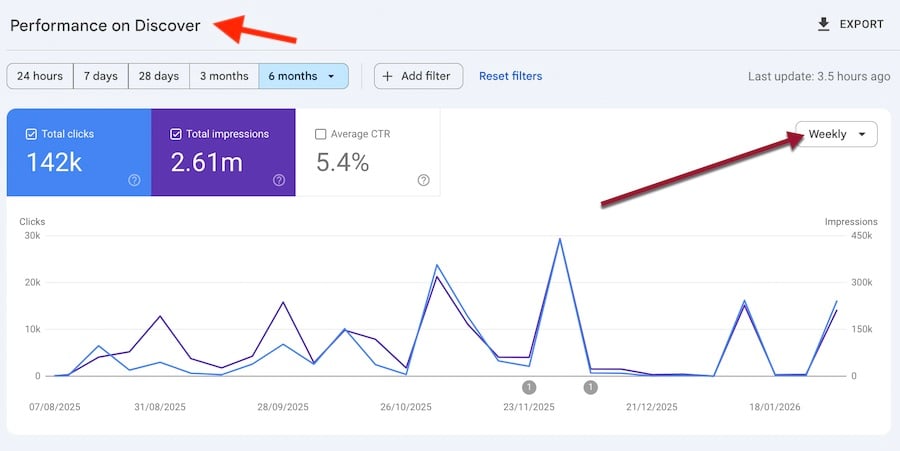
In Search Console’s Discover section, switch to “weekly” stats for a current overview.